By Dr. Asnat Raziel, specialist in obesity treatment, metabolic health and healthy longevity; Director of the Multidisciplinary Obesity Treatment Center, Assia Medical, Assuta Ramat HaHayal
Obesity treatment updates are arriving at a pace we have never seen: new drugs, pills instead of injections, studies on protecting muscle, and fresh data on how weight is linked to the heart, the brain and longevity. In November I attended two major international conferences, the Lifestyle Medicine conference in Orlando and ObesityWeek in Washington, and wrote 141 articles about them and the research around them. To make it easy to find your way, I gathered the key points into one slide guide.
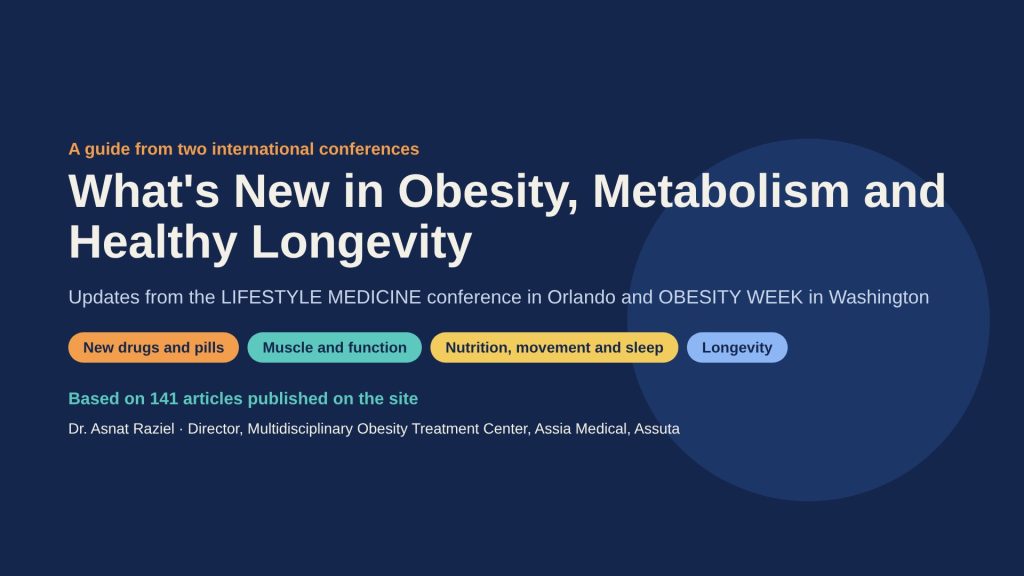
View the full guide: a 30-slide presentation
The guide is written for the general public and for health professionals alike: physicians, dietitians, nurses and therapists. Each slide covers one topic with three key messages and links to the full articles and their scientific sources. Below, the guide is summarized by topic, so you can read it here or go straight to the article that interests you. Drugs marked as experimental are not yet approved.
The big picture: why obesity treatment updates matter
Before the new drugs, both conferences opened with the question of what we are actually treating.
Obesity is a disease of diseases – and the goal is health
- 230+: Medical conditions linked to obesity – from diabetes and high blood pressure to sleep apnea, fatty liver and cancer.
- Waist size: Predicts risk better than BMI alone, in a study of 844,000 people. Use a tape measure, not just the scale.
- A new goal: New guidelines aim at health benefits and quality of life, and a JAMA report finds no single solution will be enough.
Read more: JAMA report: no single solution | Waist circumference vs BMI | A disease of diseases | Weight bias in healthcare | Healthy fat tissue
Obesity treatment updates: drugs already in use
The first group of obesity treatment updates concerns drugs that patients already use today.
Wegovy and Mounjaro: new real-world data
- 15.1%: Average weight loss in a year with Wegovy, even in overweight and mild obesity (SHIFT study); one in five reached a normal weight.
- 22.1%: Weight loss after a year and a half on Mounjaro in real-world data, outside controlled trials.
- 84.8%: Kept the weight off on the full Mounjaro maintenance dose, and 54.2% on the 5 mg dose.
Read more: Mounjaro dosing guide | Mounjaro maintenance dose | Mounjaro over the long term | Wegovy in the SHIFT study | Why response differs between people | Long-term phentermine | Switching from Wegovy to Mounjaro
Beyond weight: heart, brain and eating
- Heart: With Wegovy in heart failure, more than half reached normal heart pressures, and atrial fibrillation was less common on semaglutide (94 trials).
- Brain: A large Israeli study: GLP-1 drugs are linked to a lower risk of dementia.
- Eating: A controlled trial: Wegovy reduced loss of control in binge eating and improved body image.
Read more: Wegovy and binge eating | Obesity and dementia | Atrial fibrillation and GLP-1 | Wegovy in heart failure | The liver and Alzheimer’s (lab study) | Psoriatic arthritis and Mounjaro
The daily pill enters obesity care
- Foundayo: A daily GLP-1 pill that can be taken at any time, with or without food. Who it suits and what the studies showed.
- 43.8%: Fewer breathing pauses at night with Foundayo in sleep apnea (ATTAIN-OSA), with 11.5% weight loss.
- Shot to pill: ATTAIN-MAINTAIN: after losing weight on an injection, switching to the pill kept most of the result – with good planning and follow-up.
Read more: Switching from injection to pill | Foundayo for sleep apnea | Future drugs from the lab | Aleniglipron pill (experimental) | Wegovy pill or Foundayo: Q&A
Stopping treatment abruptly brings most of the weight back
- Only 4%: Average weight loss left in people who stopped all treatment, in a study of 20,486 patients comparing five ways to continue.
- Double risk: Of heart attack, stroke and death after stopping GLP-1 in type 2 diabetes, in a study of 80,302 patients.
- Plan ahead: Maintenance dose, switching to a pill or combining with lifestyle – plan it with your doctor and do not stop on your own.
Read more: Switching from injection to pill | Maintenance dose | Stopping GLP-1 in diabetes and the heart | Continuing treatment: what works
The next generation of drugs: what is still in trials
Most drugs in this part are not yet approved, including retatrutide and CagriSema. They are shown to illustrate where the field is heading.
Retatrutide, CagriSema and survodutide: what we know
- Up to 28%: Weight loss with retatrutide, with less sleep apnea and knee pain relief. The low dose gave 19% with fewer side effects.
- 25.4%: Average loss on CagriSema in people who had lost 5% by week 8 – early response predicts success.
- Heart-safe: Survodutide did not raise heart events in a trial of 5,530 patients, with up to 13.7% weight loss.
Read more: Early response to CagriSema | Retatrutide for sleep apnea | Retatrutide dosing | Retatrutide in the clinic | Survodutide and the heart | Retatrutide vs CagriSema
Amylin drugs quiet the “food noise”
- 79%: Reported less food noise on eloralintide, 74% fewer cravings, and 41% drank less alcohol.
- Up to 23.3%: Weight loss with eloralintide plus tirzepatide in diabetes – but at the high dose 27% stopped treatment.
- Bone: Early data suggest CagriSema and cagrilintide may protect bone during weight loss.
Read more: Bone loss and amylin | Eloralintide in diabetes | Eloralintide and food noise | All the amylin drugs | Food noise: how it is measured
Novo Nordisk: Wegovy, the pill and CagriSema
- 14.6 kg: Average loss in the first year on Wegovy in routine care (SHAPE study), and 83.5% reached the full dose.
- Heart: Fewer heart events with Wegovy in routine care in the real-world SCORE and STEER studies, in patients with heart disease.
- 20.7%-21%: Weight loss with CagriSema even at low doses (REDEFINE 9), and 23%-27% in women around menopause. Not yet approved.
Read more: SCORE study and the heart | Wegovy and metabolic health | Wegovy in the first year (SHAPE) | Novo at ObesityWeek | CagriSema around menopause | Low-dose CagriSema | STEER: Wegovy vs Mounjaro | Weight-loss pills: Q&A
Eli Lilly: Mounjaro, Foundayo and what comes next
- Up to 23.3%: Weight loss with eloralintide plus Mounjaro – an experimental combination, not yet approved.
- Knees: Less knee pain and less sleep apnea with retatrutide, with up to 28% weight loss. Not yet approved.
- Teens: Mounjaro lowered BMI in adolescents by about 19%, and Foundayo is the company’s daily pill.
Read more: Mounjaro maintenance dose | Mounjaro over the long term | Eloralintide and Mounjaro | Lilly at ObesityWeek | Retatrutide in the clinic | Mounjaro for teens
New injections on the way: monthly, muscle-sparing and more
- VK2735 injection (Phase 2 trial): Up to 14.7% weight loss in just 13 weeks.
- Obesity class (VK2735): 74% improved by at least one obesity class, vs 15% on placebo.
- Ribupatide (Phase 3 trial): Up to 17.7% weight loss, with the safiglipron pill on the way.
- DA-1726 (Phase 1 trial): 11.9% weight loss and 68% less liver fat; also a monthly shot.
- WVE-007 injection (Early trial): One shot cut belly fat and preserved muscle for a year.
- Setmelanotide (Hypothalamic obesity): 18.8% lower BMI over two years, and a new definition of the disease.
- MC4R receptor (Animal studies): Two new approaches from the lab, including activin E.
- Muscle protection (OCN-501 and more): Experimental drugs to preserve muscle during treatment.
New weight-loss pills: more options, fewer injections
- CX11 pill (Phase 2 trial): Up to 11.5% weight loss in 36 weeks.
- SYNT-101 pill (First-in-human): Mimics gastric bypass: satiety hormones rose fivefold.
- OBT-676 pill (Rat study): Amylin plus three hormones in one pill: up to 17%.
- BMF-650 pill (First-in-human): First weight-loss and safety data.
- BLX-7006 pill (First-in-human): Safe, with little nausea.
- CG-0416 pill (Mouse study): Acts in the liver and limits weight regain after stopping.
- CRB-913 pill (CANYON-1 trial): Acts on the cannabinoid system: up to 5% in 12 weeks.
- Amylin pill (ECC1542): An experimental pill that mimics the hormone amylin.
Obesity treatment updates on muscle, surgery, safety and mental health
Strong drugs raise new questions. These obesity treatment updates cover how to protect muscle, when surgery fits, how to stay safe and why the mind matters.
Protecting muscle means protecting independence
- 42% vs 0%: Loss of stair-climbing power in people 65+ on semaglutide alone, vs 0% when combined with the experimental drug enobosarm.
- Strength: European guidance for older adults: moderate calorie restriction, protein at every meal and strength training.
- Lean mass: Not every drop in lean mass is muscle loss – measure strength and function, not only weight.
Read more: Body composition on the drugs | Obesity in older adults | Enobosarm to preserve muscle | Weight-loss drugs after 65 | Drugs across the lifespan | Sarcopenia: how to spot it
Surgery does not compete with drugs – it is part of the continuum
- 23% vs 6.87%: Weight loss after surgery vs drugs in people 65+ with diabetes (107,280 patients), with fewer heart and kidney complications.
- -19%: Less obesity-related cancer after surgery, in women and men of all ages – a study of 784,105 people.
- Up to 35.8%: Weight loss two years after surgery in people for whom the drugs did not help (4,929 patients).
Read more: Treating severe obesity | Combining drugs and surgery | Surgery after the drugs | Surgery and cancer | Surgery after 65 | Low blood sugar after surgery | The microbiome after surgery
Before, during and with caution: using weight-loss drugs well
- Before: Blood tests before starting treatment: what to check and when results change the plan.
- During: Nutritional deficiencies during treatment: who is at risk, which symptoms warn and how to supplement well.
- Caution: Fake pens and black-market products – only from a pharmacy, with a prescription. Plus: what the FDA said about the optic nerve.
Read more: The optic nerve and GLP-1 | Black-market drugs | Nutritional deficiencies on the drugs | Mounjaro dosing guide
Food noise, stigma and mental health
- Food noise: Intrusive thoughts about food are real and measurable – and GLP-1 drugs turn them down.
- Stigma: After weight loss, stigma – not the number on the scale – predicts mental health. And on TikTok: “shame” and “shortcut”.
- Screening: Every patient needs screening for eating disorders, and it does not necessarily rule out treatment or surgery.
Read more: Obesity in serious mental illness | Eating disorders and obesity | Mental changes after weight loss | Food noise | When healthy advice becomes a burden | Mindfulness and emotional eating
Children, women and the liver
Some of the most practical obesity treatment updates concern children, teens, women and the liver.
Children and teens: early treatment, with the family
- 13.5%: Lower BMI in children aged 6 to 12 on Wegovy (STEP Young, NEJM).
- About 19%: Lower BMI in adolescents on Mounjaro, and more than half left the obesity range.
- Teen first: The teen speaks first and parents are partners. In teens, where fat sits matters as much as BMI.
Read more: Metabolic risk in teens | Teen obesity and parents | Mounjaro for teens | The STEP Young study | Hypothalamic obesity | Healthy eating for children | Ultra-processed food and the child’s brain
From pregnancy to menopause: what is new for women
- 2.8 kg: Less weight gain in pregnancy with obesity thanks to close nutrition support – and the baby grew normally.
- Menopause: Metabolic rate is preserved, but extra calories are stored differently – more belly fat.
- 161,000: Women followed for 30 years: movement, weight, purpose and relationships add good years.
Read more: The father’s diet before pregnancy | Women’s longevity | Menopause and metabolism
Fatty liver: common, silent – and detectable and treatable
- 1 in 3: Of adults have fatty liver, usually without symptoms. A simple blood score (FIB-4) reveals hidden scarring.
- Three organs: Obesity harms the liver, kidneys and heart at the same time, and one normal test is not enough.
- -14%: Pancreatic fat fell on a green Mediterranean diet in the Israeli DIRECT-PLUS study.
Read more: Pancreatic fat | Obesity, liver, kidneys and heart | Liver fibrosis | Fatty liver: guide and FIB-4 calculator
Lifestyle and obesity treatment updates: nutrition, movement, measurement and sleep
Lifestyle remains the foundation of all obesity treatment updates, with or without medication.
The best diet is the one you can stick with
- Your plan: No forbidden foods: Mediterranean, low-carb or plant-based – choose what fits and lasts.
- Environment: Make the healthy choice easy – at home, at work and in hospital. In type 2 diabetes, remission is possible even without drugs.
- Diet & pain: Plant-based eating studied in migraine, back pain, knee osteoarthritis and chronic pain – from Dr. Michael Greger’s talks.
Read more: Type 2 diabetes remission | A healthy food environment | Diets compared | A personal nutrition plan | Diet against pain | Knee osteoarthritis | Lower back pain | Diet for migraine | Plant-based diet and pain
Even five minutes of movement changes the picture
- None to some: Going from sitting to light movement gives the biggest gain – you do not need 10,000 steps to benefit.
- About 40%: Of walking energy the body compensates. Weight did not move in 12 weeks, but fat fell and lean mass rose.
- Zone 2 +: Zone 2 training is not enough alone: for fitness and longevity add intense and strength sessions for a smart training week.
Read more: Energy compensation in walking | How many steps you need | An exercise prescription | Zone 2: why it is not enough alone | Exercise and the brain
Watches, sensors and tests: what really helps
- Smartwatch: Most data do not change treatment – but tracking steps and sleep well does drive change.
- CGM: Helps show which habits lower blood sugar after meals, and sometimes just causes needless worry.
- -107 kcal: Less per day in resting metabolic rate after a year of weight loss – a study led by Dr. Bruria Tal.
Read more: Waist circumference | Metabolism after weight loss | PNOE breath test | Continuous glucose monitor | Wearables
Sleep is part of obesity treatment
- 4 dimensions: Duration, quality, timing and regularity – healthy sleep is not just a number of hours.
- Appetite: Short sleep raises hunger and weakens fullness, and during a diet it also increases lean-mass loss.
- Sleep apnea: New-generation drugs cut night-time breathing pauses – Foundayo, and retatrutide (not yet approved) by about half.
Read more: Retatrutide for sleep apnea | Foundayo for sleep apnea | Healthy sleep: 4 measures
Longevity and preventive medicine
Not all obesity treatment updates are about drugs: the Lifestyle Medicine conference focused on healthy years, evidence and prevention.
Healthy years, not just more years
- 53% · 64.6%: Fasting-mimicking diet cycles improved diabetes control in 53% and brought Crohn’s remission in 64.6% (Prof. Valter Longo).
- About 12%: Moderate calorie restriction alone slightly improved working memory in the CALERIE study – no extreme diet.
- Purpose: Flourishing, good habits and social connection protect mental health and longevity.
Read more: Moderate calorie restriction | Fasting-mimicking diet cycles | Fasting-mimicking diet and longevity | Slowing aging | Health habits for leaders | Mental health for young people | Flourishing and longevity
Peptides, supplements and IV drips: what is proven
- Peptides: BPC-157, epitalon and similar peptides are all over social media, but human evidence is thin and injecting them is risky.
- Supplements: Glutathione and NAC have proven medical uses, but the capsule does not always do what is promised.
- IV drips: Vitamin drips for “detox” – what is really in the bag, the risks, and when an IV is medically justified.
Read more: Tesamorelin for visceral fat | Peptide regulation | Bodybuilding peptides | Longevity peptides | Vitamin drips and detox | NAC supplement | Glutathione supplement
Lifestyle is becoming the standard of care
- About 80%: Of chronic diseases can be prevented with nutrition, movement, sleep and social connection, according to the American College of Lifestyle Medicine.
- Community: Community health centers and hospitals are making prevention a strategy. One health system even turned a whole city into a healthy city.
- Funding: New billing codes for health coaching and group visits, quality measures and AI will bring prevention to everyone.
Read more: Funding preventive medicine | Primary care in the community | Preventing chronic disease | Lifestyle medicine as standard | Israeli research at the meeting | Holistic health in a hospital
Obesity treatment updates in practice: eight steps you can start today
Even the biggest breakthroughs do not replace the basics. These are the steps that came up again and again at both conferences:
- Measure your waist. Do not rely on weight and BMI alone.
- Move, even 5 minutes. And add strength training two or three times a week.
- Protein at every meal. In a diet you can keep, with less ultra-processed food.
- Regular bedtime. And check for sleep apnea if you snore and feel tired.
- Drugs only with care. From a pharmacy, with a prescription – not from Telegram or the black market.
- A plan for later. Do not stop treatment alone; plan maintenance with your doctor.
- Connection and purpose. Friends, family and a sense of purpose are medicine too.
- Keep reading. Every topic has full articles with sources on en.asnatraziel.com.
View the full guide: a 30-slide presentation
Bottom line
Obesity and metabolic medicine are changing fast: more effective drugs, pills, treatments that protect muscle, and studies showing benefits for the heart, brain and liver. At the same time, both conferences repeated one message: strength, function and health come before the number on the scale, and nutrition, movement, sleep and social connection remain the foundation. The guide will be updated as new obesity treatment updates and articles are added. The site is also available in Hebrew.
The information in this article and guide is general and is not personal medical advice. Talk to your doctor before making any change to your treatment.