By Dr. Asnat Raziel, bariatric surgeon specializing in obesity treatment, metabolic health and healthy longevity; Director of the Multidisciplinary Center for Obesity Treatment, Assia Medical, Assuta Ramat HaChayal, Tel Aviv
Peptides for bodybuilding: a fast-growing trend
Peptides for bodybuilding are one of the hottest trends in gyms and on social media. Influencers present them as a shortcut to bigger muscles, faster injury recovery and a lean body. The same names come up again and again: BPC-157, TB-500, CJC-1295, ipamorelin and Melanotan.
But what do we actually know about them? In this article, I review the human evidence, who uses these products and the risks. I also explain what really works for building and keeping muscle.
What is a peptide?
A peptide is a short chain of amino acids, the building blocks of proteins. The body makes many peptides, such as insulin. GLP-1 drugs like semaglutide and tirzepatide are peptides too.
However, “peptide” is not a seal of quality. Some peptides are approved drugs tested in thousands of patients. By contrast, most peptides for bodybuilding have mainly been tested in rats and mice.
BPC-157: the “Wolverine peptide”
BPC-157 is based on a protein found in stomach juice. In animal studies, it sped up healing of tendons, muscles and gut tissue. That is why people call it the “Wolverine peptide,” after the comic book hero who heals from any injury.
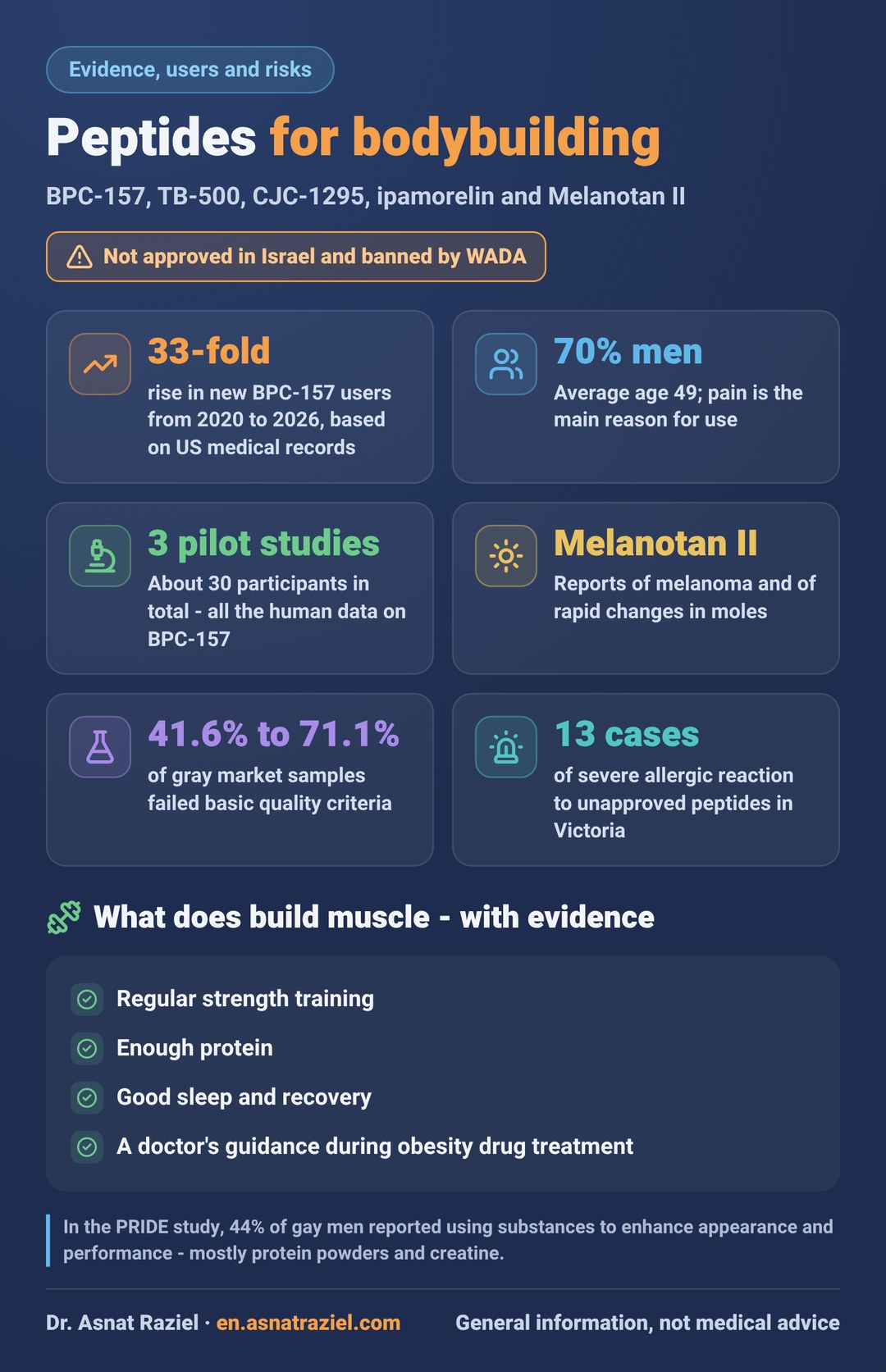
The trouble starts in humans. According to a review in Pharmacy Times, there are only three pilot studies without a control group. Together, these studies included about 30 people. In addition, there are no long-term safety studies and no solid data on how the body absorbs and breaks it down.
The newest study tested an intravenous infusion of BPC-157 in just two volunteers. Both received up to 20 mg, and they reported no side effects. Still, two people are no basis for judging safety.
Who actually uses peptides for bodybuilding?
The company nference scanned more than 15 million medical records in the United States. According to the AJMC report, the researchers confirmed 1,039 BPC-157 users. The number of new users rose roughly 33-fold, from four in the first quarter of 2020 to 134 in the first quarter of 2026.
The typical user also changed. The share of men rose from 57% to 70%, and the average age fell from 55 to 49. Among users whose race was recorded, 96% were white. Moreover, about 36% got the product from a compounding pharmacy, and 35% bought it from a gray market supplier.
Why did they start? The most common reason was pain (33%). Next came digestive problems (14%), an old injury (11%) and recovery from surgery (10%). What’s more, over half of the users took another treatment at the same time, such as testosterone or the peptide TB-500.
In the LGBTQ community: body image and muscularity
The US PRIDE study looked at the use of substances that enhance appearance and performance among LGBTQ people. According to the study in Eating Behaviors, 44% of gay men and 42% of bisexual men reported some use during their lifetime. Among lesbian and bisexual women, the rates were 29% and 30%.
The context matters: most of this use involved protein powders and creatine, not peptides. Even so, use was linked to symptoms of eating disorders and muscle dysmorphia. In other words, a focus on a “perfect” body can lead to risky use.
Peptides for bodybuilding that boost growth hormone
CJC-1295 and ipamorelin make the pituitary gland release growth hormone. As a result, IGF-1 also rises. This hormone carries out part of the effects of growth hormone. Users hope to gain muscle and lose fat.
On the other hand, too much growth hormone comes at a price. It can raise blood sugar and cause fluid retention and joint pain. For example, in a study of tesamorelin, blood sugar rose in the people whose visceral fat did not drop. I covered this in detail in my article on tesamorelin.
Melanotan II: the “Barbie drug”
Melanotan II mimics a hormone that triggers pigment production in the skin. Sellers market it as an injection or nasal spray for a quick tan, and sometimes to boost sex drive.
In July 2026, The Skin Cancer Foundation issued a warning against its use. The foundation cites reports of melanoma after use, as well as rapid changes in moles. Such changes can make early detection of skin cancer harder. There are also reports of general toxicity and muscle damage.
Risks shared by all peptides for bodybuilding
Even if a compound itself were safe, the way people get it adds risk. First, lab testing of 6,441 gray market samples showed that between 41.6% and 71.1% failed basic quality criteria. Second, the tests found bacterial toxins in 15% of the samples.
Self-injection and allergic reactions
Injecting yourself from a powder mixed at home adds a risk of infection. In addition, the state of Victoria in Australia reported 13 cases of severe allergic reaction to unapproved peptides. All but one of these patients had never had such a reaction before.
Combinations (“stacks”)
Many users combine several peptides, and sometimes testosterone as well. No study has tested these combinations. So there is no way to know how the compounds affect each other.
What authorities say about peptides for bodybuilding
In Israel, the Ministry of Health warned in October 2026 about BPC-157, TB-500, CJC-1295 and GHK-Cu. These compounds are not approved for use in Israel.
In competitive sport, the World Anti-Doping Agency (WADA) bans most of these substances. Category S0 bans any substance not approved for medical use, at all times. Category S2 also bans growth hormone releasers. That means an athlete who uses them also risks a ban.
What really works for building muscle?
The good news: the safe path has strong evidence behind it. Strength training, enough protein and good sleep build muscle at any age. I also wrote about this in building muscle after 60.
In addition, people taking obesity medication should pay special attention to muscle. I gathered ways of preserving muscle during drug treatment and of preventing muscle loss during weight loss. If you are curious about new drugs for muscle preservation, I also wrote about enobosarm and about diagnosing and treating sarcopenia.
The bottom line
Peptides for bodybuilding rely mainly on animal studies. There is very little human data, and products on the market are inconsistent and sometimes contaminated. So before any use, it is worth pausing to talk with a doctor. The muscle you build with training and good nutrition is also the safest muscle.
This article is general information only and is not a substitute for personal medical advice.
References
Heal or Harm: Body Protective Compound-157 in the Gray Zone
Safety of Intravenous Infusion of BPC157 in Humans: A Pilot Study
BPC-157 ‘Wolverine Peptide’ Use Rose 33-Fold Despite Scant Evidence
The Skin Cancer Foundation Issues Warning Regarding Melanotan II
Increase in anaphylaxis notifications related to unapproved peptides in Victoria
Health Ministry warns against illegal peptides marketed for weight loss