By Dr. Asnat Raziel, bariatric surgeon specializing in obesity treatment, metabolic health and healthy longevity; Director of the Multidisciplinary Center for Obesity Treatment, Assia Medical, Assuta Ramat HaChayal, Tel Aviv
Tesamorelin for visceral fat: a drug with a very narrow approval
Tesamorelin for visceral fat is one of the most talked-about peptides in the longevity community and in gyms. Yet this drug has a very narrow approval. In 2010, the FDA approved it only to reduce excess belly fat in people with HIV who have lipodystrophy.
Lipodystrophy is a change in how fat is distributed in the body. In some people with HIV on antiviral treatment, fat builds up around the internal organs in the abdomen. This is visceral fat, the fat that is most harmful to heart and metabolic health.
In this article, I explain how the drug works, what the studies show, and whether there is any basis for its “borrowed” use in healthy people.
How does tesamorelin for visceral fat work?
Tesamorelin mimics the hormone GHRH, which the hypothalamus in the brain releases. This hormone signals the pituitary gland to release growth hormone. In other words, tesamorelin is not growth hormone itself; instead, it boosts the body’s natural release of it.
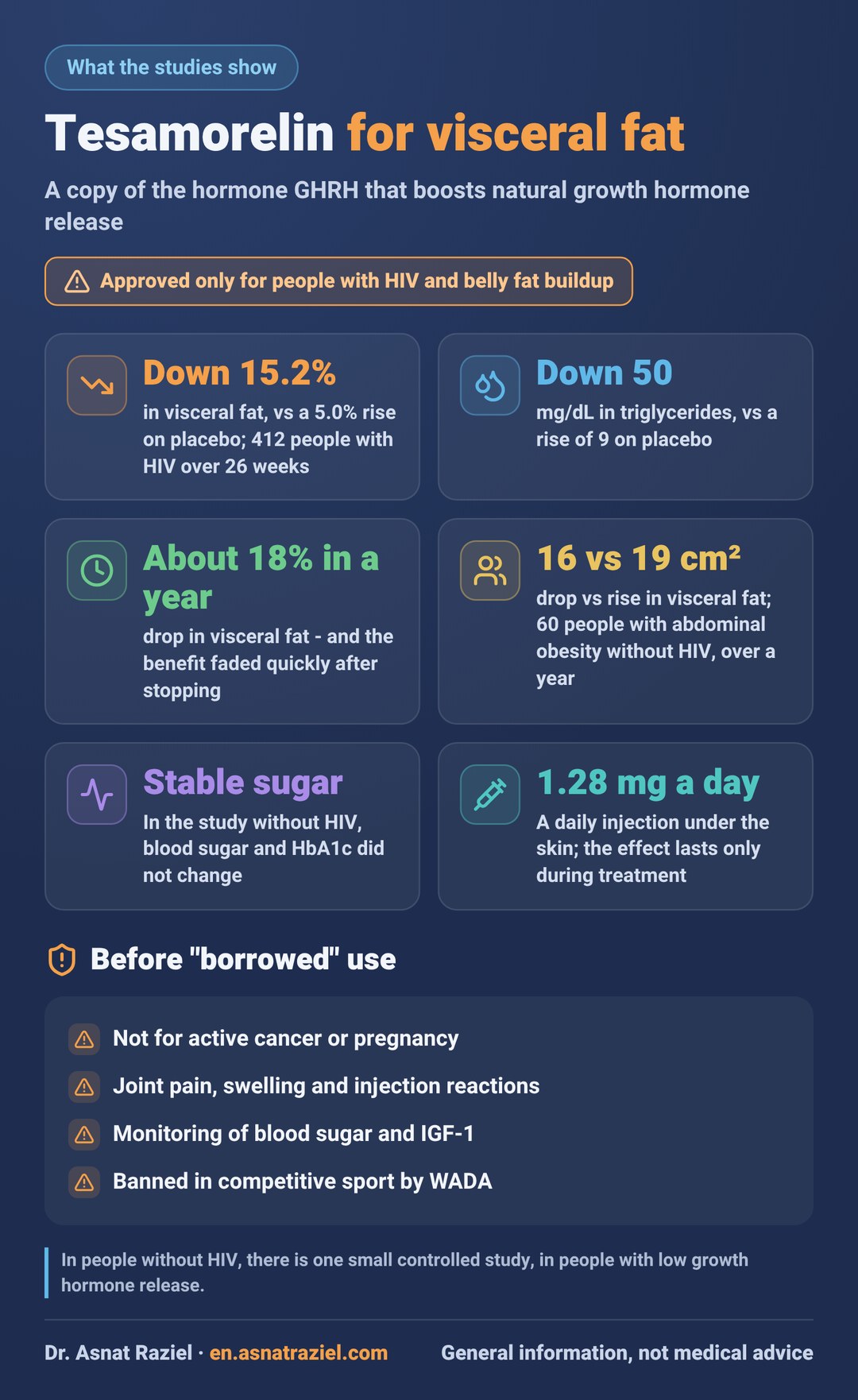
Growth hormone promotes fat breakdown, especially of visceral fat. It also raises IGF-1, a hormone that carries out part of its effects. The current US product is Egrifta WR, given as a daily 1.28 mg injection under the skin.
What the studies found in people with HIV
The main NEJM trial
The first large trial included 412 people with HIV and belly fat buildup. Participants received tesamorelin 2 mg a day or a placebo for 26 weeks. Visceral fat fell by 15.2% in the tesamorelin group and rose by 5.0% in the placebo group.
In addition, triglycerides dropped by 50 mg/dL, compared with a rise of 9 mg/dL on placebo. IGF-1 rose by 81.0%. On the other hand, more people in the tesamorelin group than in the placebo group left the study because of side effects.
What happens when you stop
A second trial included 404 people with HIV. After six months, visceral fat fell by 10.9%, compared with 0.6% on placebo. After a year of continuous treatment, the drop reached about 18%. However, people who switched to placebo quickly lost the benefit. In other words, the effect lasts only as long as the injections continue.
Not everyone responds
A combined analysis of the two trials separated “responders” from “non-responders.” Responders were people whose visceral fat fell by at least 8%. In them, triglycerides dropped and blood sugar stayed stable. By contrast, average blood sugar rose in the non-responders.
The “borrowed” use: tesamorelin for visceral fat in people without HIV
In recent years, tesamorelin for visceral fat has also become popular among healthy people. Longevity clinics and peptide websites market it for “stubborn belly fat,” body sculpting and slowing aging. Sometimes they sell it together with the peptide ipamorelin.
Is there research to support this? There is one notable controlled study. A study from Massachusetts General Hospital included 60 people with abdominal obesity and low growth hormone release, without HIV. Participants received tesamorelin 2 mg a day or a placebo for a year.
What the study found
- Visceral fat fell by an average of 16 cm² in the tesamorelin group and rose by 19 cm² on placebo.
- Triglycerides, the inflammation marker CRP and the thickness of the carotid artery wall improved compared with placebo.
- Fat under the skin of the abdomen did not change significantly.
- Blood sugar and HbA1c stayed stable.
- There were no serious side effects.
What the study does not tell us
This is a small study in a very specific group: people with abdominal obesity and low growth hormone release. It did not test lean people, athletes or healthy older adults who want to “turn back the clock.” In addition, no studies have looked at heart attacks, strokes or lifespan. So use in healthy people relies on extrapolation from other studies, not on direct evidence.
The risks of using tesamorelin for visceral fat
First, the effects of excess growth hormone. According to the prescribing information, tesamorelin must not be given to people with an active cancer or to pregnant women. Common side effects include joint pain, injection site reactions and swelling. Blood sugar and IGF-1 also need monitoring.
Second, where the product comes from. People without HIV usually get it from a private clinic or the gray market. Tesamorelin was among the fourteen substances that researchers tested in the study of 6,441 samples. In that study, between 41.6% and 71.1% of the samples failed basic quality criteria.
Third, competitive sport. The World Anti-Doping Agency (WADA) bans growth hormone releasers such as tesamorelin. I laid out the rules in my article on what is allowed with peptides. Finally, the effect disappears when you stop, so this is a daily injection with no end date.
Proven ways to lose visceral fat
The good news is that there are proven ways to lose visceral fat. Exercise, especially aerobic training combined with strength training, reduces belly fat even without large weight loss. In addition, approved GLP-1 drugs reduce visceral fat and liver fat as part of weight loss.
I wrote about Wegovy and fatty liver and about Mounjaro and fatty liver. It is also important to protect muscle while losing weight, which I covered in preserving muscle during drug treatment. If you are interested in the bigger picture of longevity, I gathered the interventions tested for slowing aging.
The bottom line
Tesamorelin for visceral fat is a real drug with good evidence, but for a defined group: people with HIV and belly fat buildup. In people without HIV, there is one small controlled study, in people with low growth hormone release. So use in healthy people is a “borrowing” of the drug, with no evidence of long-term benefit. Anyone considering it should do so only with a doctor, and with monitoring of blood sugar and IGF-1.
This article is general information only and is not a substitute for personal medical advice.
References
Metabolic effects of a growth hormone-releasing factor in patients with HIV
Egrifta WR: Package Insert / Prescribing Info
EGRIFTA WR (tesamorelin) for injection, for subcutaneous use – Prescribing Information
The NEJM trial was funded by industry.