By Dr. Asnat Raziel, bariatric surgeon specializing in obesity treatment, metabolic health and healthy longevity; Director of the Multidisciplinary Center for Obesity Treatment, Assia Medical, Assuta Ramat HaChayal, Tel Aviv
BMI category improvement: what Viking presented at ObesityWeek
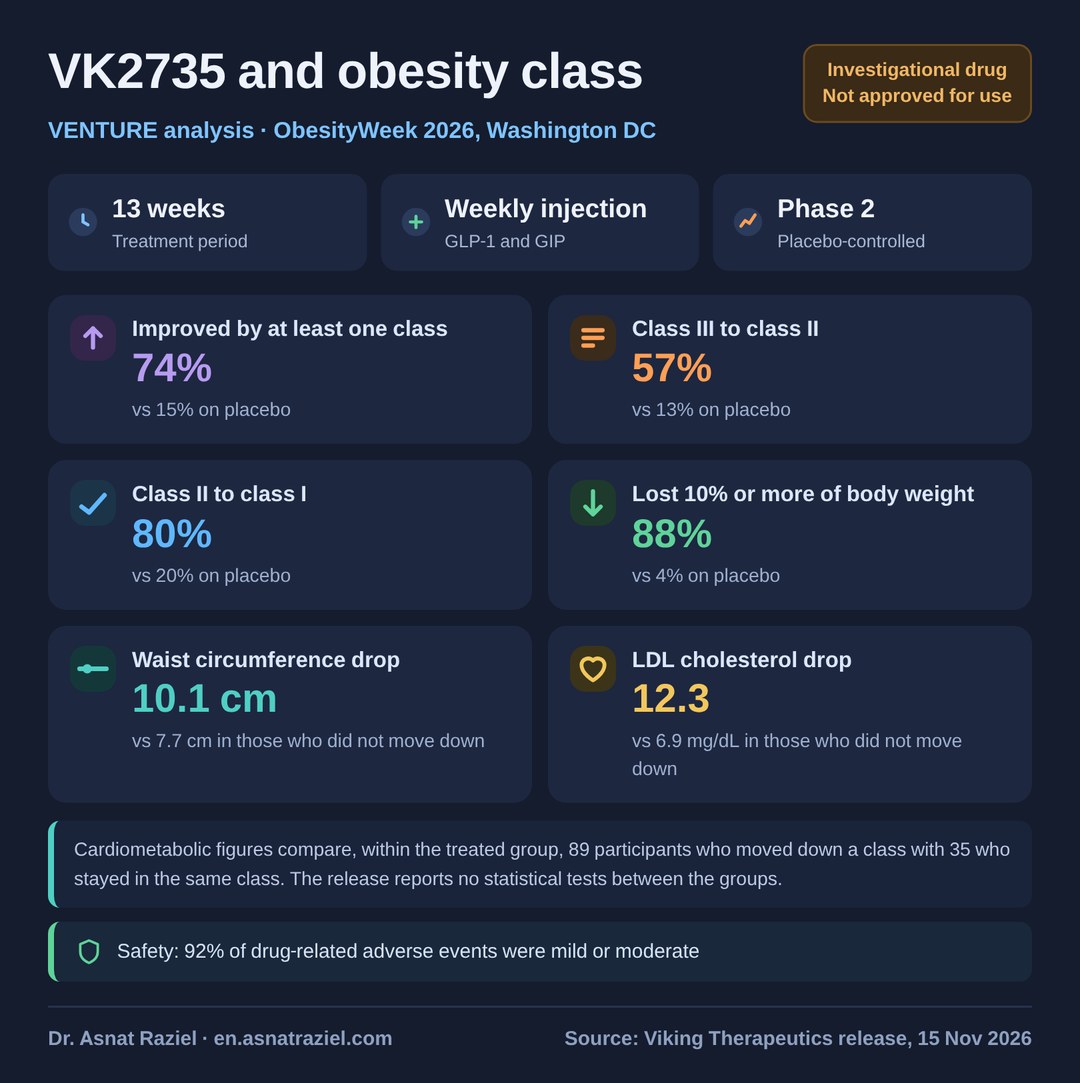
BMI category improvement is a sharper clinical goal than a percentage on the scale. At ObesityWeek, the American obesity conference in Washington, Viking presented a new analysis of its investigational drug VK2735. According to the company, 74% of people who received the injection improved by at least one category within 13 weeks, compared with 15% on placebo. In other words, the medical classification moved, not only the number on the scale.
One point needs saying up front: VK2735 is investigational. Regulators in Israel and the United States have not approved it.
What BMI category improvement actually means
The classification rests on BMI, the body mass index, which relates weight to height. The company spelled out the definitions it used. Overweight is a BMI of 25 to 29.9. Obesity class I is 30 to 34.9, class II is 35 to 39.9, and class III is 40 and above. Normal weight covers a BMI of 20 to 24.9.
That said, BMI measures only weight and height. This is why I have written separately about waist circumference as a risk predictor, and about the new guidelines that aim at health rather than weight alone. BMI category improvement is a blunt measure too, but it is one that doctors and insurers act on.
What the new VENTURE analysis asked
VENTURE was a phase 2 trial: randomized, double-blind and placebo-controlled. It enrolled adults with obesity, or with overweight plus at least one weight-related condition. Moreover, each participant received a weekly injection for 13 weeks. The main results were published in the journal Obesity in January 2026, and showed weight loss of up to 14.7% compared with 1.7% on placebo.
The analysis presented at the conference is an exploratory analysis of the same data, meaning it was not the trial’s original question. Dr. Harold Bays presented it in a poster on the Sunday of the meeting. Therefore the question was simple: does the percentage of weight lost translate into a move between categories?
BMI category improvement after 13 weeks
According to the release, 74% of people on VK2735 improved by at least one category, compared with 15% on placebo. On top of that, no one who received the drug moved up a category.
- Class III at baseline (35 on the drug, 15 on placebo): 57% moved to class II, compared with 13% on placebo. Another 11% moved to class I.
- Class II (51 on the drug, 10 on placebo): 80% moved to class I, compared with 20% on placebo.
- Class I (46 on the drug, 8 on placebo): 65% moved to overweight, compared with 12% on placebo. Another 9% reached normal weight.
- Overweight (8 on the drug, 1 on placebo): half reached normal weight.
In addition, up to 88% of those on the drug lost at least 10% of their weight, compared with 4% on placebo.
What happened to heart and sugar markers?
The company compared two groups within the treated participants: those who improved by at least one category (89 people) and those who stayed in the same category (35 people). Markers improved in both groups, as expected. Among those who moved down a category, the improvement stood out.
- Hemoglobin A1C (HbA1c, the average blood sugar over three months): a drop of 0.34% versus 0.25%.
- Blood glucose: a drop of 12.4 mg/dL versus 10.1.
- Triglycerides: a drop of 20.1 mg/dL versus only 2.2.
- Waist circumference: a drop of 10.1 cm versus 7.7.
- Systolic blood pressure: a drop of 9.0 mmHg versus 6.0.
- Diastolic blood pressure: a drop of 4.2 mmHg versus 2.8.
- LDL cholesterol (the “bad” cholesterol): a drop of 12.3 mg/dL versus 6.9.
However, the release presents no statistical tests between the two groups. This is an interesting direction, then, rather than proof.
Safety and side effects
According to the company, 92% of drug-related adverse events were mild or moderate. The release does not break the rates down by dose group. In the original trial the common side effects were gastrointestinal, as they are across this drug family, and they became less frequent after the dose-escalation phase.
Why BMI category improvement matters to you
First, moving from class III to class II changes medical risk, not just a number. Second, the classification sometimes affects treatment decisions and eligibility as well. I have written more about choosing between medication, a combination and surgery in severe obesity.
On the other hand, moving down a category is not the goal in every case. For many patients the improvement that counts is in muscle, function and quality of life. I have written about what happens to body composition on weight-loss medication.
What we still do not know
First of all, 13 weeks is a very short horizon. Second, this is an additional analysis rather than the trial’s original question. Third, the company reports 74% but does not state how many participants that percentage is based on, so I have not quoted a number. Finally, the company showed these data in a poster, and no journal has peer reviewed them yet.
In the meantime, the large trials are already running. The VANQUISH program includes two phase 3 trials lasting 78 weeks, one in obesity and one in type 2 diabetes, and they are expected to complete in 2027. I set out the program in my article on Viking’s investigational injection.
What this means for you
For now, therefore, the choice lies among the drugs that already have approval, such as Wegovy, Mounjaro and Foundayo. VK2735 is not available as a treatment, and there is no knowing when it will be. If you are considering treatment, talk it through with your physician and come prepared with your own questions.
The bottom line on BMI category improvement
The new analysis shows that for most participants the weight lost translated into BMI category improvement, along with a clearer improvement in heart and sugar markers. On the other hand, the horizon is short, the numbers come from a company release, and the drug is investigational. The phase 3 trials will decide.
This article is general information and does not replace personal medical advice.
More on the site:
Retatrutide vs CagriSema
Amylin-based drugs
References
Viking Therapeutics Highlights Clinical Data from VK2735 Obesity Program at ObesityWeek 2026
Viking Therapeutics, which is developing the drug, funded the study.