By Dr. Asnat Raziel, bariatric surgeon specializing in obesity treatment, metabolic health and healthy longevity; Director of the Multidisciplinary Center for Obesity Treatment, Assia Medical, Assuta Ramat HaChayal, Tel Aviv
Mounjaro long term: what happens outside clinical trials
Mounjaro long term has mostly been studied in controlled trials, with close follow-up and carefully selected participants. My patients ask a simple question: will it work for me, in real life? At ObesityWeek in Washington, Eli Lilly presented six real-world studies covering hundreds of thousands of patients. They show meaningful weight loss, better quality of life and fewer hospital stays, with one important condition: staying on treatment.
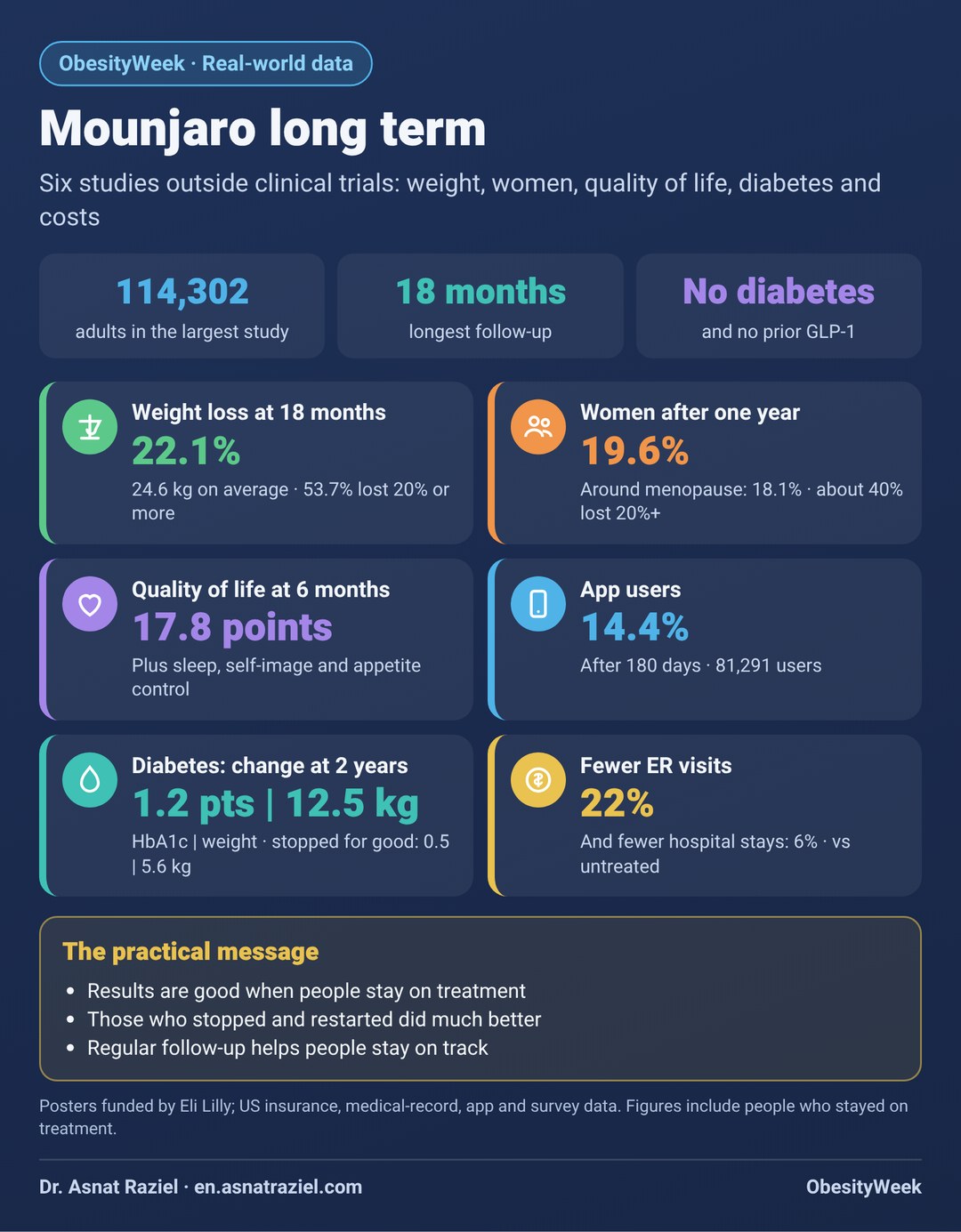
A 22.1% weight loss after 18 months
The largest study reviewed insurance claims and medical records of 114,302 adults in the United States. All of them started tirzepatide, the active ingredient in Mounjaro, without diabetes and without prior GLP-1 treatment. On average, they had three obesity-related conditions, such as high blood pressure, prediabetes or sleep apnea.
Among those who stayed on treatment for 18 months, weight fell by an average of 24.6 kg, or 22.1%. In addition:
- 89.8% lost at least 10% of their weight.
- 76.8% lost at least 15%.
- 53.7% lost at least 20%.
- 86.2% dropped at least one BMI category, and 29.2% reached a BMI below 27.
However, these figures include only people who stayed on treatment and were weighed at the start and the end. In other words, they describe those who remained on treatment, not everyone who started.
Mounjaro long term in women and around menopause
A separate study focused on 1,244 women who stayed on treatment for at least a year. The researchers noted that women make up about 70% of people on obesity medication, so it matters to study them on their own. After a year, the women lost an average of 19.6% of their weight. More than 95% lost at least 5%, and about 40% lost at least 20%.
In a subgroup of 291 women in or approaching menopause, the loss was 18.1%. So even at a stage when weight loss is especially hard, the treatment worked well. In addition, more than 80% of the women dropped at least one BMI category, and about 20% reached a healthy weight.
Quality of life, sleep and work
The PERCEPTIONS survey followed 346 women working full time through six months of treatment. Of the women who answered the survey, 94.3% were still on treatment after six months. They reported improvement in every area measured:
- Weight-related quality of life rose by 17.8 points on a 0 to 100 scale.
- Sleep problems decreased.
- Internalized weight bias, the shame and self-blame about weight, decreased.
- Control over appetite and eating habits improved.
- Missed work and reduced productivity at work decreased.
On the other hand, this survey had no comparison group, so it shows an association, not cause and effect.
An app and regular tracking: 14.4% in six months
Another study looked at 81,291 users of the Lilly Health app, a support app for patients on the company’s medications. Users reported their own weight. After 90 days, they had lost an average of 9.0% of their weight, and after 180 days, 14.4%.
Interestingly, people who opened the app at least 9 days in the first month lost slightly more: 15.0% after six months, compared with 13.7% among lighter users. There is no magic in an app, but regular tracking helps people stay on course. In my clinic, I see the same effect with regular weigh-ins and follow-up visits.
Staying on, stopping and restarting in diabetes
Another study followed adults with type 2 diabetes for two years after they started Mounjaro. The researchers split them into three groups by treatment pattern:
- Stayed on for the full two years, 17,652 people: HbA1c (average blood sugar over three months) fell by 1.2 percentage points, and weight fell by 12.5 kg.
- Stopped and restarted within two or three months, 1,662 people: blood sugar fell by 0.8 percentage points, and weight by 9.8 kg.
- Stopped and did not restart, 1,397 people: blood sugar fell by only 0.5 percentage points, and weight by 5.6 kg.
Moreover, between year one and year two, those who stayed on lost another 3.0 kg. By contrast, those who stopped and did not restart began to regain, in both weight and blood sugar. In other words, restarting after a break is much better than giving up. I wrote about this in detail in my article on staying on obesity treatment.
Mounjaro long term and healthcare costs
Another study compared 171,299 Mounjaro patients with 171,299 similar people who were not treated. The researchers counted all medical costs, excluding the price of the medication itself. Among those who stayed on treatment, costs fell gradually compared with the untreated group:
- Hospital stays fell by 6%, and emergency room visits by 22%.
- Savings reached $57 to $120 per patient per month, depending on the analysis method.
- Savings were especially large in people with two or more related conditions, or with sleep apnea, osteoarthritis, fatty liver, kidney disease or heart disease.
However, fewer than 10% of participants were still followed at 12 to 18 months, so the longer-term results rest on a small group.
What this means for you
First, real-world data look very similar to trial results, as long as people stay on treatment. So the most important decision is not only which medication to start, but how to stay on it over time.
- Plan your maintenance dose ahead of time; see my article on choosing a dose to keep the weight off.
- If you stopped, don’t give up: restarting is better than stopping for good.
- Regular follow-up, weigh-ins and visits with your care team help you stay on track.
- Pay attention to quality of life, sleep and how you feel, not only to the number on the scale.
For a real-world comparison of Mounjaro and Wegovy, read my article on the SHAPE study.
The bottom line
Mounjaro long term works outside trials too: a 22.1% loss after 18 months, 19.6% in women after a year, and better quality of life and blood sugar. In addition, staying on treatment is linked to fewer hospital stays and emergency visits. On the other hand, all of these studies are based on people who stayed on treatment, so they show the potential rather than the average for everyone who starts. The practical message is simple: the treatment works when you stay on it, and it pays to build a plan for staying on it from day one.
This article provides general information and is not a substitute for personal medical advice.
References
Lilly Scientific Information from ObesityWeek 2026
Tirzepatide Once Weekly for the Treatment of Obesity
The studies were funded by Eli Lilly, the maker of Mounjaro, and were partly conducted by company employees. They are posters presented at ObesityWeek, based on US insurance, medical-record, app and survey data, and have not undergone full peer review.