By Dr. Asnat Raziel, bariatric surgeon specializing in obesity treatment, metabolic health and healthy longevity; Director of the Multidisciplinary Center for Obesity Treatment, Assia Medical, Assuta Ramat HaChayal, Tel Aviv
Bariatric surgery after 65: what the new study found
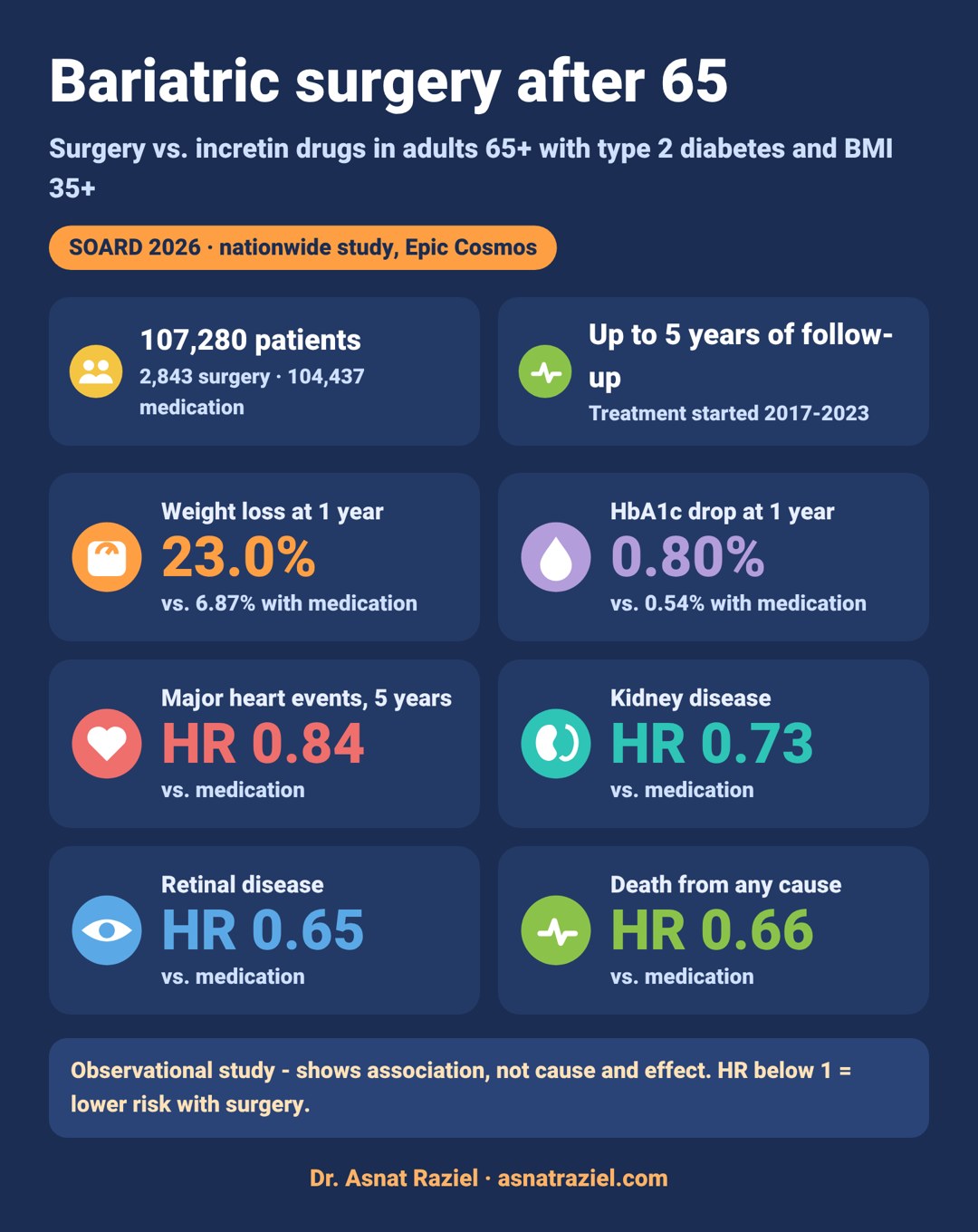
Bariatric surgery after 65 makes many people hesitate: isn’t it too late? A large American study, published in the journal of the American Society for Metabolic and Bariatric Surgery, offers an encouraging answer. Among adults 65 and older with type 2 diabetes and obesity, those who had surgery lost 23.0% of their body weight in one year, compared with 6.87% on medication. Over five years, they also had fewer heart events, less kidney and eye damage, and lower mortality.
Why this question matters
The population aged 65 and older is growing, and so are obesity and diabetes. At this age, diabetes damages the heart, kidneys and eyes, and obesity speeds up the loss of independence. Even so, many doctors still hesitate to refer older adults for surgery. Meanwhile, drugs like Ozempic and Mounjaro have become the first choice for many people. Until now, a direct comparison of the two paths in older adults was missing.
What the study looked at
The researchers used Epic Cosmos, a database that pools medical records from many US institutions. They identified 107,280 patients aged 65 and older, with type 2 diabetes and a BMI of 35 or more, who started treatment between 2017 and 2023. Of these, 2,843 had bariatric surgery and 104,437 started incretin-based therapy. Incretins are a drug family that includes GLP-1 medications such as semaglutide and tirzepatide.
To make the comparison fair, the researchers used a statistical method called overlap weighting. It focuses on patients who could reasonably have received either treatment. The main outcome was percent weight loss after one year.
Bariatric surgery after 65: the results
After one year, surgical patients lost an average of 23.0% of their body weight. In the medication group, by contrast, weight loss was 6.87%. Blood sugar control improved in both groups: HbA1c, a measure of average blood sugar over the past three months, fell by 0.80% after surgery and by 0.54% with medication.
The most important data, however, cover five years of follow-up. Compared with medication, surgery was linked to a lower risk of major cardiovascular events (hazard ratio 0.84), kidney disease (0.73), retinal disease (0.65) and death from any cause (0.66). In other words, the risk of death was about one third lower.
What it means, and the limitations
The authors’ conclusion: chronological age alone should not rule out bariatric surgery after 65. The results also fit the IFSO position statement on surgery over 65.
Still, these findings call for caution. First, this is an observational study, not a randomized trial, so it shows an association rather than cause and effect. Second, the people who had surgery were probably those their doctors judged healthy enough for it. Third, a 6.87% weight loss on medication is lower than what trials show, perhaps because of low doses or stopping treatment. Finally, the study did not report on falls, muscle or daily function, which matter a great deal at this age.
Bariatric surgery after 65: who is it for?
The decision about surgery at an older age is always personal. We assess the heart and lungs, the kidneys, physical and cognitive function, and the ability to cope with the change in eating. At this age we usually prefer a simpler, shorter operation such as a sleeve, but sometimes a Roux-en-Y gastric bypass is the better fit, for example with severe reflux or long-standing diabetes. It is also important to make sure there is support at home during recovery.
What you can do today
- Ask for a multidisciplinary assessment: in our center, a physician, dietitian, psychologist and exercise specialist decide together what fits you: medication, surgery or both.
- Check the basics: HbA1c, kidney function and urine protein, an eye exam, an echocardiogram or stress test as needed, bone density and vitamin D.
- Protect your muscle: strength training two to three times a week and protein at every meal.
- Medication as an alternative or a complement: Wegovy, Mounjaro and Foundayo are available in Israel. For type 2 diabetes, some GLP-1 drugs are covered by the national health basket under set criteria. Medication can also be combined before or after surgery.
- Lifestyle: a Mediterranean diet, a daily walk, about seven hours of sleep and stress management. All of these improve results with any treatment.
For more on the link between weight and blood sugar, read about obesity and type 2 diabetes.
The bottom line
The data show that bariatric surgery after 65 can be an effective treatment for selected patients with diabetes and obesity. Weight loss was roughly three times greater than with medication, and long-term complications were fewer. So age alone is not a reason to skip considering it. The right question is not “how old are you?” but “what is your health like, and what will give you more good years?”
This article is general information and does not replace personal medical advice.
Questions and answers
Is there an age when surgery is no longer done?
There is no strict age limit. The decision rests on health, function and the expected benefit, and over 65 the assessment is especially thorough.
Is it better to start with medication?
For many people it is a good first step. In this study, however, surgical patients lost much more weight and had fewer diabetes complications.
Is surgery riskier at an older age?
The risk is somewhat higher than at a younger age, so preparation, the choice of procedure and follow-up matter even more.