By Dr. Asnat Raziel, bariatric surgeon specializing in obesity treatment, metabolic health and healthy longevity; Director of the Multidisciplinary Center for Obesity Treatment, Assia Medical, Assuta Ramat HaChayal, Tel Aviv
Mounjaro maintenance dose: the question every patient asks
The Mounjaro maintenance dose is one of the topics my patients ask about most. After a year of losing weight, many want to know whether they can lower the dose without losing what they gained. At ObesityWeek in Washington, Eli Lilly presented five new analyses from the SURMOUNT-MAINTAIN trial. Together, they answer that question in detail. They also show who keeps the weight off and what happens when people restart treatment.
What SURMOUNT-MAINTAIN tested
The trial enrolled adults with obesity, or overweight with a related condition, who did not have diabetes. First, everyone took tirzepatide, the active ingredient in Mounjaro (Zepbound in the US), at the highest dose they tolerated, 10 or 15 mg, for 60 weeks. They started at an average of 113.8 kg and weighed 88.3 kg by week 60.
Next, people who had lost at least 5% of their weight were randomly assigned to one of three groups for another 52 weeks. One group stayed on the full dose, one stepped down to 5 mg, and one switched to placebo. The researchers published the main results in The Lancet, and I covered them in my article on long-term obesity treatment. This article covers the follow-up analyses presented at the meeting.
Mounjaro maintenance dose: who kept the weight off
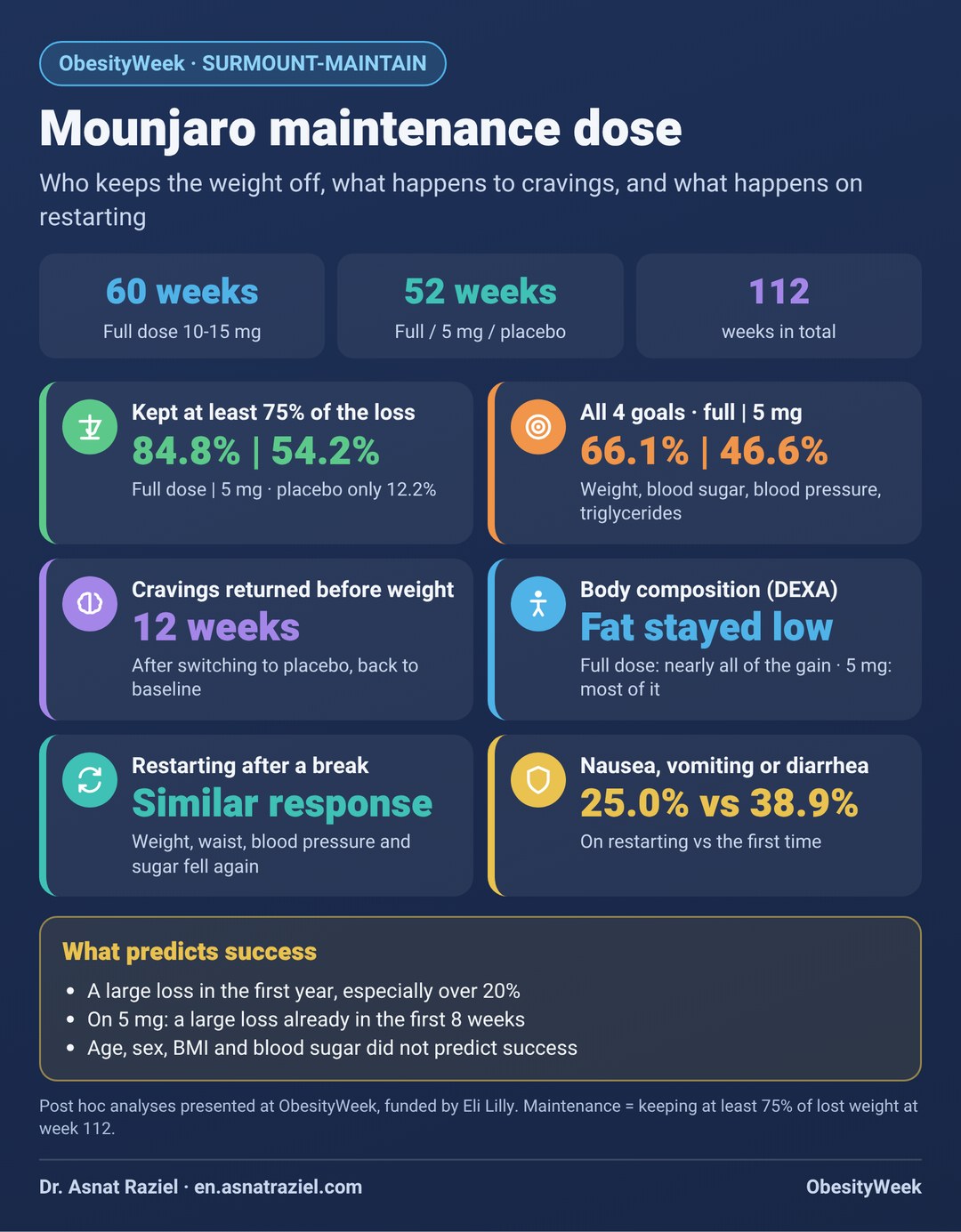
Dr. Tina Thethi, an endocrinologist in Orlando, defined “maintainers” as people who kept at least 75% of the weight they had lost. At the end of the trial, at week 112, the picture was clear:
- Full dose: 84.8% kept the weight off.
- 5 mg: 54.2% kept the weight off.
- Placebo: only 12.2% kept the weight off.
In other words, most people kept their results even on the lower dose. However, nearly everyone on the full dose did.
What predicts success on a Mounjaro maintenance dose
The researchers looked at which traits were linked to keeping the weight off. The key finding was simple. People who lost a lot in the first 60 weeks also did well later. For example, among maintainers on 5 mg, 70.1% had lost at least 20% in the first year. By contrast, only 38.5% of those who regained had reached that level.
In the 5 mg group, weight loss in the first 8 weeks also predicted success. According to Healio’s report, each extra percentage point of early weight loss was linked to 22% higher odds of keeping the weight off. On the other hand, age, sex, BMI, blood sugar and blood pressure did not predict who would succeed.
Cravings come back before the weight does
Dr. Fatima Cody Stanford of Harvard presented an especially practical finding. The researchers used two questionnaires. One measured hedonic hunger, the urge to eat for pleasure even when not hungry. The other measured food cravings. Both scores dropped clearly during the first year.
People who stayed on the full dose or on 5 mg kept that improvement, and it deepened further on the full dose. In contrast, cravings in the placebo group were back to their starting level by week 72, just 12 weeks after stopping. Weight, meanwhile, came back gradually and more slowly.
So returning cravings are an early warning sign. If thoughts about food start coming back after a dose reduction, talk to your doctor before the scale moves. I wrote more about this in my article on food noise.
Mounjaro maintenance dose and body composition
Weight loss is more than a number on the scale. Dr. Steven Heymsfield and Dr. Grant Tinsley used DEXA scans, which measure fat and muscle separately, in 104 participants. In the first year, body fat fell from 45.8% to between 35.8% and 40.8%, depending on the group.
On the full dose, participants kept nearly all of their gains in total fat, visceral fat and the fat-to-lean balance. Visceral fat, the deep fat around the abdominal organs, even kept falling slightly. On 5 mg, they kept most of the benefit, especially for total and visceral fat, though to a smaller degree than on the full dose. My article on body composition on weight loss drugs covers how to protect muscle.
Four health goals, not just weight
Dr. Carel le Roux of Dublin looked at four goals together: at least 10% weight loss, an HbA1c (average blood sugar over three months) below 5.7%, systolic blood pressure below 130, and triglycerides below 150. At week 112, the results were:
- 10% or more weight loss: 88% on the full dose vs. 68% on 5 mg.
- Normal blood sugar: 96% vs. 88%.
- Normal blood pressure: 81% vs. 76%.
- Normal triglycerides: 92% vs. 86%.
- All four goals at once: 66.1% vs. 46.6%.
Moreover, an analysis of the SURMOUNT-1 trial in people with prediabetes, after 176 weeks, pointed to a clear target. Those who reached a BMI under 25 were far more likely to have normal blood sugar and to meet all the heart-health goals. Waist size and waist-to-height ratio also predicted normal blood sugar.
What happens when you restart after a break
In the trial, people on placebo who regained at least half of the lost weight were restarted on tirzepatide from week 84. Dr. Gitanjali Srivastava of Vanderbilt compared how 36 of them responded the second time with the first time, at matching doses.
The news is encouraging. Restarting brought weight, waist size, blood pressure, blood sugar and blood fats down again, by a similar amount to the first time. Digestive side effects were also milder. Nausea, vomiting or diarrhea affected 25.0% after restarting, compared with 38.9% the first time. Nobody reported vomiting after restarting, compared with 19.4% the first time.
In short, stopping is not the end of the road. Still, this was a small group and an after-the-fact analysis.
Mounjaro maintenance dose: what this means for you
First, these findings support what I see in my clinic. Obesity is a chronic disease, and treating it takes time. So before lowering the dose or stopping, plan it together with your doctor. My guide to Mounjaro dosing explains each step of dose escalation.
- If you lost a lot in the first year, especially more than 20%, you may be able to try a lower dose with your doctor.
- When lowering the dose, pay attention to cravings and food thoughts, not only to the scale.
- Protein and strength training help protect muscle at any dose.
- If weight returns, you can restart, and the medication usually works again.
I explain how to plan for stopping treatment in my article on stopping GLP-1 without regaining weight.
The bottom line
A Mounjaro maintenance dose can be 5 mg, and for most people it preserves most of the result. Still, the full dose works better across every measure. A large loss in the first year and cravings that stay quiet are good signs. People who regain after stopping can restart, and the medication usually works again. Choosing a Mounjaro maintenance dose should be a personal decision made with your doctor.
This article provides general information and is not a substitute for personal medical advice.
References
Lilly Scientific Information from ObesityWeek 2026
Early weight loss with tirzepatide may raise odds for long-term maintenance
Tirzepatide for Obesity Treatment and Diabetes Prevention
A Study of Tirzepatide For the Maintenance of Body Weight Reduction (SURMOUNT-MAINTAIN)
The studies and analyses were funded by Eli Lilly, the maker of Mounjaro, and some researchers are company employees. The data come from posters and talks presented at ObesityWeek; they are post hoc analyses that have not yet been peer reviewed.