By Dr. Asnat Raziel, specialist in obesity treatment, metabolic health and healthy longevity, director of the multidisciplinary obesity center, Assia Medical, Assuta Ramat HaHayal
Food noise: a report from ObesityWeek
Food noise is one of the terms patients mention most since GLP-1 drugs arrived. It means thoughts about food that do not let go, even when you are not hungry. At ObesityWeek in Washington, the annual meeting of The Obesity Society, the first day opened with a whole session on it, called “Do You Hear What I Hear?”. Two researchers and a patient living with obesity and diabetes took the stage. In this article I summarize what they presented, and I checked the numbers against the original studies.
The core message was simple: everyone talks about food noise, but we may not all mean the same thing. I wrote before about food noise research and about constant hunger. This time the meeting added a new question: is this a distinct condition, or a new name for things we already know?
Does food noise really exist?
Dr. Emily Dhurandhar of Texas Tech opened with a philosophical question. She said that once we give something a name, we tend to assume it exists as a separate thing. She did not doubt patients’ experiences. Instead, she asked how science can show that this is a defined condition.
To answer that, she described several tests. First, the condition should come in different amounts, not just “yes or no”. Second, it should fit what we already know about appetite and the brain’s reward system. In addition, we should be able to turn it up or down and see an effect in real life. In her view, food noise is only beginning to pass these tests.
Three definitions of food noise
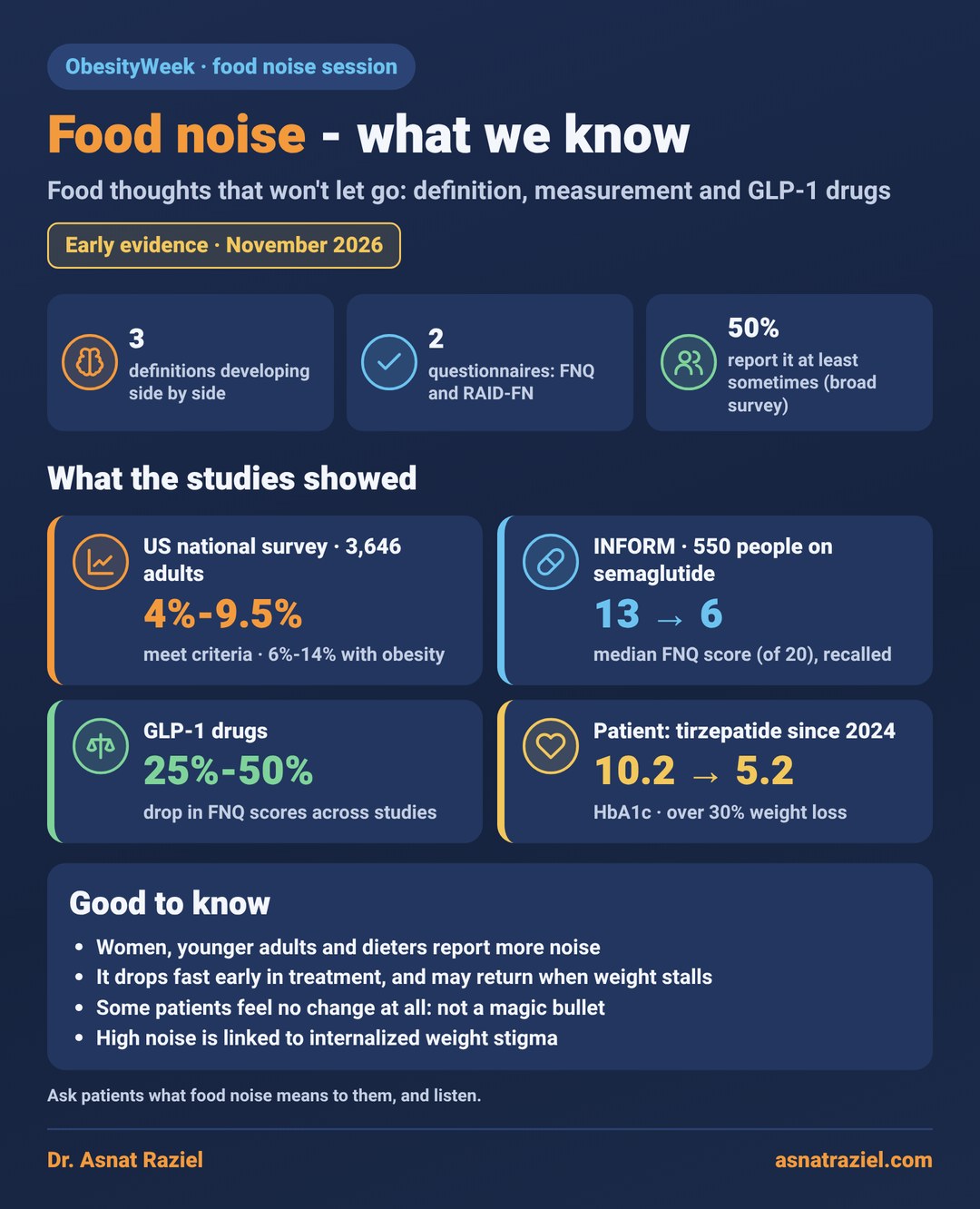
There is still no single agreed definition. The session presented three that are developing side by side:
- Dr. Travis Masterson’s group at Penn State sees it as a form of food cue reactivity, meaning a strong response to the sight, smell or advertising of food.
- Dr. Corby Martin’s group describes persistent, intrusive thoughts about food that disrupt daily life and make healthy habits harder.
- A group that met in 2024 proposed a broad definition: persistent thoughts about food that a person feels are unwanted or unpleasant, and that may cause social, mental or physical harm.
The three do not contradict each other. All of them describe persistence, an unwanted quality and a cost. However, each has a different emphasis. According to Masterson, that is useful: different definitions let researchers test what really sits at the core.
How food noise is measured: two questionnaires
Today there are two main questionnaires. The first, the Food Noise Questionnaire (FNQ), has five items. It focuses on how much food thoughts interfere with life, for example when they distract you from work. In a study published in the journal Obesity, it showed high reliability, including when people filled it in again a week later.
The second, RAID-FN, was developed by Dhurandhar’s group. The short form has seven items and focuses on the unpleasant side, for example “I hate myself for not being able to control my thoughts about food”. It is linked to cravings and to food cue responsiveness. According to her, it is especially precise for people above average. There is a caveat, though: people can exaggerate their answers to look worse, so clinicians should know this limit.
Who has more food noise
According to the studies presented, women, younger adults and people who diet report more. Interestingly, the link to BMI was not consistent in earlier studies. In contrast, a new US national survey, posted in October 2026 and not yet peer reviewed, found that scores rise with weight.
How common is it? The answer depends on the question. In Masterson’s survey of about 1,000 people, about half said they experience it sometimes, often or always. However, that survey asked broadly, with no definition. In the new survey, which used the FNQ in 3,646 adults, only 4% to 9.5% met the criteria, and 6% to 14% of people with obesity. In other words, most people know what it is to think about food, but noise that truly disrupts life is less common.
Another interesting finding from Masterson’s survey: people who had stopped GLP-1 drugs reported it at a much higher rate. His explanation is that they now recognize it, but have lost the help of the drug.
GLP-1 drugs and food noise: what we know
According to Dhurandhar, GLP-1 drugs lower FNQ scores by about a quarter to a half. The largest study is INFORM, which surveyed 550 people using semaglutide injections (Wegovy). Before treatment, the median score was 13 out of 20, and after it was 6. In addition, the share who agreed with statements describing food noise fell from 47%-63% to 15%-20%.
Still, these numbers need care. Researchers asked people to recall how they felt before treatment, and there was no comparison group. Also, Novo Nordisk funded the study. In another study, a digital behavioral program lowered the noise a little, but combining it with a GLP-1 drug lowered it more.
Qualitative studies, which interview patients over time, describe a repeating pattern. The noise drops quickly at the start of treatment. For some patients it comes back when weight loss stalls. After stopping the drug it returns, but patients describe it as easier to manage. I wrote about the brain side of this in GLP-1 drugs and the brain.
To sum up, Dhurandhar stressed that the quality of the evidence is still low. Most studies rely on surveys and on people’s memory, and no controlled trial has yet tested food noise as a main outcome.
Food noise and weight stigma
One of the most important findings, in my view, is the link to stigma. People with high food noise tended to internalize more negative views about weight, meaning they believed those views were true about themselves. The data came from a study of patients after bariatric surgery, where the noise was also linked to loss of control over eating and to cravings for highly palatable food. I wrote about this in weight bias in healthcare.
What patients say on social media
Masterson’s group looked at how people talk about it online. In the top 100 TikTok videos, the attitude was almost always negative, and GLP-1 drugs were described as something that helps. However, most creators appeared to be over 30 and white, so it is not clear their description represents everyone.
The team also collected 33,000 Instagram comments and analyzed 797 that mentioned both GLP-1 and food noise. Five themes emerged: emotional relief, changed thoughts about weight, a different outlook on food, and realizing how much the noise had affected them. The fifth theme matters most: a group of people who felt no decrease at all. According to Masterson, the drug is not a magic bullet for everyone.
In interviews before and after starting treatment, patients used the term in different ways. For one it was a reaction to the sights and sounds of food. For another it was simply craving. One patient said that after the drug she thinks about food just as much, only for a different reason: she worries that something will make her feel sick.
One term, many experiences
Masterson also showed differences between cultures. In Japan, a common word means longing for food and actually has a positive tone. In Brazil, people use a phrase that literally means “fat people’s way of thinking”, which carries stigma. Therefore, he warned against using two names for the same thing, or one name for several different things. That confusion splits research apart and confuses both clinicians and patients.
The patient’s voice: “Ask what it means to me”
The third speaker, Michael Donnelly-Boland, is an associate dean at a law school and an advocate for people with obesity. He lives with obesity and type 2 diabetes, and said he has felt the noise go quiet twice, in two different ways.
The first time, in 2022, the quiet came by accident, after an unplanned change in the dose of another medicine. He said food thoughts had followed him all his life: at breakfast he was already planning dinner, and vacations were built around food. Suddenly he thought about food only when hungry, and stopped eating when full. But it was temporary, and it came with side effects.
The second time, in March 2024, he started tirzepatide (Mounjaro, Zepbound). This time the quiet was subtler. His cravings did not disappear, they changed: instead of cinnamon toast and orange juice, he now craves cottage cheese and yogurt. He has lost more than 30% of his body weight, and his HbA1c, the three-month average of blood sugar, fell from 10.2 to 5.2.
He said the quiet in his mind was one of the most meaningful benefits, even though it does not show on the scale or in blood tests. That is why patients are so afraid of losing it. This fear affects decisions: some people delay tests such as a colonoscopy so they do not have to pause the drug. His message to clinicians was clear: when a patient says the noise is back, ask what they mean, and listen.
What you can do today
- If thoughts about food take up much of your day, tell your doctor. It is not a lack of willpower, it is part of the biology of obesity.
- Try to describe exactly what you feel: craving, a reaction to seeing food, worry or self-criticism. A clear description helps tailor treatment.
- GLP-1 drugs reduce food noise for many people, but not for all. Behavioral and nutrition support add to the medication.
- If you worry about pausing treatment, talk to your doctor ahead of time. A short pause before surgery or a procedure can be planned.
- If you have a history of an eating disorder, mention it before starting medication.
At our multidisciplinary center, we bring together a physician, dietitian, psychologist and physical activity, and we ask each patient what the noise means to them.
Bottom line: food noise
Food noise is a real experience for many people, and science is starting to define and measure it. GLP-1 drugs reduce it for many, but the evidence still rests mostly on surveys and on people’s memory. In the end, the most important message from the meeting is also the simplest: ask patients what they mean, and listen.
This article is general information and is not a substitute for personal medical advice.
References
Development and validation of the Food Noise Questionnaire
Food noise: definition, measurement, and future research directions
Food noise: A theoretical review
This article is based on the session “Do You Hear What I Hear? Perspectives on Food Noise” at ObesityWeek in Washington, and the data were checked against the original studies.