By Dr. Asnat Raziel, bariatric surgeon specializing in obesity treatment, metabolic health and healthy longevity; Director of the Multidisciplinary Center for Obesity Treatment, Assia Medical, Assuta Ramat HaChayal, Tel Aviv
Ultra-processed food for kids: effects on the brain before weight
Ultra-processed food for kids may affect the developing brain even before any weight gain appears. That was the message from Prof. Michael Goran of Children’s Hospital Los Angeles in his talk at ObesityWeek in Washington, DC. Prof. Goran has studied infant and child nutrition for 35 years and has published more than 450 papers.
In his words, most of us think of a simple path: unhealthy food, extra calories, weight gain and disease. But in children, nutrition is also a developmental exposure. It shapes the brain’s reward system, blood sugar regulation and gut bacteria, and sometimes all of this happens before anything shows on the scale.
What ultra-processed food is
Under the common definition, the NOVA system, ultra-processed food is an industrial product with a long ingredient list. It usually contains fast-digesting sugars and carbohydrates, plus additives designed to make it especially tasty. I covered this in depth in my article on ultra-processed food and the brain.
Prof. Goran acknowledged that the definition is still debated. In his view, the question that really matters is what exactly in this food affects development. Maybe it is the sugars, the sweeteners or the additives. Or maybe ultra-processed food simply crowds important nutrients off the plate.
Ultra-processed food for kids starts in pregnancy
The story begins before birth. The Project Viva cohort followed 1,683 children from birth to age 18. Children of mothers with the highest intake of artificial sweeteners during pregnancy, mostly diet drinks, were heavier at birth. Later on, their BMI and body fat climbed too, and the gap grew over the years.
In the same cohort, according to Prof. Goran, children of mothers who drank diet beverages in pregnancy showed lower learning ability at age 3. At age 8, researchers saw lower verbal learning in children of mothers who drank either sugar-sweetened or diet beverages.
Ultra-processed food for kids from day one: corn-syrup formula
One of the most surprising findings in the talk concerned infant formula. According to Prof. Goran, more than half of the formula sold in the United States contains no lactose, the main sugar in breast milk. Instead, it is based on corn syrup solids. He explained that the regulations allow this, because they require a carbohydrate but not lactose.
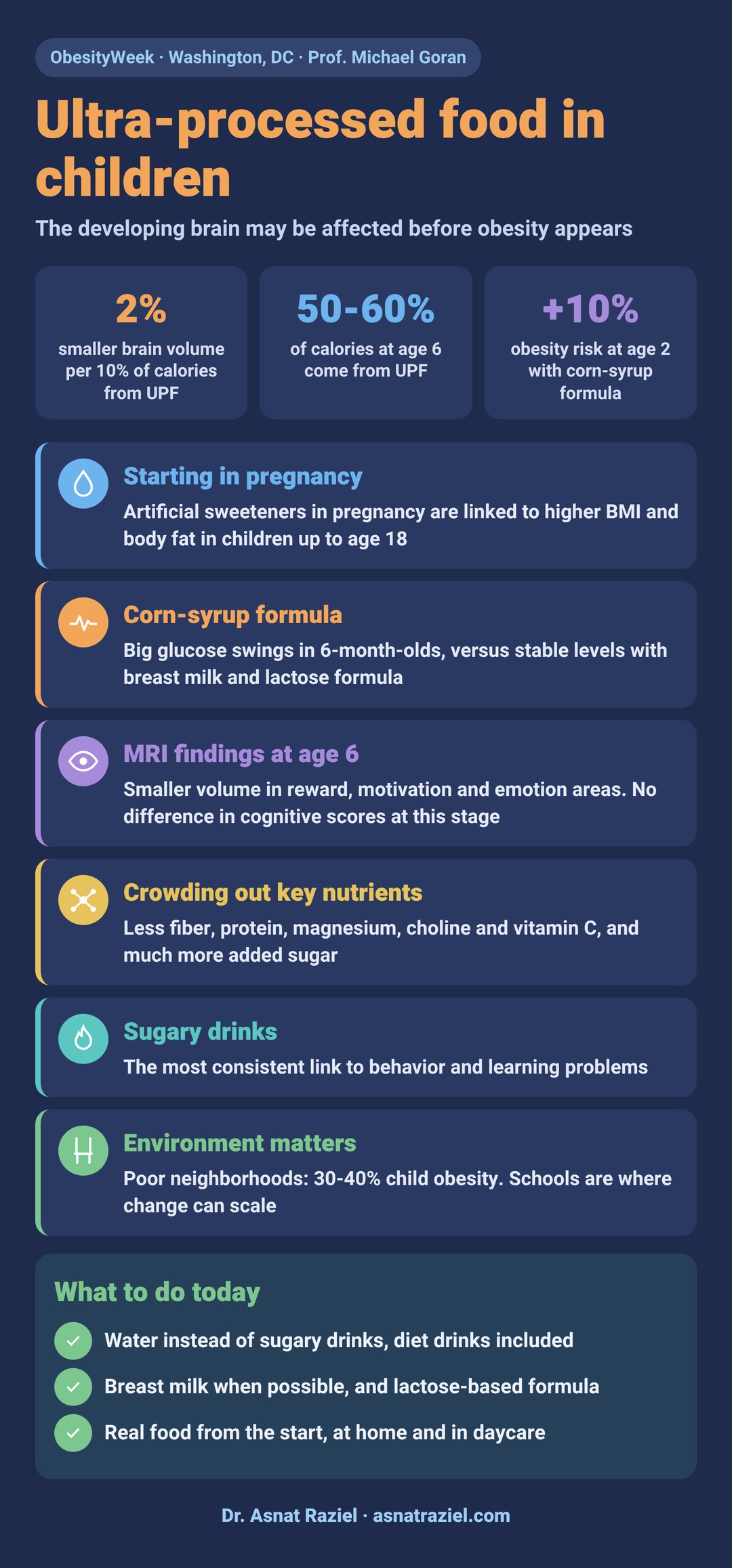
In a study of 15,246 children in the federal WIC nutrition program in California, children given corn-syrup formula had a 10% higher risk of obesity at age 2. According to Prof. Goran, obesity rates were 16.2% versus 14.3%. The gap persisted to age 4, and the risk rose the longer the infant received that formula.
What the babies’ glucose sensors showed
In a striking study, 6-month-old babies wore continuous glucose monitors for several days. In a study published this year on 45 infants, glucose levels in breastfed babies were very stable. Babies on regular lactose-based formula were stable too. In contrast, babies on corn-syrup formula showed large glucose swings.
What’s more, about a third of them fell into the group with the biggest swings. Prof. Goran showed one baby’s glucose curve and said you might think it belonged to an adult with prediabetes.
Ultra-processed food for kids and the brain: the MRI findings
The key finding of the talk came from a study that followed children from 6 months to 6 years. At 6 months, ultra-processed food made up a small share of the diet. By age 6, it already supplied about 50% to 60% of calories.
At age 6, the children had a brain MRI. Researchers found that every 10% higher share of ultra-processed food over the years went along with about 2% smaller volume in deep brain regions. These regions are linked to reward, motivation and emotional regulation, such as the amygdala and the nucleus accumbens. However, the researchers found no differences in cognitive abilities at age 6.
According to Prof. Goran, changes in brain structure may appear before changes in function. At this stage they also found no link to belly fat. So, in his view, the brain may be an “early target” of a diet high in ultra-processed food.
Why does it happen? Two possible directions
The mechanism is still unknown. The first direction is crowding out key nutrients. Children who ate the most ultra-processed food got about 80% of their calories from it. They ate 13% more calories and much more added sugar. They also got less fiber, protein, magnesium, choline and vitamin C, all important for brain development. The second direction is gut bacteria, and the researchers are still analyzing the data.
What other studies show about ultra-processed food for kids
According to Prof. Goran, other studies point the same way. A meta-analysis of 35 studies in about 84,000 children found links between ultra-processed food and lower executive function, attention, intelligence and language. In addition, a study of more than 2,000 three-year-olds found a link to behavior problems. Of all types of ultra-processed food, only sugary drinks were linked to both outward and inward behavior problems.
Still, it is important to remember that most of these studies are observational. They show a link, but they do not prove that ultra-processed food is the cause.
The environment, not just parents’ choices
Prof. Goran stressed that all of this happens within a social environment. In Los Angeles, child obesity was about 5% or less in affluent neighborhoods and 30% to 40% in poor ones. In an analysis of nearly 700,000 children, the strongest single factor was school poverty.
That is why, he said, schools are “the biggest restaurant chain in the US.” Thirty million children eat there and get about half their calories there. In an observational analysis, schools that switched to healthier menus in the Eat Real program showed a 5.5 percentage-point rise in the share of children meeting language standards. California has also passed a law to phase the most harmful ultra-processed foods out of school meals. I wrote more about this in my article on a healthy food environment.
How to cut ultra-processed food for kids today
In pregnancy: water instead of sweetened drinks, diet drinks included.
In infancy: breast milk is the best choice when possible. When choosing formula, read the ingredient list and ask your pediatrician about lactose-based formula.
In early childhood: real food from the start. Vegetables, fruit, legumes, eggs, fish and whole grains provide fiber, protein, magnesium and choline.
For drinks: water as the default at home and in daycare. Skip sugary drinks, which are most consistently linked to the worst outcomes.
In the community: push for healthy menus in daycare and school, where children eat a big part of their day.
Read more about healthy eating for children and preschool obesity.
No shame and no blame
At the end of the talk, an important question came up: how do we discuss this data without shaming parents? To me, the answer is clear. Parents are not to blame. They live in an environment where ultra-processed food is cheap, available and marketed everywhere. So change has to come from policy, daycares and schools, not only from the home kitchen.
Bottom line: ultra-processed food for kids and the developing brain
Nutrition in the first years is part of developmental biology. The data suggest that ultra-processed food for kids may affect the brain and blood sugar regulation before obesity appears. This is a new field, and many questions are still open. But the direction is clear: plenty of real food, few sugary drinks, and an environment that helps parents choose well.
This article is general information and does not replace personal medical advice.