By Dr. Asnat Raziel, bariatric surgeon specializing in obesity treatment, metabolic health and healthy longevity; Director of the Multidisciplinary Center for Obesity Treatment, Assia Medical, Assuta Ramat HaChayal, Tel Aviv
Combining medication and surgery: not a competition, but a sequence
Combining medication and surgery is the new direction in obesity care. That was the core message of a dedicated session at ObesityWeek in Washington, DC. As a bariatric surgeon, I followed this session closely. Its title said it all: what’s new, what’s true and what’s next.
Prof. John Morton of Yale moderated. Obesity is a chronic disease, he said, so it calls for staged care. Medications and surgery do not compete. They complement each other.
Why medications don’t replace surgery
The new medications have changed the picture. By Prof. Morton’s estimate, about 80% of patients who arrive for surgery have already tried GLP-1 medications. Yet only a tiny share of candidates ever had surgery. According to one speaker, surgery reaches fewer than 1% of the people who need it.
Dr. McNary of Albert Einstein College of Medicine presented a real-world comparison from NYU. At two years, weight loss with tirzepatide was about 11.3%. Sleeve gastrectomy, by contrast, led to about 22%. This was a retrospective study, but the gap stands out. Medications also usually need to be continued long term.
A large US study in people with diabetes, published this year, points the same way. Researchers checked who reached both 20% weight loss and full glucose control within a year. That double target was reached by 3% of patients on semaglutide, 13.2% on tirzepatide and 24% after a sleeve. This too was an observational study, and the groups were not identical.
Obesity severity and combining medication and surgery
Dr. Vance Albaugh of Pennington Biomedical presented a troubling figure. In the US NHANES survey, where participants are actually weighed, the BMI 60-and-over group grew by 220% over 20 years. Similar trends appeared in Brazil and England.
Why does this matter? First, the starting point shapes the result. A patient who starts at a BMI of 35 and responds well to medication can reach a BMI of 26. A patient who starts at 55 stays above 40 even after an excellent response. Dr. Albaugh compared this to a blood pressure of 180 that drops only to 170. There is improvement, but the disease is still there. So the aim is to treat to a personal goal, not to settle for “some” weight loss.
Who should consider surgery early
The speakers listed several situations in which surgery deserves early consideration:
- A BMI over 50, where medication alone struggles to reach the goal.
- No response to medication, or side effects that prevent continuing it.
- Type 2 diabetes.
- Severe reflux. One speaker noted that GLP-1 medications can worsen reflux, so in conditions such as severe esophagitis or Barrett’s esophagus, surgery may be the better choice.
- Limited access to medication, and patient preference.
Dr. Albaugh added that complex patients can benefit too: people with heart failure, patients on dialysis, candidates for transplant or joint replacement, and even people in their 70s. It all depends on the center’s experience and its multidisciplinary team.
Sleeve or gastric bypass: what the trials show
Not every operation suits everyone. In recent years the sleeve’s share has fallen from a peak of 71.2% of procedures, while gastric bypass has risen slightly. Reflux after a sleeve is one reason.
Dr. Albaugh highlighted the Norwegian Oseberg trial, a triple-blind randomized trial in patients with diabetes. At five years, diabetes remission was far more common after Roux-en-Y gastric bypass: 63% versus 30% after a sleeve. Weight loss was 22.2% versus 17.2%. Pathological acid reflux, on the other hand, was much less common after bypass. Bypass has a price, though: symptomatic low blood sugar after meals affected 28% of bypass patients, versus 2% after a sleeve.
Prof. Morton summed it up: for patients with pathological reflux or insulin-treated diabetes, bypass is probably the better choice.
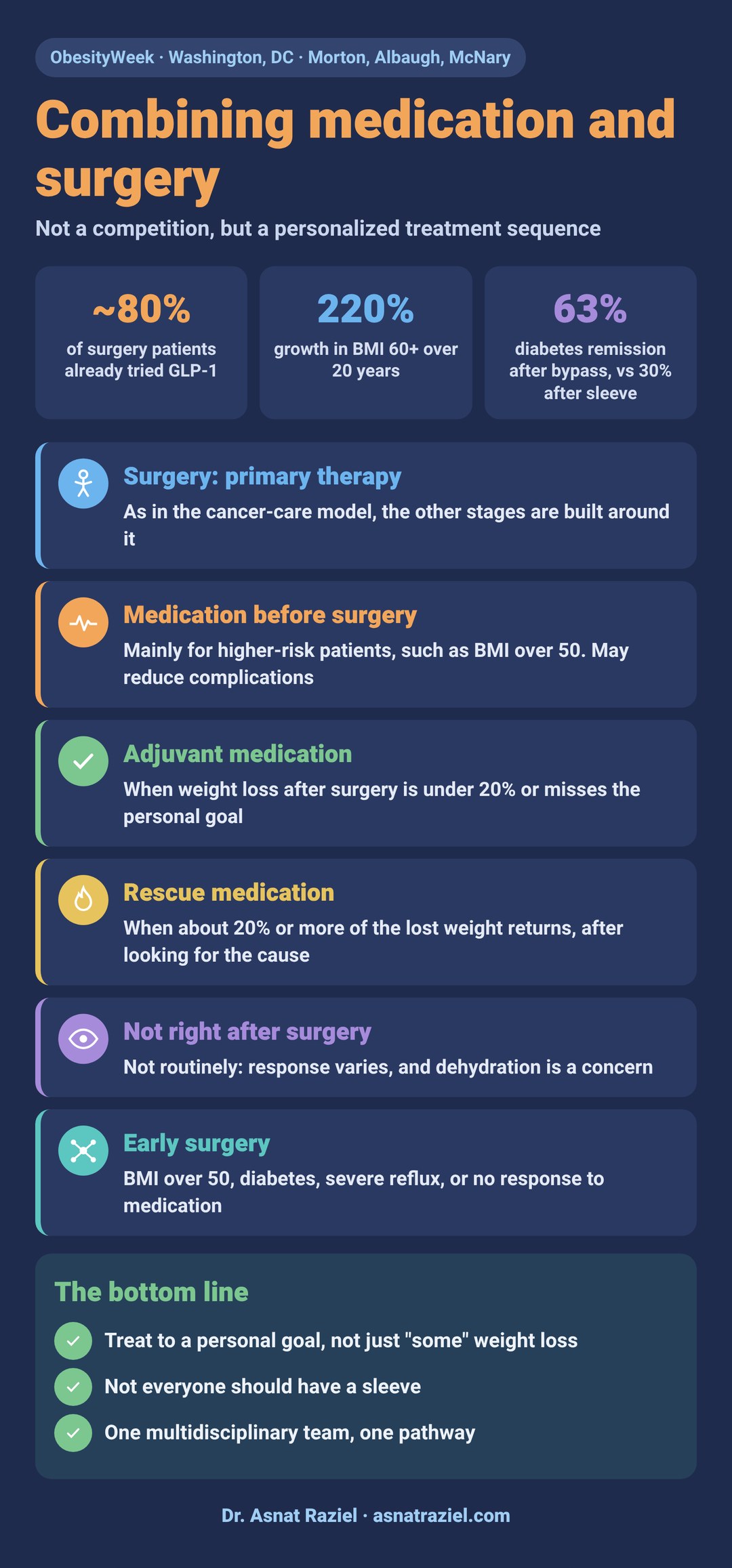
Combining medication and surgery: a model borrowed from cancer care
Dr. McNary gave the most practical talk of the session. He borrowed a model from cancer treatment, with four roles:
- Surgery is the primary therapy.
- Medication before surgery is neoadjuvant therapy.
- Medication after surgery, when the response is partial, is adjuvant therapy.
- Later medication, when weight returns, is rescue therapy.
Medication before surgery
Losing weight before surgery does not necessarily improve the final result. However, it may make the operation easier and reduce complications. One estimate presented put the reduction in complication risk at about a quarter. On the other hand, requiring weight loss first can delay surgery and lead patients to drop out. Dr. McNary therefore reserves this approach mainly for higher-risk patients, such as those with a BMI over 50.
Right after surgery: not routinely
Dr. McNary does not recommend starting medication routinely right after surgery. First, the response to surgery varies from person to person. Second, in the first weeks there are concerns about dehydration and electrolyte problems. Finally, these are long-term medications, so it makes sense to start them only when there is a clear reason.
When to add medication after surgery
After surgery, weight usually falls to its lowest point. Then comes a mild, natural regain, followed by stabilization. A common definition of a good response is losing at least 20% of body weight, or improvement in related conditions. But this is a general definition, and it is not always enough for every person.
Dr. McNary’s framework:
- Loss of less than 20%, or loss that misses the personal goal: consider adjuvant medication.
- Regain of about 20% or more of the weight lost: consider rescue medication.
Before any medication, it is important to find out why weight is returning. Sometimes the cause is anatomical, such as a widened connection or an enlarged pouch. Sometimes it is eating patterns, other weight-promoting medications, or low blood sugar episodes that drive frequent eating.
The good news: according to Dr. McNary, liraglutide, semaglutide and tirzepatide are safe and effective after surgery too. It works the other way as well. A new Cleveland Clinic study looked at patients who responded inadequately to semaglutide or tirzepatide. At two years, gastric bypass led to 32.7% weight loss in this group, versus 17.8% after a sleeve.
Combining medication and surgery in practice: three patients
Dr. McNary presented three cases from his clinic:
- A 44-year-old woman, ten months after a sleeve: she lost only 13% and later held at 8%. Lifestyle changes and two medications, one used off-label, brought her total loss to 26%.
- A 70-year-old man, four years after bypass: he lost 36%, then regained about 35% of the weight lost. Lifestyle changes and two medications, including treatment for depression, brought a further 13% loss.
- A 43-year-old woman, four years after a sleeve: she reached 30% loss but stayed at a BMI of 36 with poor quality of life. Adding tirzepatide and moderate physical activity brought her total loss to 56%, from a BMI of 48 to 23.
Three patients, three different paths. That is the principle of combining medication and surgery: care tailored to the person, not one protocol for everyone.
What’s on the horizon
One speaker also presented new developments, such as targeted revision procedures for patients who did not reach their goal after bypass, and a new technique that creates an intestinal connection with magnets after a sleeve. These are still early data from small series. He also mentioned medications that aim to preserve muscle mass.
Many questions remain open. What happens when medication stops? What is the long-term safety? And what about cost? More randomized trials are needed.
The bottom line: combining medication and surgery in one team
The message from the conference is clear: obesity is a chronic disease, and not every patient needs the same treatment. Combining medication and surgery, at the right time, can bring each patient closer to their own goal. The best way to do it is with one multidisciplinary team: surgeon, obesity physician, gastroenterologist, dietitian with a personal nutrition plan, and psychologist. That is how we work at our center too.
This article is general information and does not replace personal medical advice. Any change in medication, before or after surgery, should be made only with your care team.
References
Bariatric Surgery as a Rescue Strategy After Semaglutide or Tirzepatide