By Dr. Asnat Raziel, bariatric surgeon specializing in obesity treatment, metabolic health and healthy longevity; Director of the Multidisciplinary Center for Obesity Treatment, Assia Medical, Assuta Ramat HaChayal, Tel Aviv
Obesity is a disease of diseases: my first report from Washington
Obesity is a disease of diseases. That was the message that opened the first workshop day at ObesityWeek in Washington, DC, this morning. ObesityWeek is the leading international meeting for obesity researchers and clinicians. I am here at the conference, and I will share the most important updates with you every day.
The first workshop focused on obesity care in primary care. It was led by The Obesity Society together with the American Academy of Physician Associates. The opening talk asked a basic question: what is obesity, really?
Who the speaker is, and why he is worth hearing
Dr. Thomas George is a family nurse practitioner and an obesity specialist. He teaches pathophysiology at New York University. He also co-authored the Obesity Medicine Association’s adult obesity algorithm.
But it was his personal story that held the room. In the military he weighed about 84 kg and was lean and active. After a severe head injury and a skull base fracture, his weight climbed to about 150 kg. He was hungry all the time. His doctors told him to eat less and move more, exactly what he used to teach soldiers. It did not work.
Finally, one neuroendocrinologist told him: “It’s all in your head.” He meant an underactive thyroid. Today Dr. George maintains a weight loss of about 54 kg.
Why obesity is a disease of diseases
First, Dr. George reminded us of the definition. A disease is a disorder of the body’s structure or function, with a known cause and typical signs. Obesity meets that definition. It is chronic, progressive and relapsing.
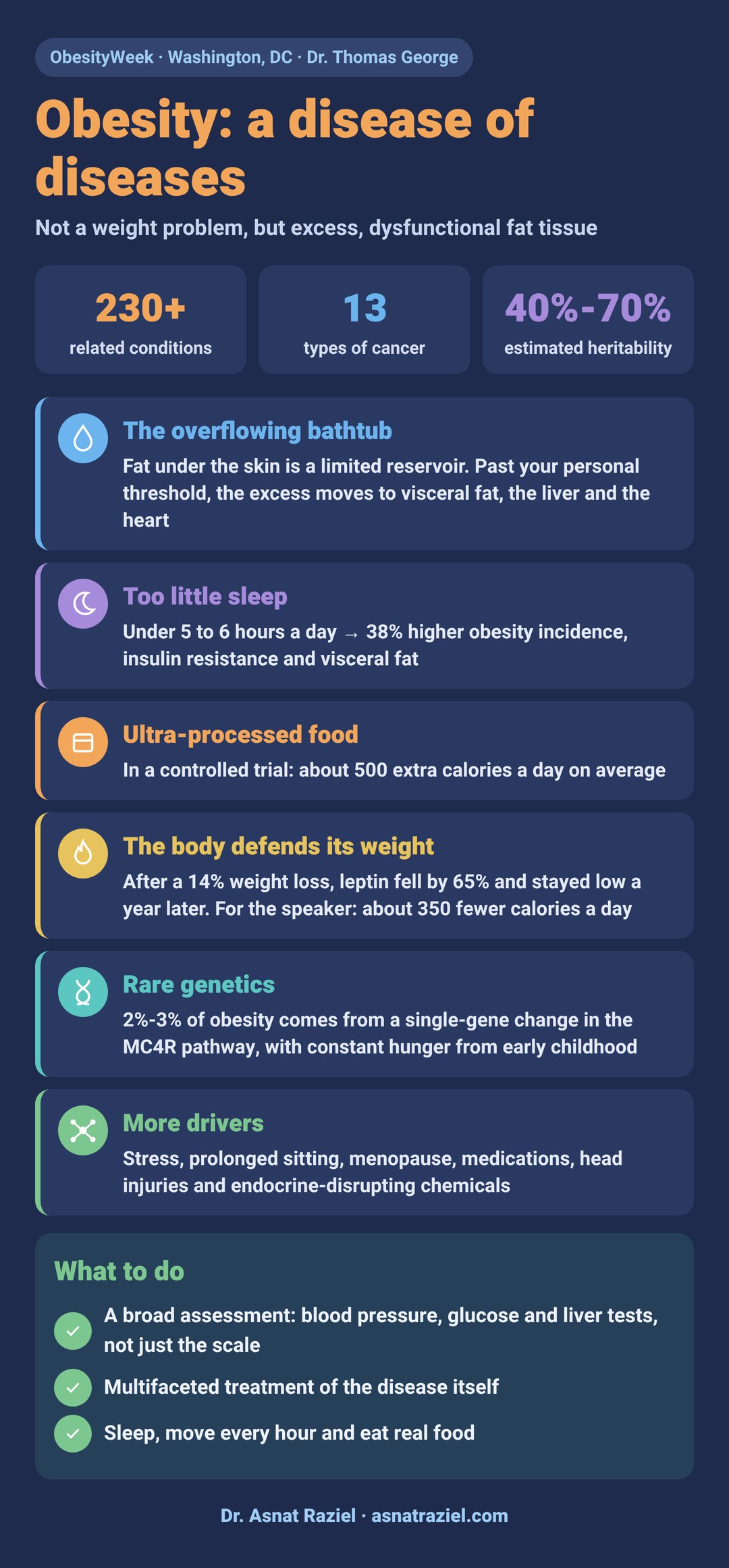
However, he asked us to go one step further. In his words, obesity is a disease of diseases. It sits upstream of more than 230 medical conditions and 13 types of cancer. So treating obesity itself may also improve the conditions downstream. I have also written about obesity-related diseases and about obesity as a chronic disease.
A disease of diseases, not a weight problem
The second message was simple. The problem is not the number on the scale. The problem is excess fat tissue that does not work properly. So it matters where the fat sits, how it functions and what drives it.
The overflowing bathtub
Dr. George used the image of a bathtub. Fat under the skin is a reservoir of limited size. This fat even does good things, for example releasing adiponectin, an anti-inflammatory hormone. But everyone has a personal threshold. When the tub is full, the excess spills over into the internal organs.
That is where visceral fat builds up, the fat that wraps the abdominal organs. These fat cells grow faster than their blood supply. They release inflammatory signals and fatty acids into the liver. This is how fatty liver and insulin resistance develop. From there, fat also reaches the muscles and the heart. Fat around the heart, for instance, can stiffen it and cause local inflammation.
What’s more, people of Southeast Asian descent may carry a lot of visceral fat even at a “normal” weight. So we cannot rely on weight or BMI (body mass index) alone. It is worth checking blood pressure and liver markers too, such as the FIB-4 score, which is calculated from blood tests and estimates liver scarring.
What drives the disease of diseases
According to Dr. George, obesity arises where genetics meets environment. The heritability of obesity is estimated at 40% to 70%, and some studies put it as high as 90%. Still, DNA is not destiny. It only raises the risk.
Alongside genetics, he listed a long series of drivers: stress and the hormone cortisol, desk jobs, lack of sleep and highly processed food. He also mentioned certain medications, head injuries, inflammation, endocrine-disrupting chemicals, menopause and the gut microbiome.
Here is the key point. The energy equation is true: when more energy enters the body than leaves it, the body stores it. But the equation only describes what happens. It does not explain why.
Ultra-processed food bypasses fullness signals
Dr. George showed a protein snack whose package said 120 calories. In fact, that was the value per serving, and the package held four servings. Food like this, he said, bypasses the body’s natural hunger and fullness systems.
As an example, he cited a controlled trial in which people on an ultra-processed diet ate about 500 extra calories a day on average. I covered this in more depth in my article on ultra-processed food and the brain.
Sleep: a driver that is easy to miss
Sleep was a central example in the talk. According to the slides, sleeping less than five to six hours a day is linked to a 38% higher incidence of obesity. The link between sleep length and mortality looks like the letter U: both too little and too much are harmful. Dr. George described experiments that cut healthy people’s sleep to under six hours. Insulin resistance and visceral fat followed. Some participants reached the prediabetes range within weeks.
Lack of sleep lowers GLP-1 and leptin, hormones that calm hunger. At the same time, it raises ghrelin, the hunger hormone. In addition, self-control weakens, and high-calorie food looks especially tempting. Dr. George also warned against very high doses of melatonin, because melatonin is a hormone in every sense.
Three voices in the brain that run our eating
To explain hunger, Dr. George described three characters. The first is “the accountant”, the system that protects us from starvation. The second is “the party guy”, the pleasure and reward system. The third is “the well-meaning friend”, the prefrontal cortex, in charge of goals and self-control.
He also separated two terms. Satiation is the feeling of fullness during a meal. Satiety, by contrast, is how long that fullness lasts afterward. Read more in the physiology of fullness.
When the body fights for its old weight
About 2% to 3% of obesity is a rare genetic form. It is caused by a change in a single gene in the MC4R pathway, a brain pathway that regulates hunger and fullness. Children with such a change are hungry all the time from an early age. These cases teach us that intense hunger is sometimes biological, not a lack of willpower. I covered this in my report on the genetics of obesity.
Beyond that, weight loss itself triggers a defense mechanism. The body ramps up hunger and lowers energy use. The talk presented a well-known study: after a 14% weight loss, leptin, the fullness hormone made by fat tissue, dropped by 65%. Even a year later, at 9% below starting weight, leptin was still 35% lower. Dr. George described an indirect calorimetry test, which measures how much energy the body burns at rest. It showed that he burns about 350 calories a day fewer than standard equations predict. In his words, this adaptation lasts a long time and is not a matter of choice. It also explains part of the weight-loss plateau.
Treating a disease of diseases: what it means for you
If obesity is a disease of diseases, its treatment must be as multifaceted as the disease. “Eat less, move more” alone is not enough. Dr. George showed this with a patient named Kathleen. She came because of the number on the scale. Yet every detail of her story was a lever for treatment: menopause, smoking, a desk job and medications that cause weight gain.
Here are some steps you can take today:
Sleep: aim for seven to eight hours a night.
Movement: get up and move every hour. As Dr. George put it, a gym session does not cancel out six hours of sitting.
Food: choose real food, and check the serving size on the package.
Medications: ask your doctor whether any of your regular medications cause weight gain.
Tests: ask for a broad assessment, including blood pressure, glucose and liver tests, not just a weigh-in.
Treatment: remember that effective treatments exist today, from medications to surgery, that treat the disease itself.
Words matter too
Dr. George asked all of us to say “a person with obesity” instead of hurtful labels. I wrote about this in respectful language in obesity. At the end of the talk, he asked us to think about how to explain the biology with compassion to a patient who feels like a failure. His message was clear: the struggle comes from physiological mechanisms, not from personal failure.
A disease of diseases in one picture: the visual summary of the workshop
Throughout the workshop, the Ink Factory team drew a live illustration that sums up the talks of Part I. It is a special summary, so I am sharing it here. It shows the key messages: obesity as a disease of diseases, sleep as a critical factor, the three voices in the brain that run eating, and the biologic adaptation that makes it hard to keep weight off. A corner of the board also calls to reduce bias and stigma.
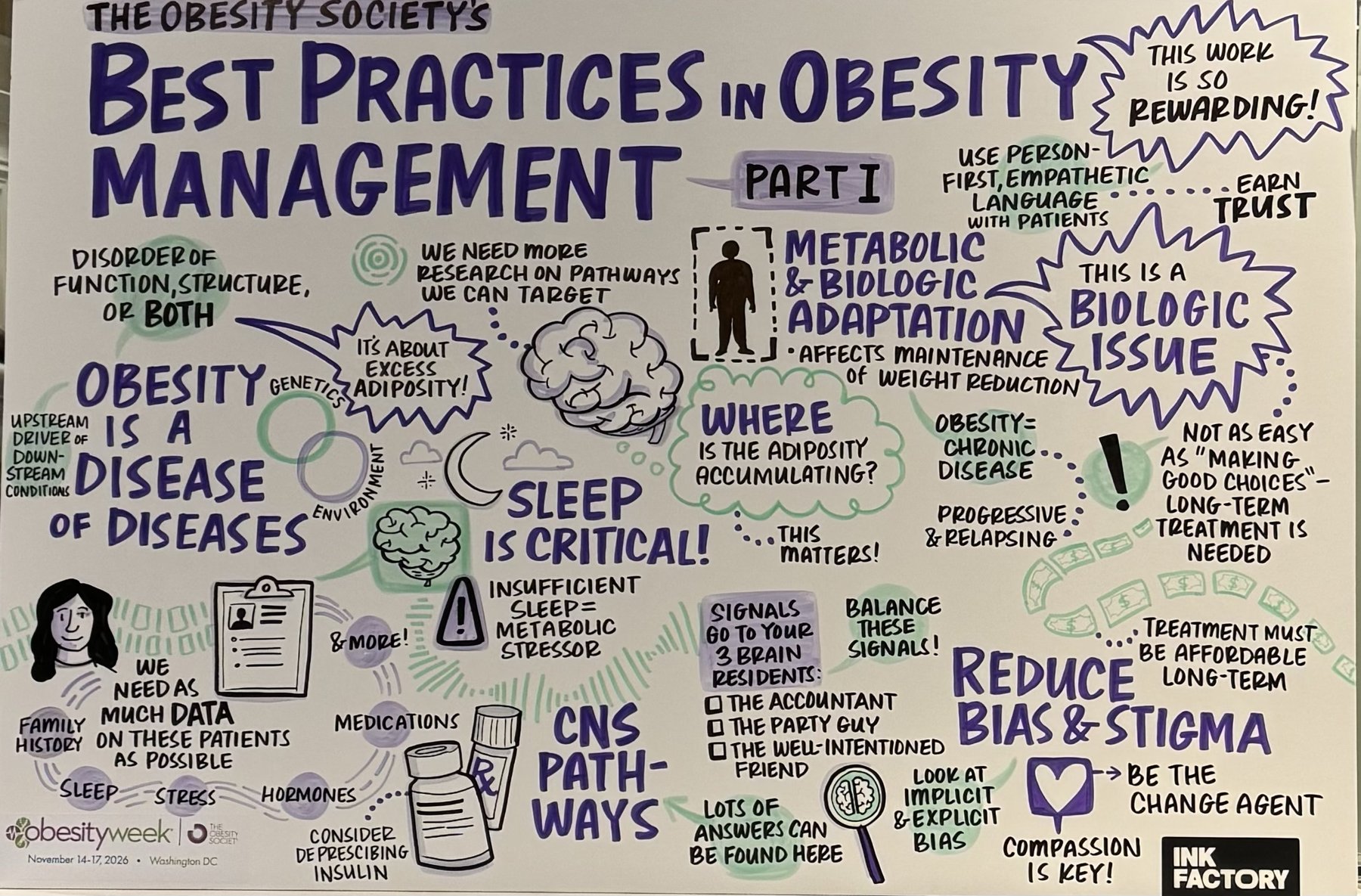
Illustration: Ink Factory for The Obesity Society, ObesityWeek, Washington DC. Photo: Dr. Asnat Raziel. Click the image to enlarge.
Bottom line: obesity as a disease of diseases
The talk reminded all of us that obesity is a disease of diseases. Behind it stand genetics, hormones, sleep, stress and environment. That is why treating it is also an effective way to prevent many other diseases. Over the coming days, I will keep reporting from the conference on what’s new in treatment.
This article is general information and does not replace personal medical advice.
Sources
The Global Conference Where Obesity Science Moves Evidence-Based Research Forward
Best Practices in Obesity Management Series
Long-Term Persistence of Hormonal Adaptations to Weight Loss
The workshop was supported by educational grants from Amgen, Lilly, Novo Nordisk and Zealand. According to the organizers, the sponsors had no influence on the content.