By Dr. Asnat Raziel, bariatric surgeon specializing in obesity treatment, metabolic health and healthy longevity; Director of the Multidisciplinary Center for Obesity Treatment, Assia Medical, Assuta Ramat HaChayal, Tel Aviv
Genetics of obesity: the message that opened the European Congress on Obesity
The genetics of obesity took center stage at the opening of the European Congress on Obesity, ECO 2026, in Istanbul. In this article, I focus on one question: how do genes, hormones and brain circuits decide how hungry we feel? I have written separately about why obesity is defined as a chronic disease. Here, the spotlight is on the genes behind that definition.
The opening ceremony marked 40 years of EASO, the European Association for the Study of Obesity. It combined history, science and an open call to reduce stigma. At its center stood Prof. Sadaf Farooqi of the University of Cambridge, who won the 2026 Obesity Prize for Excellence from EASO and the Novo Nordisk Foundation.
The message came up again and again: obesity is not a personal failure. Instead, it is a disease largely driven by genetic, hormonal and neural mechanisms. The words we use to talk about it matter too.
When science changes the conversation
In their opening remarks, EASO leaders stressed that the prize program has become an important engine of obesity research in Europe. According to them, this year’s competition was especially intense. The prize is worth 2 million Danish kroner, most of it for follow-up research.
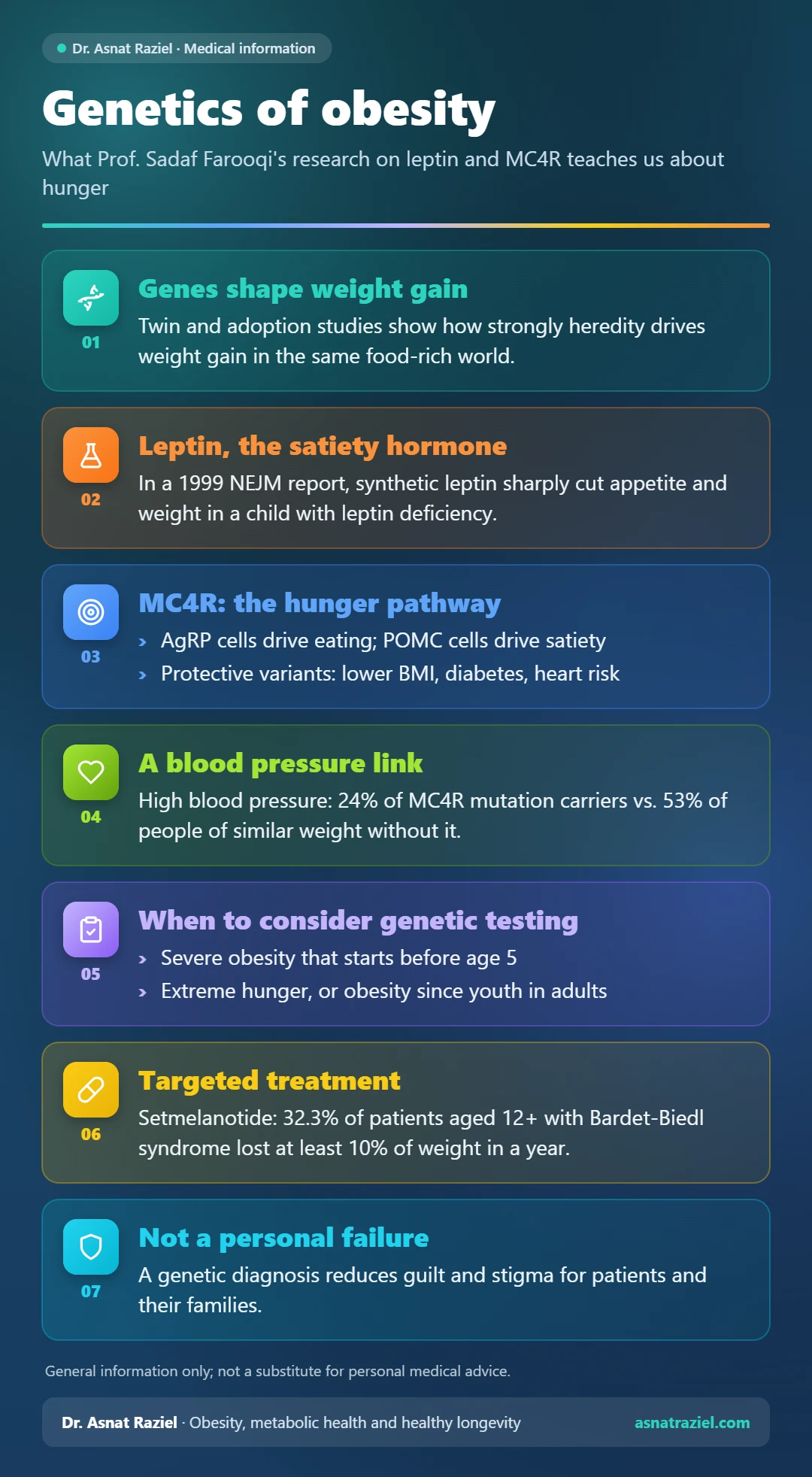
However, the highlight was Prof. Farooqi’s lecture. Her work has changed how we understand hunger and satiety. She explained that today’s food-rich environment affects all of us. Even so, the tendency to gain weight in that same environment varies widely from person to person because of genetics. For example, twin studies and studies of adopted children have shown the power of heredity again and again. This is where the genetics of obesity begins.
Leptin: the discovery that changed obesity medicine
One of the high points was a story that became a milestone in medicine. Farooqi described children with extreme obesity caused by a complete lack of leptin, the satiety hormone released by fat cells. A rare mutation in the leptin gene caused uncontrollable hunger and severe obesity from a very young age.
In a 1999 report in NEJM, a girl with congenital leptin deficiency was treated with synthetic leptin. Her appetite dropped dramatically, and her weight came down accordingly. So the message was clear: hunger is not just a matter of “willpower.” Hormones and deep brain circuits control it. Leptin also affects the immune system and sexual development. In addition, fMRI studies, a type of functional brain imaging, showed that the treatment changed how the brain’s reward centers responded to pictures of food.
Genetics of obesity: the brain pathway that controls hunger
Farooqi reviewed the leptin-melanocortin pathway, one of the central pathways in obesity medicine. At its core are neurons in the hypothalamus that regulate hunger and fullness. AgRP cells encourage eating, whereas POMC cells promote satiety. These signals act through the MC4R receptor, which has become an important target for drug treatment. I explain the mechanism in more detail in my article on the physiology of satiety.
On the one hand, mutations that damage the MC4R receptor are among the most common causes of genetic obesity in children. On the other hand, a study of half a million people in the UK Biobank identified “protective” variants of the same receptor. Carriers had a lower BMI and a lower risk of obesity, type 2 diabetes and coronary heart disease.
Why do people crave different foods?
A fascinating part of the lecture dealt with food preferences. In a study by her group, people with MC4R deficiency clearly preferred high-fat food. By contrast, they were less drawn to sweet food. In other words, obesity is not only about “how much we eat.” It is also about how the brain interprets reward, desire and the pleasure of food.
Farooqi explained that the same neural pathway also influences cravings, the intense urge to eat, during a diet. That is why the body actively fights weight loss over time.
Obesity, blood pressure and the sympathetic nervous system
The lecture also covered a surprising link between obesity and blood pressure. In a study published in NEJM, 24% of MC4R mutation carriers had high blood pressure, compared with 53% of people of similar weight without the mutation. Moreover, carriers had low activity of the sympathetic nervous system, the “fight or flight” system. These data show that the mechanisms of obesity involve many systems in the body, not just a simple energy balance.
Not just eating: genes that also shape behavior
Farooqi also described genetic syndromes linked to emotional and behavioral traits. A striking example is the TRPC5 gene. In a study published in Cell, men lacking this gene showed increased food seeking, obesity, anxiety and autism. Women with the same deficiency, by contrast, suffered from severe postpartum depression. As she put it, the hypothalamus is not just a “hunger center.” Rather, it regulates a wide range of instinctive behaviors. In other words, the genetics of obesity reach well beyond appetite.
Genetic testing and personalized care: the genetics of obesity in the clinic
One of the key messages was the shift from a one-size-fits-all approach to personalized care. The researchers recommended genetic testing for severe obesity that begins before age 5, especially with extreme hunger. This recommendation also appears in the Endocrine Society guidelines on obesity in children. In addition, they said testing is worth considering in adults with a history of obesity from a young age. A genetic diagnosis is not only a medical tool. It also reduces guilt and stigma toward families and parents. I wrote about early care in my article on treating obesity in children.
Beyond leptin, the lecture presented treatments that act directly on the MC4R receptor. Setmelanotide is already approved for Bardet-Biedl syndrome, a rare genetic syndrome that causes obesity from a young age. In a phase 3 trial, 32.3% of patients aged 12 and older with the syndrome lost at least 10% of their body weight after one year. More drugs are expected in the coming years.
Genetics of obesity: when to suspect a genetic cause
So when is it worth asking about genes? Based on the recommendations above, a few signs stand out:
- Severe obesity that starts before age 5.
- Extreme, persistent hunger, especially in early childhood.
- An adult with a history of obesity from a young age.
In these situations, it makes sense to raise genetic testing with your doctor. A diagnosis can point to a targeted treatment, such as setmelanotide for specific syndromes. Just as important, it can lift years of guilt from patients and their parents.
EASO at 40: a revolution in how we see obesity
The opening ceremony also marked a historic milestone. EASO was founded in 1986 in Jerusalem, during the Sixth International Congress on Obesity. Today it brings together professional associations from 40 European countries. Over the years, it has set up working groups, research networks and centers of excellence for obesity treatment. It has also built partnerships with diabetes, heart, liver and cancer organizations.
The emphasis on patients’ own voices stood out in particular. The European Coalition for People Living with Obesity works to reduce stigma and promote a respectful approach. You can read more about the harm stigma causes in my article on weight stigma and health.
The genetics of obesity show it is not a personal failure
Throughout the ceremony, one idea kept returning: it is time to stop seeing obesity as a problem of character or discipline. The science presented in Istanbul showed how genes, hormones, the brain, the immune system and the environment work together. Ultimately, understanding the genetics of obesity opens the way to personalized medicine and a far more humane approach. I covered the clinical studies presented at the same congress in my article on how new obesity drugs go beyond weight loss.
The information in this article is general and does not replace personal medical advice.
References
Effects of recombinant leptin therapy in a child with congenital leptin deficiency
Human Gain-of-Function MC4R Variants Show Signaling Bias and Protect against Obesity
Divergent effects of central melanocortin signalling on fat and sucrose preference in humans
Modulation of blood pressure by central melanocortinergic pathways
Loss of transient receptor potential channel 5 causes obesity and postpartum depression
The prize is awarded in partnership with the Novo Nordisk Foundation.




