By Dr. Asnat Raziel, bariatric surgeon specializing in obesity treatment, metabolic health and healthy longevity; Director of the Multidisciplinary Center for Obesity Treatment, Assia Medical, Assuta Ramat HaChayal, Tel Aviv
What the ECO congress presented on obesity medicine
The ECO congress, the European Congress on Obesity held in Istanbul in May 2026, dealt with much more than kilograms. Researchers asked how treatment affects breathing, muscles, metabolism and eating behavior. In other words, the goal is no longer just to “lose weight.” The goal is to understand how fat affects every system in the body, and to treat it in a precise, personal way.
The congress presented data on an experimental drug that improves lung function. In addition, researchers presented drugs that lead to more than 20% weight loss, and treatments that protect muscle. Finally, they examined why people respond differently to the same drug. In this article, I have gathered the highlights, updated as of October 2026.
When obesity affects the lungs, too
One session focused on monlunabant. This experimental drug blocks the CB1 receptor, a receptor in the endocannabinoid system, which influences appetite and metabolism. The company Inversago developed it, and Novo Nordisk later acquired the company. The study, presented by Dr. Glenn Crater, focused on reactive airway disorders in people with obesity.
For years, doctors almost always blamed shortness of breath in obesity on the weight itself or on poor fitness. However, the researchers used oscillometry, a test that measures airway resistance using pressure waves. The test requires almost no effort from the patient. So in the future, it may serve as a simple screening tool in obesity clinics.
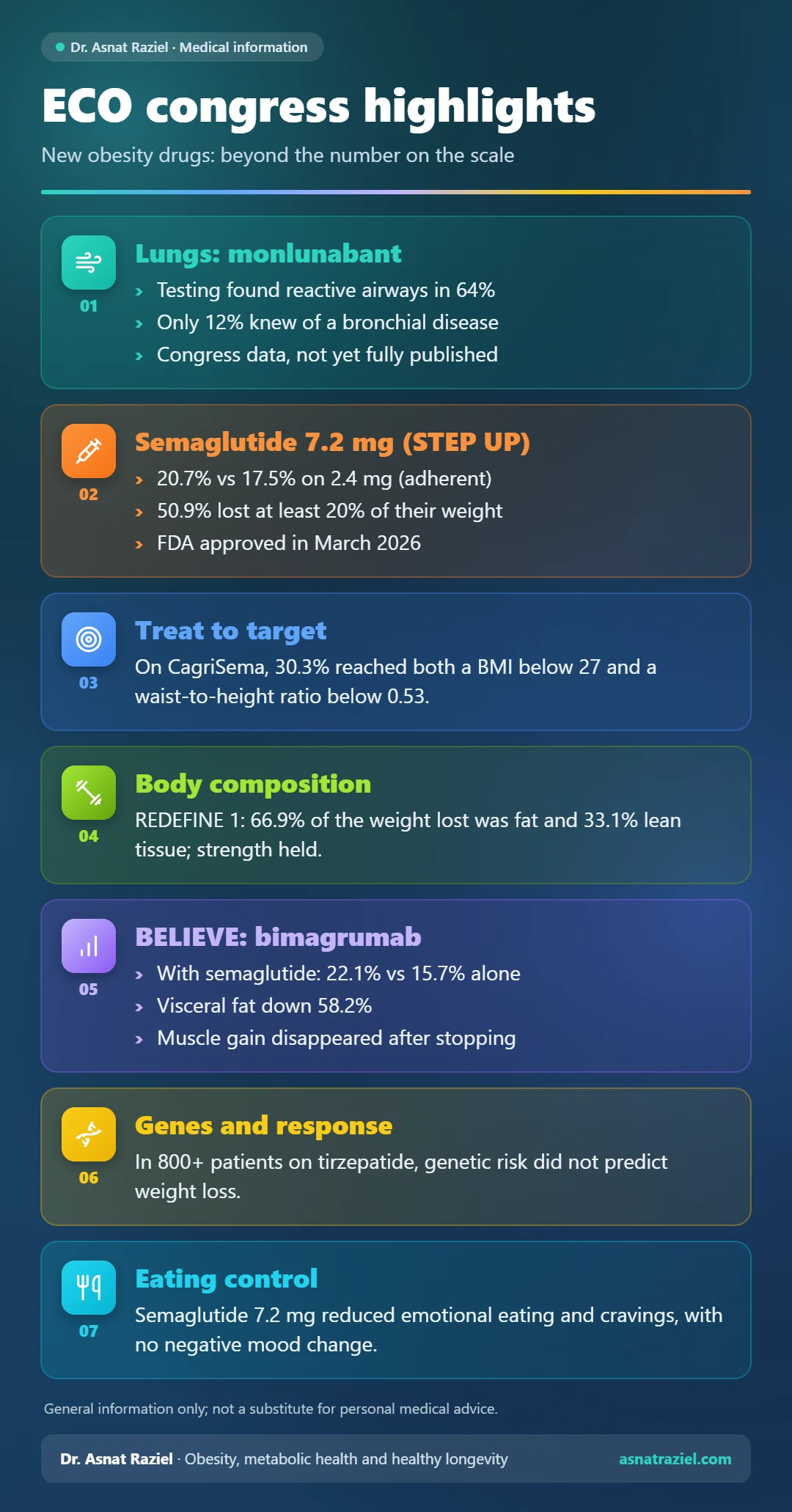
According to the data presented, only 12% of participants had previously reported a bronchial disease. By contrast, in 64% the test showed a reactive airway disorder. The treatment improved measures of the small airways, especially at doses of 20 and 50 mg. It is important to know that these are congress data and have not yet appeared in a full paper. In addition, in a phase 2a trial, the company also reported mild to moderate psychiatric side effects, such as anxiety, irritability and sleep disturbances. I also discuss the link between obesity and asthma in my article on GLP-1 drugs and asthma.
Semaglutide 7.2 mg at the ECO congress
The STEP UP trial drew a lot of interest at the ECO congress. The STEP UP trial enrolled 1,407 adults with obesity and without diabetes. Their average BMI was 39.9. Participants received semaglutide at 7.2 mg, at 2.4 mg or a placebo for 72 weeks.
Among those who stayed on treatment, average weight loss reached 20.7% on the high dose, compared with 17.5% on 2.4 mg. In the analysis of all participants, regardless of adherence, the figures were 18.7% and 15.6%. What’s more, 50.9% of patients on the high dose lost at least 20% of their weight, and 33.2% lost more than 25%. In the placebo group, not a single participant reached 25% weight loss.
A follow-up analysis presented at the congress showed that patients on the high dose reached their goals earlier and kept them until the end of the trial. Since the congress, regulatory approval has also moved forward. The FDA, the US Food and Drug Administration, approved Wegovy at 7.2 mg in March 2026. You can read more about the new dose in my article on high-dose Wegovy.
New treatment targets presented at the ECO congress
Prof. Luca Busetto presented a treat-to-target approach. That means we don’t settle for asking how many kilograms someone lost. Instead, we set clear health goals. He analyzed the REDEFINE 1 trial, which tested CagriSema. This is a combination of semaglutide with cagrilintide, an analog of the hormone amylin. In REDEFINE 1, average weight loss reached 20.4%, compared with 3.0% on placebo.
The researchers defined two targets: a BMI below 27 and a waist-to-height ratio below 0.53. According to the published analysis, 30.3% of patients on CagriSema reached both targets together. By comparison, 19.1% reached them on semaglutide, 9.0% on cagrilintide and 3.3% on placebo. In addition, those who reached the targets usually also showed good control of blood sugar, blood pressure, triglycerides and HDL.
The message for doctors is clear: waist circumference should be a regular part of follow-up, alongside weight and BMI. As of October 2026, CagriSema is still awaiting an FDA decision. You can read more about the research in my article on the REDEFINE trials of CagriSema.
Weight loss that preserves muscle
One of the main concerns with drug treatment is losing muscle mass along with fat. Prof. Eric Ravussin presented a REDEFINE 1 substudy that measured body composition with DEXA scans. Participants on CagriSema lost 23.9% of their weight, compared with 2.8% on placebo. Of the weight lost, 66.9% was fat and 33.1% was lean tissue.
More importantly, muscle strength did not suffer compared with placebo. What’s more, patients reported better everyday physical function. In an era when patients lose 20% or even 25% of their weight, the number on the scale is not enough. That is why we also need to check what the new body composition looks like. I cover this topic in depth in my article on preserving muscle on GLP-1 treatment.
The BELIEVE trial at the ECO congress: what happens after stopping
The BELIEVE trial tested bimagrumab, an antibody that blocks activin receptors and affects skeletal muscle. The study, published in Nature Medicine, enrolled 507 adults with obesity. By week 72, combining bimagrumab with semaglutide led to 22.1% weight loss, compared with 15.7% with semaglutide alone. In addition, the combination preserved muscle mass and reduced visceral fat by 58.2%.
The congress also presented what happened after treatment stopped. At week 96, patients on bimagrumab alone kept a weight loss of 9.0%, and patients on semaglutide alone kept 9.1%. In other words, the semaglutide group regained a much larger share of the weight they had lost. However, the muscle gain from bimagrumab disappeared after stopping. The common side effects of bimagrumab were muscle cramps, diarrhea and acne.
Do genes determine the response to treatment?
Researchers from the Mayo Clinic asked whether it is possible to predict in advance who will respond well to tirzepatide. According to the data presented, they examined more than 800 patients. They compared people with a high genetic risk of obesity and people with a low risk, using a polygenic risk score, which combines the effects of many genes.
The result was surprising: the researchers found no significant difference in weight loss between the groups. A high starting BMI also did not predict a weak response. So it is worth looking beyond the genetics of BMI and understanding the mechanisms of hunger, fullness and eating behavior. I explain the reasons for different responses in my article on why weight-loss injections don’t work for everyone.
Eating control as a treatment goal
Another analysis of STEP UP, presented at the EASD 2025 diabetes congress, looked at control of eating with semaglutide 7.2 mg. According to the data, the treatment reduced emotional eating, uncontrolled eating and food cravings over time. In addition, the researchers saw no negative change in mood. This finding matters, because concerns about the psychiatric effects of drugs of this type have come up in the past.
The main message of the ECO congress
The ECO congress showed how quickly obesity medicine is changing. Treatment no longer comes down to counting calories or kilograms. Today it involves lung function, muscle preservation, lower inflammation and appetite regulation. Ultimately, the simplest message is also the most important one: obesity is a biological, multisystem disease. It therefore requires a deep and precise approach, as I also describe in my article on the ceremony that opened the congress.
The information in this article is general and does not replace personal medical advice.
References
FDA Approves Higher-Dose Semaglutide (Wegovy HD) Injection 7.2 mg for Obesity
Coadministered Cagrilintide and Semaglutide in Adults with Overweight or Obesity
ECO 2026: REDEFINE-1 demonstrates CagriSema’s improvement in body composition
Monlunabant phase 2a trial in obesity successfully completed
Control of eating with semaglutide 7.2 mg in adults with obesity: The STEP UP trial
The data on monlunabant and on the genetics of the response to tirzepatide were presented at the congress and have not yet appeared in a full paper. Most of the studies were funded by the drug manufacturers.




