By Dr. Asnat Raziel, bariatric surgeon specializing in obesity treatment, metabolic health and healthy longevity; Director of the Multidisciplinary Center for Obesity Treatment, Assia Medical, Assuta Ramat HaChayal, Tel Aviv
The CRB-913 pill: a different approach to obesity treatment
The CRB-913 pill is an experimental obesity pill that works through the body’s endocannabinoid system rather than through the GLP-1 hormone. In the CANYON-1 trial, it led to weight loss of up to 5.0% in just 12 weeks. The company, Corbus, will present the full data at ObesityWeek, the American obesity congress in Washington, on November 15. One thing to know right away: no health authority has approved this drug yet, and it is still at an early stage of development.
Why look for a new pill at all?
GLP-1 medications have changed obesity treatment. However, many people struggle to stay on them. According to the study investigator, Dr. Harold Bays, more than 60% of people stop GLP-1 treatment within the first year. Nausea, vomiting and constipation are part of the reason. That is why many companies are looking for new mechanisms that could be used alone or in combination.
In addition, many people prefer a pill to an injection. Today we already have the Wegovy pill and Foundayo, and aleniglipron is on the way. All of them act on the same GLP-1 receptor. CRB-913, by contrast, tries a completely different route.
How does the CRB-913 pill work?
The brain and many organs carry a receptor called CB1. The body’s own cannabinoids activate it, and among other things it drives appetite and fat storage. CRB-913 is an inverse agonist, meaning a compound that switches off the receptor’s activity rather than simply blocking it.
This field has a complicated history. The first drug of this type, rimonabant, was approved in Europe in 2006. However, it was withdrawn in 2008 because of depression, anxiety and suicidal thoughts, since it also acted inside the brain. So the company designed CRB-913 to work mainly outside the brain. In other words, the goal is to get the effect on weight without harming mood. I have written in detail about the link between the brain, hormones and hunger.
What did the CANYON-1 trial test?
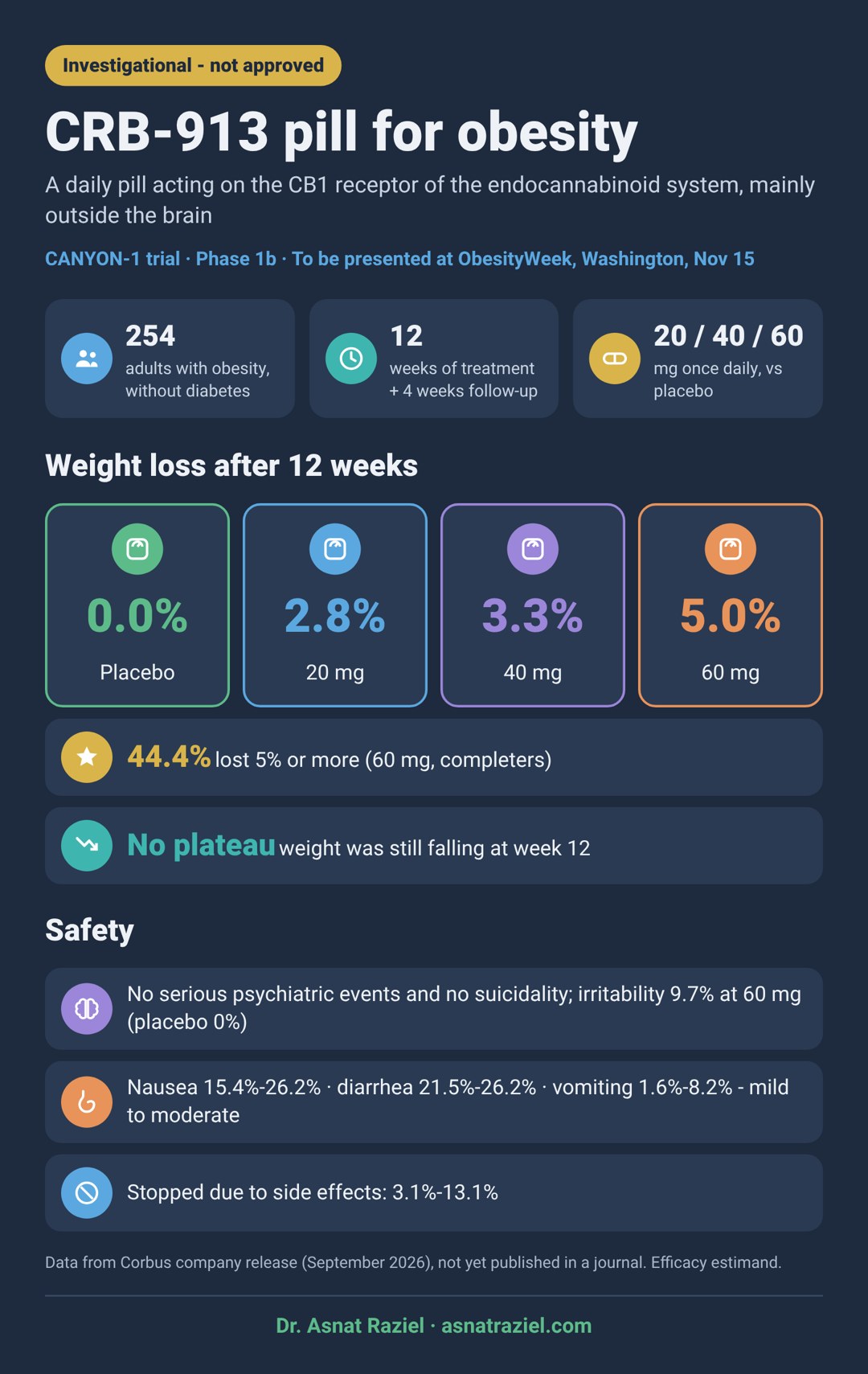
The study, a registered phase 1b trial, enrolled 254 adults with obesity and without diabetes at 15 sites in the United States. Participants were randomly assigned to placebo or a daily pill of 20, 40 or 60 mg. Everyone started at 20 mg, and the dose rose every two weeks to the target dose. Treatment lasted 12 weeks, followed by 4 more weeks of follow-up.
The results: how much weight did people lose with the CRB-913 pill?
According to the topline results released by the company, after 12 weeks:
The placebo group had no weight loss (0.0%).
At 20 mg: 2.8% weight loss.
With 40 mg: 3.3% weight loss.
And at 60 mg: 5.0% weight loss.
The difference from placebo was significant at every dose. At the highest dose, 44.4% of completers lost at least 5% of their weight, and 6.7% lost more than 7.5%. The largest loss in a single participant reached 13.4%. Moreover, according to the company, weight loss had not yet leveled off at week 12, so it may continue with longer treatment.
Safety: what about mood and the stomach?
This is the most important question in this field. In the CRB-913 pill trial, there were no serious psychiatric side effects and no suicidal thoughts. Of 188 participants who received the drug, one reported a moderate, transient depressive symptom. Still, irritability appeared in 9.7% at the 60 mg dose, compared with 0% on placebo. Anxiety appeared in 4.8% at the highest dose, compared with 4.5% on placebo.
In the digestive system, nausea occurred in 15.4% to 26.2% of patients, and diarrhea in 21.5% to 26.2%. Vomiting was relatively uncommon, at 1.6% to 8.2%. All digestive side effects were mild to moderate. Overall, 3.1% to 13.1% stopped treatment because of side effects.
How does it compare with other drugs?
The company compared the CRB-913 pill data with studies of other drugs. For example, in a study of monlunabant, another drug acting on the same receptor, 13% to 42% stopped treatment because of side effects such as anxiety, irritability and sleep problems. Still, it is important to remember that these are comparisons across different studies, not a head-to-head trial. In addition, the GLP-1 drug studies lasted 36 to 72 weeks, while CANYON-1 lasted only 12 weeks.
What does the CRB-913 pill mean for you?
First, this is an investigational drug, and it is not available in Israel or anywhere else. A 5% loss in three months is modest compared with today’s approved drugs, but the study was short. That is why the interesting finding is that weight loss was still continuing at the end of the study. Second, the interesting direction is combination: the company is evaluating CRB-913 together with GLP-1 drugs. It also plans to meet with the FDA and to start a phase 2 study in the first half of 2027.
Meanwhile, anyone living with obesity can already receive effective, approved treatments today. Ahead of the congress, I also wrote about what Lilly will present and about the latest news from the lab.
The bottom line
The CRB-913 pill tries to bring an old mechanism back to life, without the side effects that brought down its predecessor. The first results are encouraging, but they are early, short and come from a company announcement. The full data will be presented at ObesityWeek, and only large, longer studies will show whether this becomes a real addition to the toolbox.
The information in this article is general and does not replace personal medical advice. Before any change in treatment, talk to your doctor.
References
The CRB-913 data are based on announcements by the developer, Corbus Pharmaceuticals, and have not yet been published in a scientific journal.




