By Dr. Asnat Raziel, bariatric surgeon specializing in obesity treatment, metabolic health and healthy longevity; Director of the Multidisciplinary Center for Obesity Treatment, Assia Medical, Assuta Ramat HaChayal, Tel Aviv
A personal nutrition plan: my third report from ObesityWeek
A personal nutrition plan works better than any one “right” diet. That was the message from Dr. Michelle Look at The Obesity Society workshop at ObesityWeek in Washington, DC. Dr. Look is a family physician and obesity medicine specialist, and a medical director of clinical research at the Knownwell clinic network. Her talk was very practical: what to do in a short visit, and how to build a plan with the patient that they can stick with.
Before nutrition: measuring beyond BMI
Dr. Look opened with a patient named Kathleen, 48, with a BMI of 34.7 and type 2 diabetes. In her words, BMI is a good screening tool, but it does not tell fat from muscle. It also does not show where fat sits, and it varies by ethnicity, sex and stage of life.
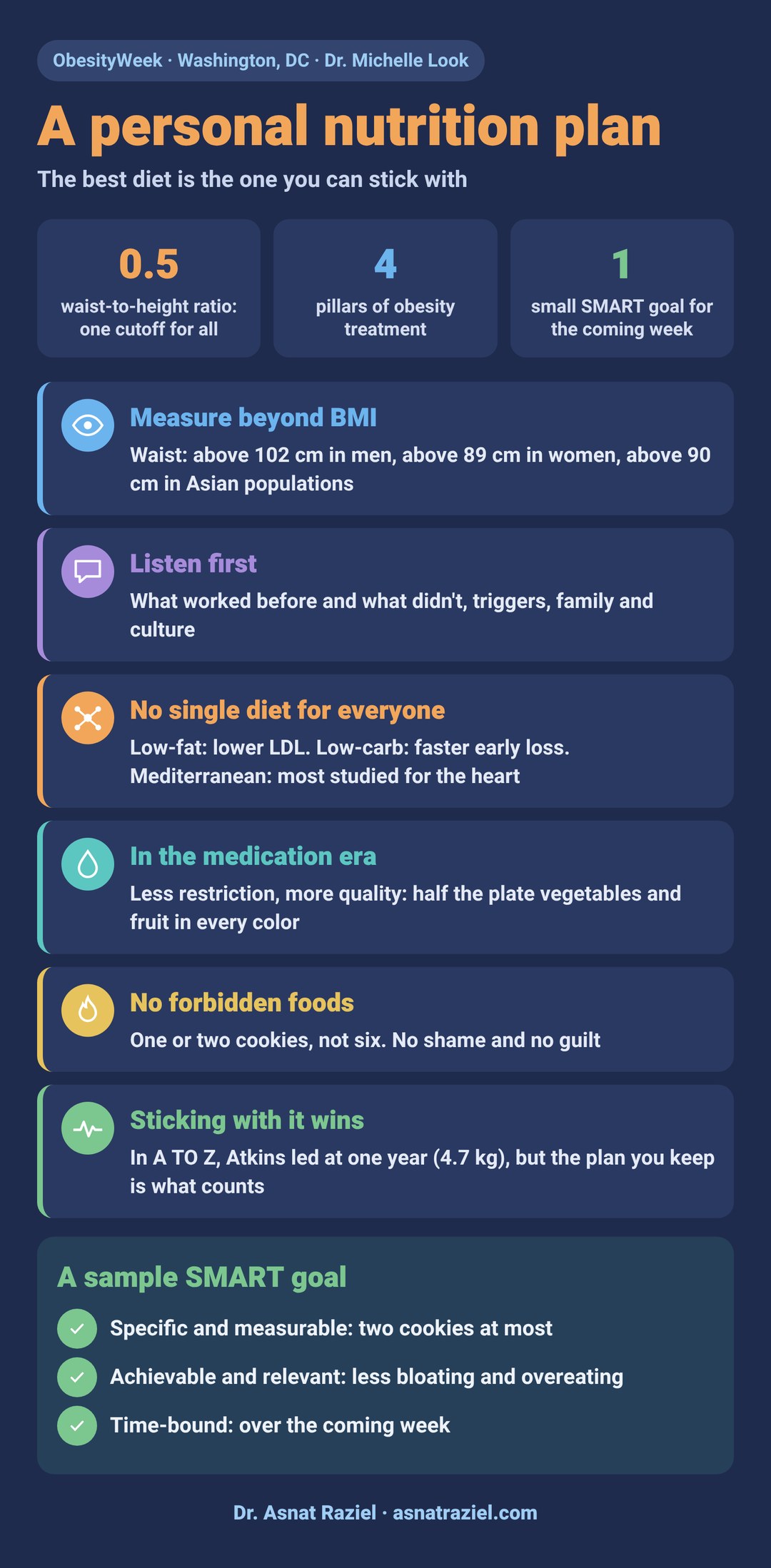
So it is worth measuring waist circumference too, which tracks well with visceral fat. Dr. Look gave the cutoffs: above 102 cm in men, above 89 cm in women, and above 90 cm in Asian populations. Her favorite tool is the waist-to-height ratio. The one number to remember is 0.5, regardless of ethnicity, age or sex.
She also has a few tips for respectful measuring. She recommends a long, quiet tape measure, without embarrassing “clicks.” The tape goes at the level of the navel, and the patient turns around so no “hug” is needed. Ask for a slight exhale, without sucking in. Keep in mind that a long trip, a meal, bloating or a period can change the result.
The four pillars of obesity treatment
Dr. Look reviewed the four pillars of obesity medicine: nutrition, physical activity, behavior change and medical treatment, meaning medications and bariatric surgery. However, she stressed three areas that often get missed: mental health, stress and sleep.
In her view, there is no point assuming patients don’t know their weight affects their health. Most of them have already lost weight in the past, then regained it. So it matters to hear the personal story: what they tried, what worked, and what happened afterward.
How to build a personal nutrition plan
First, listen. Dr. Look asks what has worked before and what hasn’t. For example, one patient tried one meal a day but couldn’t cook for her family. Another tried keto or a low-carb diet. There are also triggers and culture: in many families, turning down grandma’s food is an insult.
In her words, the classic instruction to “cut 500 calories a day” appears in almost every drug trial. But it tells the patient very little, and it can even be biased. Instead, there are several options: cut calories, change the balance of macronutrients, replace a meal with a meal replacement, or shorten the eating window, as in intermittent fasting.
Low-fat, low-carb or Mediterranean?
Each approach has pros and cons. A low-fat diet may lower LDL, the “bad” cholesterol. In contrast, a low-carb diet brings especially fast weight loss at first, but in some people it raises LDL. The Mediterranean diet is the most studied, and it has the most proven benefits for the heart and metabolism.
Dr. Look mentioned the A TO Z trial, which compared diets from Atkins to Zone in 311 women. After one year, the Atkins group, the lowest in carbohydrates, lost 4.7 kg on average. In the other groups, weight loss ranged from 1.6 to 2.6 kg. Still, Dr. Look’s conclusion is that the best diet is the one the patient can stick with. Keto, for example, brings big early losses, but it is hard to keep up over time.
A personal nutrition plan in the new medication era
Today, with highly effective medications, the conversation is changing. Dr. Look talks less about restriction and more about food quality and adequate nutrition. I have also written about nutritional deficiencies on weight-loss medications.
In a short visit, you can teach patients to read a food label and to look at serving size, not just the calories for the whole package. There are also apps today that estimate carbs, fat and protein from a photo of the plate. People who don’t want to share data with AI can write it down on paper. The goal is to understand where calories and nutrition come from.
Dr. Look recommends filling half the plate with vegetables and fruit in every color of the rainbow. As she put it, we have pushed “protein, protein, protein,” but vegetables and fruit matter a great deal too. Read more in my nutrition guide for weight-loss injections.
No forbidden foods
“I will never tell you there is a food you absolutely can’t eat,” Dr. Look tells her patients. Want a cookie? You can, in moderation. The question is whether you eat one or two, or six. An even more important question is whether thoughts about food run your day.
She noted that some patients on a weekly injection feel their sweet cravings return toward the end of the week. In her view, that does not mean something went wrong. You can add vegetables, fruit or protein first, and choose a less processed option. Likewise, favor whole, less processed food, but without bringing shame and guilt back into the conversation.
Two examples of a personal nutrition plan
Kathleen: 48, with type 2 diabetes and epilepsy. She skips breakfast or has yogurt, and she prefers savory foods to sweets. So Dr. Look suggested considering a low-carb diet for her. She added that some data suggest a very low-carb or ketogenic diet may reduce seizures.
Todd: 42, who gained weight after an injury cut back his activity. His BMI is 28, his triglycerides are 215 and his LDL is 165, despite a statin. He also had pancreatitis from gallstones in the past, mild depression and back pain. He stopped eating meat because of his cholesterol, but he eats a lot of seafood, and he eats late at night. For him, a Mediterranean diet may be an especially good fit.
In other words, there is no single plan for everyone. You choose based on what the person likes, on their health conditions and on what they can keep doing over time.
A SMART goal: how to set a target you can meet
At the end of the talk, participants got a three-day food diary from Kathleen and were asked to set one goal for her. Dr. Thomas George reminded us of the SMART method: specific, measurable, achievable, relevant and time-bound.
His example was simple. “Avoid cookies” is too broad. In contrast, “this coming week I’ll eat no more than two cookies” is specific and measurable. It is also achievable, relevant to bloating and overeating, and time-bound. I wrote about building habits in 12 steps for habit change on obesity medication.
What you can do today
Measure: divide your waist by your height. A result above 0.5 is a reason for a closer look.
Reflect: write down what has worked for you before and what hasn’t, and bring the list to your next appointment.
Choose: an eating approach that fits your taste, your health and your routine.
Divide the plate: half vegetables and fruit, a quarter protein and a quarter carbohydrates.
Set one goal: small, measurable and for the coming week.
A personal nutrition plan in one picture: the visual summary of the workshop
The Ink Factory team also drew a live illustration for Part II of the workshop. It sums up the key messages: BMI is just the start, and waist circumference is worth measuring too. It shows the four pillars of obesity care and the advice to focus on balance rather than counting calories or banning “bad foods”. It also highlights personal goals for each patient and adding movement to existing habits.
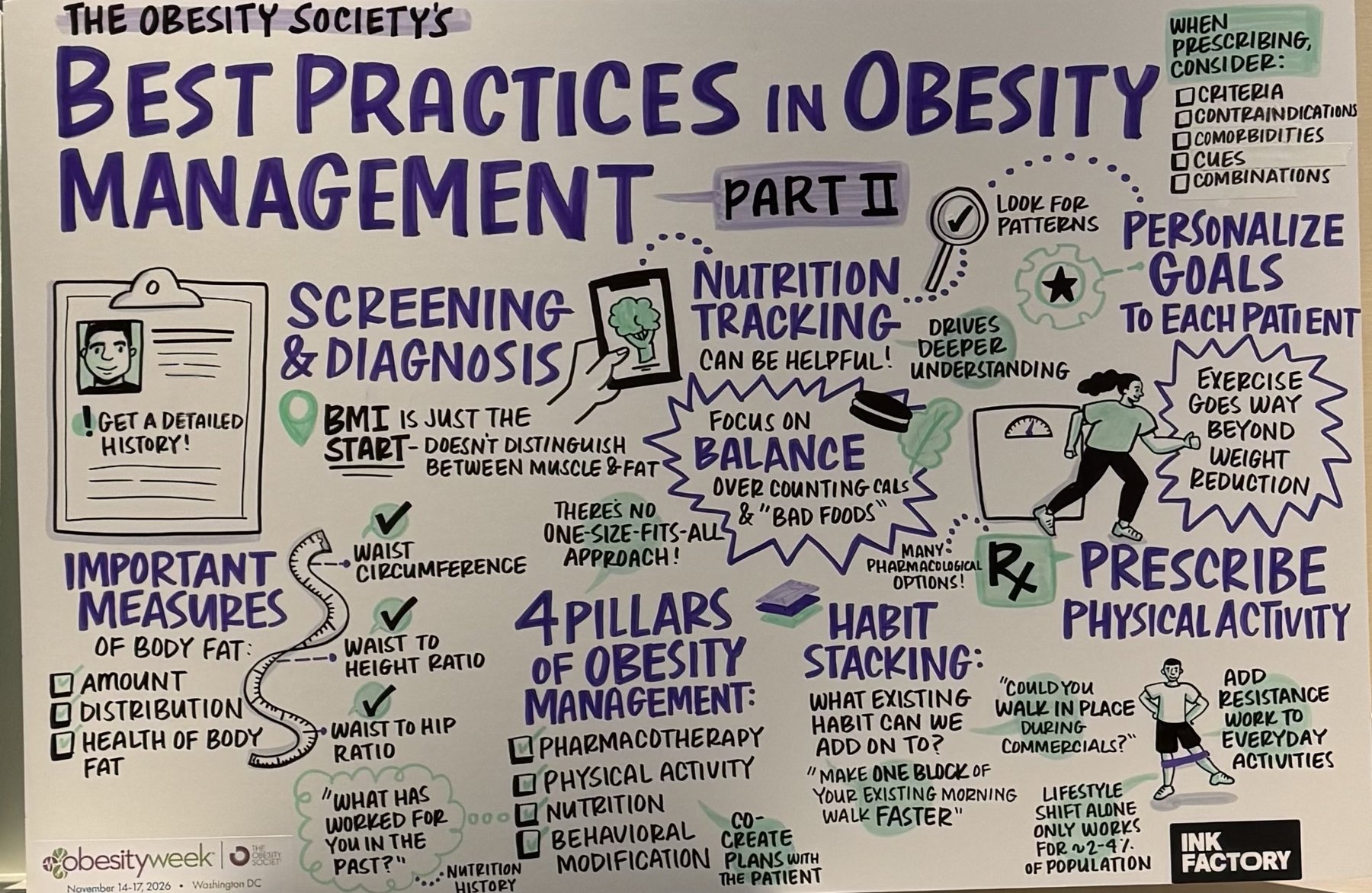
Illustration: Ink Factory for The Obesity Society, ObesityWeek, Washington DC. Photo: Dr. Asnat Raziel. Click the image to enlarge.
Bottom line: a personal nutrition plan that lasts
No single diet fits everyone. A personal nutrition plan grows out of listening: to each person’s story, taste, culture and health conditions. In the new medication era, the focus is shifting from restriction to quality. And the best goal is the one you can meet this week.
This article is general information and does not replace personal medical advice.
Sources
Best Practices in Obesity Management Series
The Global Conference Where Obesity Science Moves Evidence-Based Research Forward
The workshop was supported by educational grants from Amgen, Lilly, Novo Nordisk and Zealand. According to the organizers, the sponsors had no influence on the content.