By Dr. Asnat Raziel, bariatric surgeon specializing in obesity treatment, metabolic health and healthy longevity; Director of the Multidisciplinary Center for Obesity Treatment, Assia Medical, Assuta Ramat HaChayal, Tel Aviv
A healthy food environment matters as much as the advice itself
A healthy food environment is the quiet secret behind many successful habit changes. We advise patients to eat whole, plant-rich food. Yet in the hospital cafeteria, pastries, sweets and processed meals are waiting for them. At the LM2026 Lifestyle Medicine conference, two experts from Kaiser Permanente presented a practical way to change that. Their message was simple: make the healthy choice the easy choice.
The talk was given by Dr. Allison Collins, Medical Director of Lifestyle and Culinary Medicine at Kaiser Permanente Santa Clara, and Amanda Assaf, a dietitian and Senior Director of the organization’s National Nutrition Services. They opened with a sharp question: if food is medicine, what does the food environment we work in “prescribe”?
Why willpower alone is not enough
In the traditional model, the clinician educates, the patient understands, and behavior changes. However, most of us know what is healthy and still choose otherwise. So the speakers proposed a complementary systems model. In it, the environment sets the default, the default shapes the choice, and the choice becomes behavior.
In their view, we need both models. They also stressed an important distinction: a default is not a mandate. A default answers the question “what happens if I do nothing?” A choice answers “what happens if I want something different?” In other words, nobody takes away the diner’s freedom to choose.
Defaults: the strongest tool for a healthy food environment
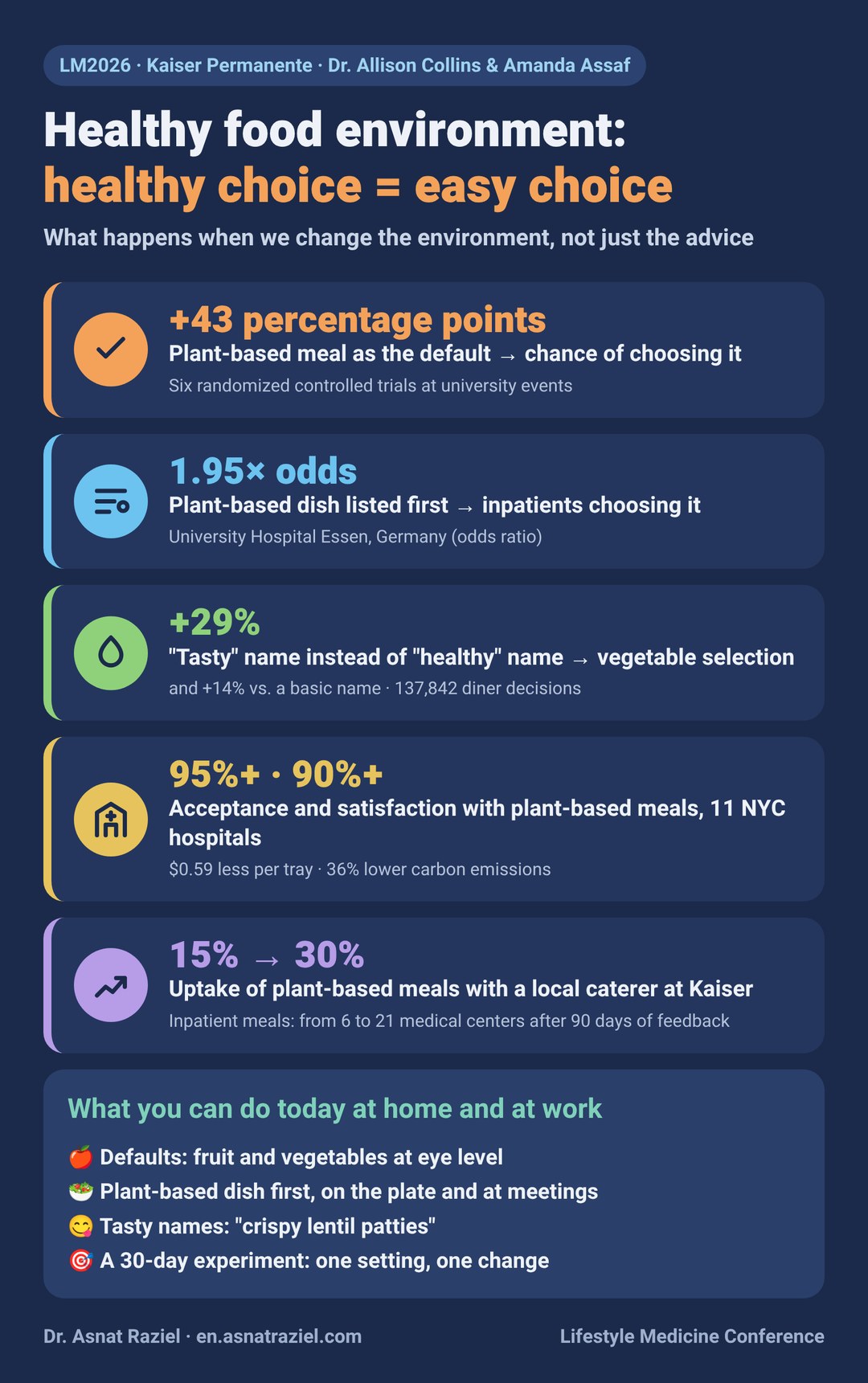
First, the data are striking. A series of six randomized controlled trials tested events at four US academic institutions. When the plant-based meal was the default on the RSVP form, the probability of choosing it rose by 43 percentage points. The effect held across events and institutions.
In addition, menu order matters too. At University Hospital Essen in Germany, a study of hospital inpatients moved the plant-based dish to the top of the menu. As a result, patients were nearly twice as likely to choose it (odds ratio 1.95).
The largest example comes from New York. The city’s public hospital system made plant-based meals the primary lunch and dinner option at 11 hospitals. According to the report in the American Journal of Lifestyle Medicine, patient acceptance exceeded 95% and satisfaction exceeded 90%. Moreover, each tray with a plant-based entree cost $0.59 less. Calculated carbon emissions also fell by 36%.
Sell “delicious,” not “healthy”
However, here is an interesting paradox. When a dish is labeled “healthy,” people expect it to taste worse. So they choose it less often. A large multisite study in five university dining halls tracked 137,842 diner decisions. Taste-focused names increased vegetable selection by 29% compared with health-focused names, and by 14% compared with basic names.
In other words, a “Healthy Lentil and Vegetable Bowl” sells worse than “Smoky Moroccan Lentils with Fire-Roasted Carrots and Tangy Lemon-Tahini Sauce.” The speakers recommended words like crispy, smoky, roasted, creamy, spicy and caramelized. They also suggested dropping labels like “vegetarian option” or “healthy choice.” Instead, simply give the dish an appetizing name, such as “Crispy Cauliflower Shawarma” or “Smoky Three-Bean Chili.”
Finally, before changing a whole menu, taste first. Taste, gather feedback, adjust the recipe and retest. This cycle prevents costly failures later.
A healthy food environment: where the system chooses for us
To begin with, the speakers’ first recommendation: don’t start by asking people to choose differently. First ask where the system is already making the choice for them. The leverage points are procurement, vendor contracts, menus, defaults, placement, marketing and communication. They operate in patient meals, the cafeteria, catering, celebrations, vending, staff areas, clinician lounges and visitor food.
Kaiser Permanente first updated its national nutrition standards. These standards cover food for meetings and events, the cafeteria, vending machines and inpatient meals. Even more important, they were built into contracts, sourcing and daily operations.
Four settings where a healthy food environment was built
Cafeteria
The cafeteria added a menu of plant-based dishes based on recipes from the Lifestyle Medicine department’s cooking classes. The dishes are offered at breakfast, lunch and dinner, and as grab-and-go snacks. In addition, they were priced lower than the non-plant-based items. Tastings, cooking demos, recipe handouts and marketing to staff and patients supported the change.
Meeting catering
According to the speakers, a typical catered lunch contains over 1,500 calories. So they showed simple swaps for drinks, snacks and meals. Working with a small local caterer, uptake of plant-based meals rose from 15% to 30%. Satisfaction and variety improved too.
Clinician lounge
The staff lounge gained new options, including an oatmeal and soup bar that provides a real meal. Still, there were complaints, special requests and trouble keeping products stocked.
Inpatient meals
In contrast, here the process was gradual. First, the team wrote a lifestyle medicine cookbook. Next came taste tests and production testing, and plant-forward recipes were added at six medical centers. After a 90-day study of patient feedback, the program expanded to 21 medical centers. Partners included the nonprofit Greener by Default and the food service company Sodexo. Interestingly, strong interest came from mother-baby and pediatric units.
How to bring every stakeholder on board
Of course, every role wants something different. The CFO looks at cost, the chef at quality and the nurse at workflow. Patients want taste and choice, employees want convenience, and vendors want volume. So the speakers’ advice is to connect your goal to their goal.
Moreover, research supports this approach. A qualitative study interviewed 35 hospital menu experts, and 25 of them supported increasing the share of plant protein. All of them also voiced concerns: patients not eating, lower protein intake, malnutrition and cost. Their preferred strategies were swapping ingredients in familiar recipes, adding plant-based dishes and moving these dishes to a prominent spot on the menu.
In practice, the speakers built a broad food transformation team. It includes an executive sponsor, food service, a chef, a dietitian, clinicians, nursing, a patient representative, procurement, vendors, sustainability, employee wellness, marketing and finance. The key question for each of them: what would make this initiative succeed for you?
From pilot to a healthy food environment across the organization
The speakers recommended piloting the whole system, not just the recipe. Can we procure the dish? Prepare it at scale? Market and serve it? Will people choose it? And can we measure the result?
Their roadmap has four stages:
- Discover (0 to 4 weeks): map, listen and set a baseline.
- Design (4 to 8 weeks): recipes, tastings and standards.
- Pilot (2 to 4 months): one setting, with measurement.
- Scale (4 to 12+ months): policy, contracts and culture.
For measurement, they suggested a five-part dashboard: health, experience, operations, planet and culture. Of course, the challenges did not disappear. Across settings, the teams reported inconsistent quality, staff turnover, training needs and vendor difficulties.
A healthy food environment at home and at work: what you can do today
Still, this idea is not only for hospitals. I see it in my clinic every day: patients succeed far more often when their environment works for them. That is true even for people taking medications such as oral Wegovy or Foundayo. The medication lowers appetite, but the fridge still decides what gets eaten.
- Defaults at home: a fruit bowl on the counter, cut vegetables at eye level in the fridge, and processed snacks out of sight.
- Your plate: start with vegetables and add plant protein such as lentils, chickpeas and tofu.
- Tasty names: at home, especially with kids, call it “crispy lentil patties,” not “a healthy meal.”
- At work: order meeting catering where the plant-based dish comes first and looks appealing.
- A 30-day experiment: pick one setting, one partner and one change, then see what happens.
This is also how to build an eating pattern that supports slower aging and chronic disease prevention. In the end, a healthy food environment spares us a daily battle of willpower.
The bottom line
Health systems that recommend healthy eating need to serve it themselves. The Kaiser Permanente talk shows it can be done without bans or preaching. Smart defaults, tasty names, the right placement and engaging every stakeholder create a healthy food environment that people choose willingly. The same principles work in our own kitchens at home.
This article provides general information and is not personal medical advice.
References
An Innovative Program for Hospital Nutrition
Practicing What We Preach: Making the Healthy Choice the Easy Choice on Healthcare Campuses (LM2026, Allison Collins, MD and Amanda Assaf, MPH, MS, RD)