By Dr. Asnat Raziel, bariatric surgeon specializing in obesity treatment, metabolic health and healthy longevity; Director of the Multidisciplinary Center for Obesity Treatment, Assia Medical, Assuta Ramat HaChayal, Tel Aviv
Lifestyle medicine at LM2026: the opening message
Lifestyle medicine is no longer a movement of a few pioneers. That was the message that opened LM2026, the annual Lifestyle Medicine Conference of the American College of Lifestyle Medicine (ACLM). The conference runs November 8-11 in Orlando, Florida, and I am attending it. The opening keynote was titled “Lifestyle Medicine: From Movement to Standard of Care.” Its central question was simple: how do we turn long-standing evidence into routine care in every clinic?
Most of the examples came from the US health system. Still, I believe they can inspire health system leaders in Israel and elsewhere. That is why I have also covered the programs, the new billing codes and the economic model presented on the slides.
Who took the stage
This is ACLM’s annual “State of the Field” keynote, given by the college’s president. This year it was delivered by Dr. Padmaja Patel, an internist, ACLM president and certified lifestyle medicine intensivist. She previously directed the Lifestyle Medicine Center at Midland Health in Texas, where she led the Ornish and Pritikin cardiac rehabilitation programs. She noted that her term ends this week, but her commitment continues.
The session was opened by Dr. John Findley, who became ACLM’s chief executive officer in June 2026. Findley is a physician executive and has been an ACLM member since 2007. Early in his career, he directed a medically supervised weight loss clinic and coached patients in a drug and alcohol rehabilitation program. Later, he founded models for chronic disease reversal and for school-based prevention.
A health system at its point of failure
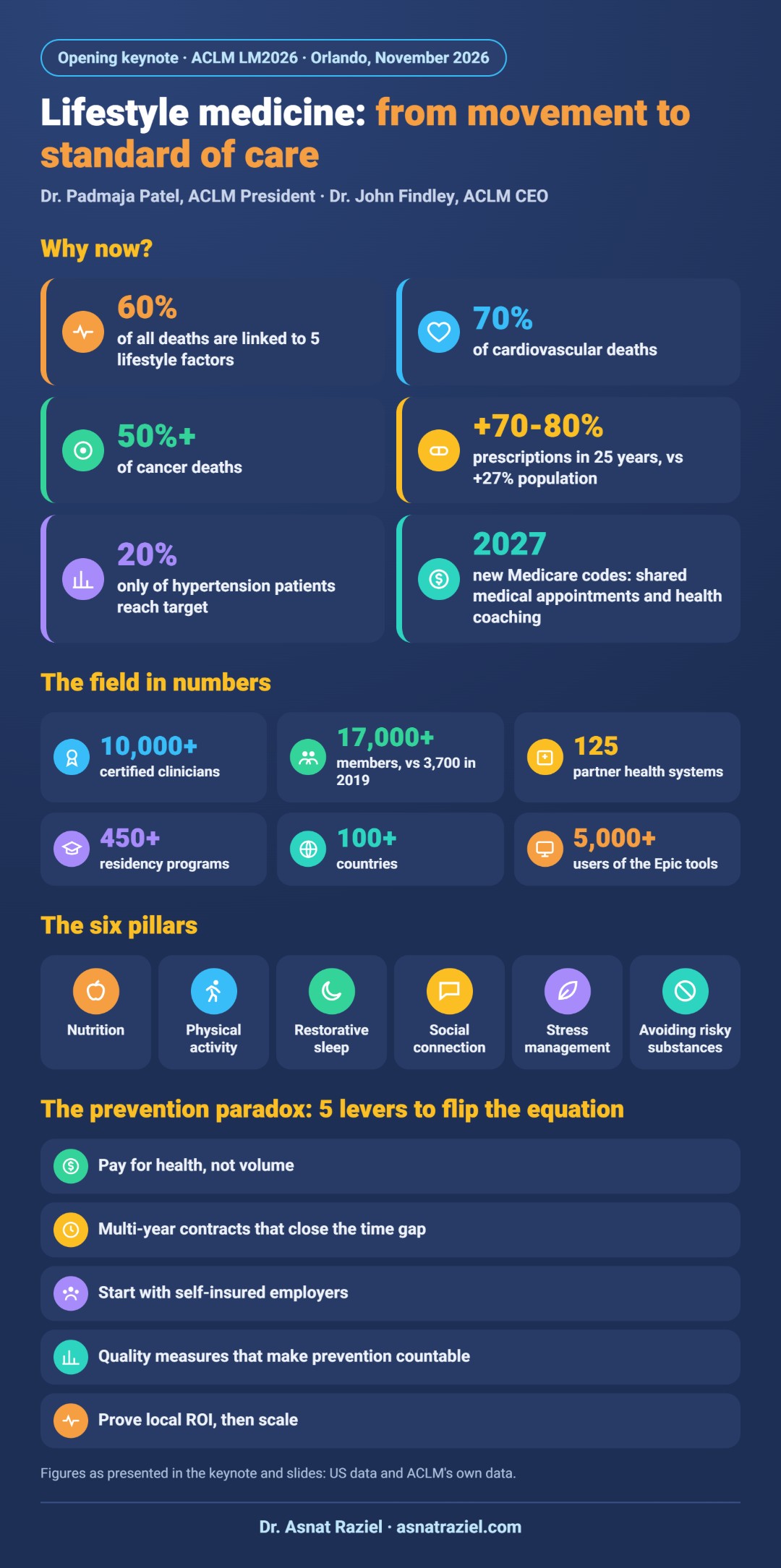
Findley, whose father is an architect, compared the health system to a bridge that collapsed because of a design flaw. In his view, chronic disease is the system’s point of failure. He presented a striking figure: five lifestyle factors account for 60% of all deaths, 70% of cardiovascular deaths and more than 50% of cancer deaths.
He also described the end of a “golden era of pills.” Over roughly 25 years, the US population grew by about 27%, but prescription use grew by 70% to 80%. Take high blood pressure: about 60% of patients know they have it. About 50% take medication, yet only 20% reach their target. Moreover, the Mirror, Mirror reports rank the United States first in health spending and last in outcomes.
Patel added an important angle: innovation is everywhere, but impact is not. New tools rarely change routine care, because payment still rewards encounters and procedures rather than outcomes. In her view, the missing link is whole-person care that aligns innovation, payment and care delivery.
Lifestyle medicine by the numbers
Next came the infrastructure ACLM has built over two decades. More than 100,000 clinicians have seen its educational content. In addition, more than 10,000 clinicians are certified in the field. Membership grew from 3,700 in 2019 to more than 17,000 today, with 90% retention. According to the slides, it is one of the fastest-growing medical specialties, while many other societies are shrinking.
What’s more, 125 health systems now work with ACLM. More than 450 residency programs use its curriculum, and the field is represented in more than 100 countries. ACLM has also been admitted to the American Medical Association House of Delegates. Finally, its evidence library holds about 1,500 papers, mostly systematic reviews and meta-analyses.
What lifestyle medicine care looks like
Dr. Patel reviewed the six pillars: nutrition, physical activity, restorative sleep, social connection, stress management and avoiding risky substances. She urged the field not to lead with its favorite pillar alone, because the strength is in the whole approach. She also noted that guidelines for heart disease, type 2 diabetes, high blood pressure, dementia and cancer already recommend lifestyle change as first-line treatment.
Usual care, she said, is a loop: diagnose, prescribe, monitor, refill, repeat. In contrast, the new model makes the patient an active partner. The goal is not just disease management, but treatment, remission and prevention. The model has seven components:
- Lifestyle vital signs and a structured lifestyle assessment.
- A lifestyle prescription, with interventions and patient engagement.
- Group-based care, including shared medical appointments.
- An interprofessional care team.
- Longitudinal, coordinated care.
- Medication de-escalation, with remission and health restoration as goals.
- Technology and behavior-change support.
Supervised deprescribing
Patel stressed that deprescribing is not withdrawal of care. It is a planned, evidence-based process with close monitoring, and the evidence is strongest in diabetes and hypertension. This year ACLM published two studies on diabetes deprescribing after lifestyle treatment, plus a national survey on the topic. So please never stop your medications on your own.
The prevention paradox: why cheap prevention loses
This was the most interesting part of the keynote. Patel asked why prevention costs far less than treatment, yet treatment keeps winning the budget. Her answer: the system isn’t broken. It is doing exactly what we pay it to do. Five forces explain why.
The five forces that defeat prevention
1. The money. Fee-for-service pays for procedures performed, not for disease prevented. Staying healthy generates no billable event.
2. The clock. The costs of prevention land today. The payoff arrives years later, beyond the next election cycle or quarterly earnings call.
3. The wrong pocket. Whoever funds prevention rarely keeps the savings. In the US, members switch insurers, so the return goes to a competitor or to the next administration.
4. The credit. A prevented heart attack is invisible. You can cut the ribbon on a new cardiac wing, but never on the surgeries that never happened.
5. The rescue reflex. We spend almost without limit on the identifiable patient in front of us. Yet we invest little in the statistical lives that prevention saves, because they have no face.
The five levers that flip the equation
For each force, Patel offered a lever. The idea: change what we pay for, measure and reward, and prevention stops being charity and becomes the business model.
1. Pay for health, not volume. Outcomes-aligned payment, capitation, shared savings and accountable care organizations (ACOs) make the healthy patient the profitable patient. This counters the money.
2. Close the time gap. Multi-year contracts and outcomes-based financing let long-horizon returns survive political and earnings cycles. This counters the clock.
3. Match the payer to the payoff. Start with self-insured employers. They carry both the medical bill and the cost of lost productivity, and they keep people long enough to capture the return. This counters the wrong pocket.
4. Make prevention countable. Build lifestyle medicine quality measures and adopt them into the US rating systems that drive payment, such as HEDIS and Medicare Star Ratings. What gets measured gets funded. This counters the credit problem.
5. Prove it, then scale. Lead with hard local ROI, such as integrated programs that cut hospitalizations and pharmacy spend, and then replicate the model. This counters the rescue reflex.
From cost center to operating system
Patel summed up the shift in four reversals. Sickness is no longer the product; health is. Prevention is no longer a cost line; it is the return. Payment moves from volume to outcomes. And wins are no longer invisible; they are measured and rewarded. In one sentence: “When we pay for health, we get health.”
Paying for lifestyle medicine: new Medicare billing codes
According to Patel, the main barrier to lifestyle medicine today is not evidence but payment. So she walked through the final rule for the 2027 Medicare physician fee schedule, released just days before the conference and effective January 1, 2027:
- Shared medical appointments: a new code with separate payment for group visits, plus an add-on code for longer sessions.
- Health and well-being coaching: for the first time, national payment for individual and group coaching under general supervision.
- Longitudinal care: a 16% add-on at every visit level, rising to 32% for clinicians in value-based programs.
- Collaborative care and behavioral health: higher work values and updated care manager rates.
- Nutrition and diabetes education: medical nutrition therapy and diabetes self-management training added as preventive services in rural health clinics.
- Already payable today: intensive behavioral therapy, intensive cardiac rehabilitation and the Medicare Diabetes Prevention Program.
In addition, new quality pathways were added for diabetes and hypertension, and Medicare telehealth flexibilities were extended through the end of 2027. ACLM’s LEADR program was recognized as a quality improvement activity. Medicare’s innovation center (CMMI) also proposed domains for prevention quality measures: absence of disease and risk reduction, slowing disease progression, function and well-being, avoiding adverse events and time at home. Patel noted that there are no prevention-specific quality measures today, so lifestyle medicine should help write them.
Programs worth knowing
A large part of the keynote was about real-world implementation. These are the programs I believe can inspire leaders elsewhere:
LEADR: diabetes remission in groups. A 12-session shared medical appointment program aimed at type 2 diabetes remission. It assesses the program’s financial feasibility, changes in cardiometabolic markers and predictors of adherence. It comes with facilitator and participant workbooks and a training website.
Rural workforce training in Indiana. A state partnership under the rural health transformation program has trained 6,000 rural health workers, with 2,000 board certifications and 4,000 courses.
Tools in the health record. A lifestyle assessment is built into Epic, and its lifestyle medicine tools already have more than 5,000 users. So far, 6,000 patients have answered more than 155,000 questions.
Community health centers. A partnership with the National Association of Community Health Centers (NACHC), which serve underserved populations, includes training, scholarships and a webinar series.
Enterprise partners. 38 organizations have sponsored 1,211 courses and 150 certifications for their staff. ACLM has also published a standard for bringing lifestyle medicine into the workplace.
Medical education. 76 institutions pledged to the US Department of Health and Human Services to provide at least 40 hours of nutrition education, and ACLM submitted recommendations to the ACGME, which accredits residency programs. A medical school curriculum has also been launched.
Coming soon. A “payment roadmap” for clinicians and health systems, with a billing codes library. In addition, Lifestyle Medicine Rx, a public platform launching next week to connect patients with information and clinicians.
Policy. ACLM signed coalition letters supporting legislation such as produce prescriptions for veterans, medically tailored meals and federal Food Is Medicine funding. It also highlighted CMMI models aligned with the field, such as ACCESS, LEAD and mDPP.
AI: two timelines
Patel warned that artificial intelligence could simply copy the current model and skip lifestyle medicine. Most tools today focus on sensing, such as wearables and glucose monitors, or on administrative tasks, such as documentation, coding and prior authorization. In other words, the treatment of chronic disease itself has barely changed. As she put it, administrative AI lowers the cost per unit of care, but only a therapeutic protocol lowers the number of units required.
Two numbers capture the urgency. Lifestyle medicine needed 22 years from its founding until a federal payer began testing and pricing it. Meanwhile, Dr. David Brailer in Health Affairs estimates that AI will affect health spending within two years, compared with ten years in the electronic health record era. Her conclusion: the infrastructure being built right now is the infrastructure we will have.
The future of lifestyle medicine: six shifts
Patel closed with six shifts that will define the field’s next decade:
- Payment: from fee-for-service to outcomes. “We will pay for health restored, not visits billed.”
- Delivery: from a solo physician to an integrated team of dietitians, coaches, behavioral health and pharmacists working from one plan.
- Measurement: from volume metrics to outcomes that matter, such as remission, function and reduced medication burden.
- Reach: from clinic visits to tech-enabled care at home, at work and at the table.
- Equity: from privilege to access. People with the heaviest chronic disease burden often have the least access to care.
- Identity: from a niche specialty to the “operating system” of medicine, the foundation under every specialty.
Findley closed with a vision of care for every patient, everywhere, every time. He reminded the audience that medicine is slow to change. Harvey’s theory of blood circulation took 50 years to be accepted, and Semmelweis’s handwashing took 130 years. Today, he said, the question is no longer whether there is enough evidence to offer lifestyle change. The question is whether there is any justification not to.
Lessons for Israel and beyond
To me, the prevention paradox is highly relevant in Israel too. Here, health funds are both insurer and provider, and many members stay with the same fund for years. As a result, some of the forces that defeat prevention in the US, such as the wrong pocket, are weaker here. That is a real opportunity to invest in prevention and see the return.
Moreover, several ideas could be applied directly: paid shared medical appointments, health coaching as a recognized service, quality measures that reward remission and deprescribing, and lifestyle vital signs in the health record. Large employers could also lead, since they bear the cost of lost productivity.
At our multidisciplinary center, we already work this way. Patients work with a dietitian and, when needed, with a mind-body team. Even in the era of GLP-1 medications, the drug is only part of the story. People with prediabetes can benefit from the same principles before the disease develops. To learn more, see my guide to obesity and type 2 diabetes.
Bottom line: lifestyle medicine as the foundation of care
The message from Orlando is clear: after twenty years of building evidence, it is time to make it routine. Ultimately, the question is no longer “whether” but “how”: how to pay for it, how to measure it and how to reach every patient. Patel ended with a task for each of us. Clinicians: prescribe the pillars at a therapeutic dose, build a team and start one group visit. Health systems: embed the care in daily workflow and track outcomes. Policymakers: align payment and measures.
Keep in mind that some figures in the keynote are US data and ACLM’s own figures, not results of controlled trials. This article provides general information and is not personal medical advice. Please consult your physician before making any change to your treatment.
References
Lifestyle Medicine 2026 Online – American College of Lifestyle Medicine
American College of Lifestyle Medicine names Dr. John Findley chief executive officer
Mirror, Mirror 2024: A Portrait of the Failing U.S. Health System
AI Will Accelerate Inflation Because It Cannot Deliver Value In Today’s Health Care Market
Presentation slides, “Lifestyle Medicine: From Movement to Standard of Care,” Dr. Padmaja Patel, LM2026, November 8, 2026.