By Dr. Asnat Raziel, bariatric surgeon specializing in obesity treatment, metabolic health and healthy longevity; Director of the Multidisciplinary Center for Obesity Treatment, Assia Medical, Assuta Ramat HaChayal, Tel Aviv
Chronic disease prevention: what US lifestyle medicine doctors decided
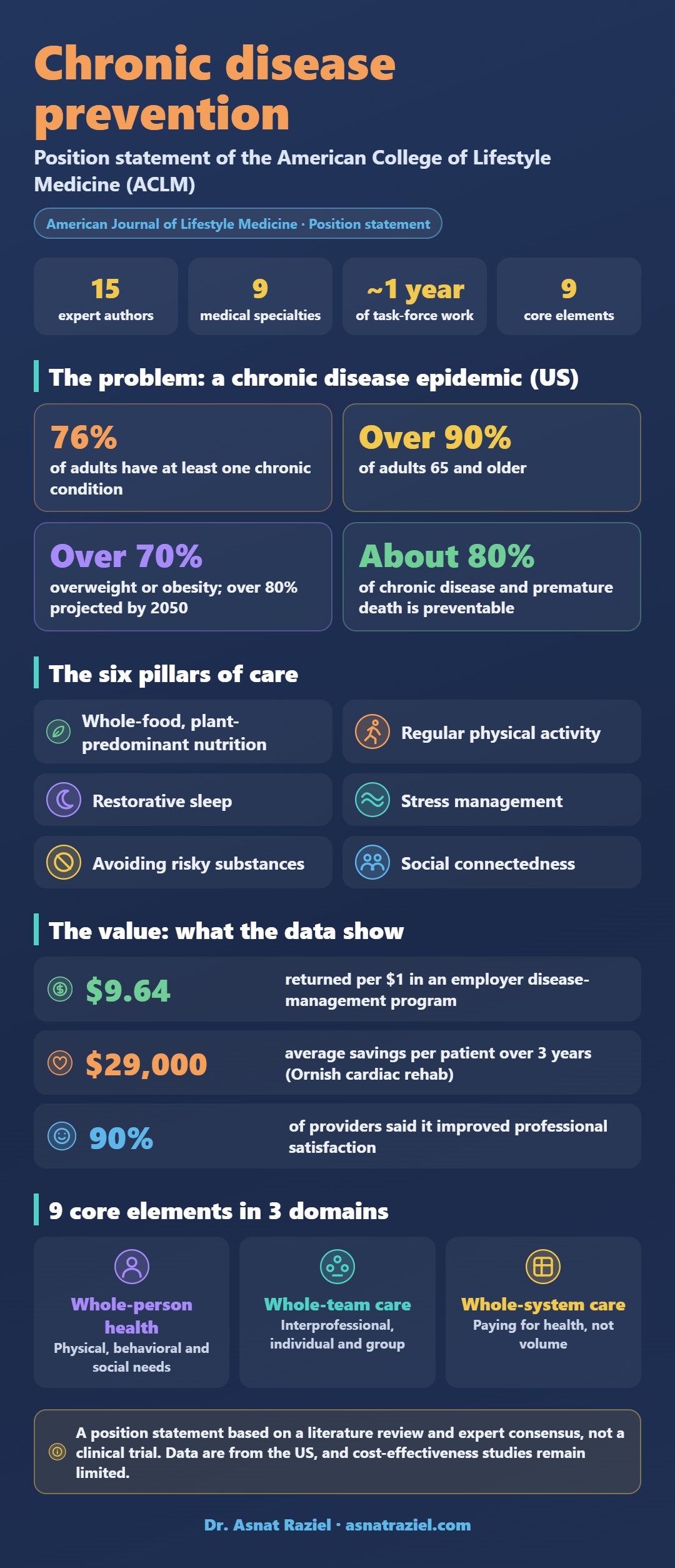
Chronic disease prevention may be the most important task facing medicine today. The American College of Lifestyle Medicine (ACLM) has published an official position statement on the subject in the American Journal of Lifestyle Medicine. According to the authors, about 80% of chronic diseases and premature deaths could be prevented through behavior change. So their message is sharp: changing habits is real medical treatment, not a nice extra. In their view, it improves outcomes, lowers costs and gives doctors back their sense of satisfaction at work.
Who wrote the position statement, and how
Fifteen experts wrote the document. Among them is Dr. Padmaja Patel, the organization’s president, who also spoke at the opening of the annual lifestyle medicine conference. The task force included physicians from nine fields: family medicine, internal medicine, emergency medicine, endocrinology, cardiology, pediatrics, oncology, preventive medicine and psychiatry.
The team met every month for about a year. At first it defined 11 core elements, and in the end it voted to adopt nine. In addition, the authors reviewed the medical literature, and the organization’s executive committee approved the positions. It is worth knowing that the organization itself supported the work.
Chronic disease prevention: why now
The numbers from the United States are worrying. 76% of adults live with at least one chronic condition, and over age 65 the rate exceeds 90%. About 30% of children also have a chronic condition or a functional limitation.
What is more, overweight and obesity affect over 70% of adults aged 20 and older. The projection for 2050 is above 80%. By then, 21% to 33% of adults are expected to have type 2 diabetes, and worldwide over 1.3 billion people are expected to have diabetes.
The economic price is huge. US health spending reached $4.9 trillion in 2024, driven mainly by chronic disease. Even so, the United States ranks last among comparable countries on life expectancy and avoidable deaths.
The six pillars of lifestyle medicine
Lifestyle medicine uses habit change as a primary treatment, not just as general advice. This is the foundation of chronic disease prevention, and it rests on six pillars:
Nutrition – whole foods, mostly from plants. The Mediterranean diet is a good example of this pattern.
Physical activity – regular movement, including strength and aerobic training.
Sleep – restorative, sufficient sleep, which also protects metabolism.
Stress management – practical coping tools, because stress has a biological link to obesity.
Avoiding risky substances – smoking, harmful amounts of alcohol and addictive substances.
Social connection – meaningful social ties are part of treatment, not a luxury.
The authors point to an interesting figure: 83% of clinical practice guidelines published from 2010 to 2021 included recommendations on food groups. In other words, guidelines already recognize the power of nutrition. In practice, however, few doctors get the time, training and payment to apply them.
Paying for health, not for the number of visits
In the United States, most doctors are paid per service. According to the position statement, this system rewards volume over quality, fragments care and contributes to the rise of chronic disease. That is why the authors call for better reimbursement for lifestyle medicine and for training in it.
At the same time, the US system is already moving toward paying for outcomes. The goal of CMS, the agency that runs the government health insurance programs, is that by 2030 all Medicare beneficiaries and most Medicaid beneficiaries will be in models that hold providers accountable for outcomes. In such models, prevention and treating the root of the problem pay off.
The five goals that care should aim for
The position statement argues that lifestyle medicine meets the Quintuple Aim, the five goals of a good health system. These are better health outcomes, a better patient experience, lower cost, the well-being of the care team and health equity.
Cost and savings
In an employer-sponsored disease management program, every dollar invested returned $9.64. In addition, the 1998 Ornish intensive cardiac rehabilitation program saved an average of $29,000 per patient over three years by avoiding revascularization procedures. However, the authors themselves admit that cost-effectiveness studies in the field are still limited.
Less burnout for doctors
In one study, providers who integrated lifestyle medicine more deeply reported less burnout. Moreover, 90% of them said the approach improved their professional satisfaction. Team-based care and shared medical appointments also improve the quality of care and reduce clinician burnout.
For every age and every care setting
According to the authors, lifestyle medicine suits every population, every setting and every level of intensity. It can be delivered in an individual visit, in a group or virtually.
Primary care – a comprehensive assessment, habit change at low to medium intensity, and an intensive program for those aiming at remission.
Pediatrics – from birth to age 18, in obesity, high blood pressure, diabetes, asthma, ADHD and autoimmune disease.
Endocrinology – intensive dietary change can lead to type 2 diabetes remission. The organization’s clinical guideline for type 2 diabetes and prediabetes includes 14 key action statements and serves as a roadmap.
Oncology – from risk reduction, through treatment, to survivorship. For example, the authors note a significant reduction in colorectal cancer risk.
Hospitals – fewer readmissions, fewer avoidable emergency department visits and fewer complications after discharge. The inpatient consultation service at Loma Linda serves as an example.
Chronic disease prevention in nine core elements
At the heart of the position statement are nine core elements. According to them, lifestyle medicine should be accessible, comprehensive, high quality, integrated, whole-person, accountable, cost-effective, equitable and achievable.
The authors group the elements into three domains. The first is whole-person health – body, mind and social needs. The second is whole-team care. The third is whole-system change, including fair, long-term payment.
An interdisciplinary team: who treats, and how
The American Board of Lifestyle Medicine has defined 88 core competencies for clinicians. According to the position statement, these are interdisciplinary chronic disease experts, from prevention to remission. The document also describes training pathways for the different professionals on the team.
In practice, care follows several steps. First, an assessment of lifestyle across all six pillars. Next, setting specific, measurable goals (SMART). Then, a lifestyle prescription – written instructions, just like a prescription for a drug. Finally, follow-up and reassessment.
Chronic disease prevention in Israel: what it means for you
In my clinic, I see these principles every day. That is why we work as a team: a physician, a dietitian and, when needed, psychologists, coaches and practitioners of Pilates, yoga and stress reduction. This is holistic obesity treatment, not just a prescription.
The position statement notes that lifestyle medicine may be a lower-cost alternative to the new obesity medications, which face cost and adherence barriers. Here my experience adds another angle. In my view, GLP-1 medications and lifestyle are not competitors. The medication quiets the noise around food, and lifestyle protects muscle, the heart and the result over time. That is exactly why I built 12 steps for changing habits during drug treatment.
Limitations worth knowing
A position statement is not a clinical trial. It is a summary by a professional organization, based on a literature review and expert consensus. In addition, most of the data come from the United States, where the payment system is very different from Israel’s health funds. Finally, the authors themselves note that cost-effectiveness data are still limited.
Bottom line: chronic disease prevention starts with habits
The message of the position statement is simple: the real value in medicine is years of good health, not the number of procedures. Chronic disease prevention means treating the root of the problem. In the end, that root usually lies on our plate, in our movement, our sleep, our stress and our relationships.
This article is general information and is not a substitute for personal medical advice.
References
New clinical practice guideline puts lifestyle interventions at forefront of diabetes care
Combined impact of healthy lifestyle factors on colorectal cancer: a large European cohort study
The work on the position statement was supported by the American College of Lifestyle Medicine (ACLM).