By Dr. Asnat Raziel, bariatric surgeon specializing in obesity treatment, metabolic health and healthy longevity; Director of the Multidisciplinary Center for Obesity Treatment, Assia Medical, Assuta Ramat HaChayal, Tel Aviv
Healthy eating for children: a keynote at LM2026
Healthy eating for children does not start with a menu. It starts at home, at school and in a child’s neighborhood. That was the message of a keynote at LM2026, the annual conference of the American College of Lifestyle Medicine (ACLM), which I am attending this week in Orlando. The talk was titled “Planting Seeds of Health: Cultivating Pediatric Lifestyle Medicine from Kitchen to Community.”
Three physicians took the stage, each with a different angle. The first explained what children need to eat. The second showed how to bring fresh produce into the home of a family that is struggling. The third described how the kitchen can become part of medical care.
Three physicians, three angles
Dr. Reshma Shah is a pediatrician at Stanford University. Next to her stood Dr. Qadira Ali, a pediatrician at Children’s National Hospital in Washington, D.C., and George Washington University. The third, Dr. Jaclyn Albin, is a specialist in pediatrics and internal medicine at UT Southwestern, where she leads the culinary medicine program.
As a result, the talk did not stay at the level of general advice. It moved from the child’s plate, through the clinic, all the way to public policy.
Four principles of healthy eating for children
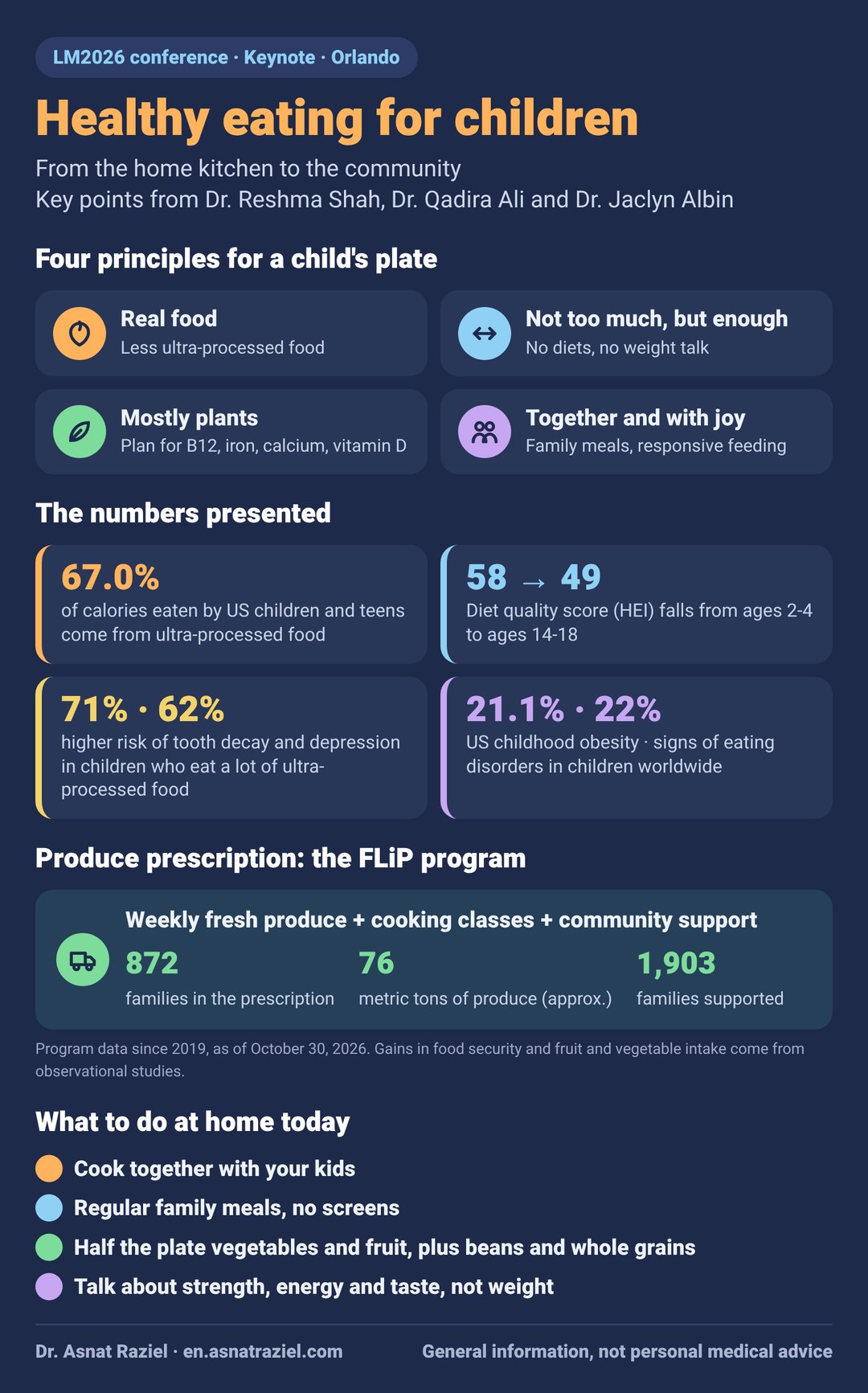
Dr. Shah opened with a simple question: what makes a meal good? Parents want a meal that is quick, nutritious and free of arguments at the table. Inspired by the famous rule of writer Michael Pollan, she offered four principles: eat real food, not too much but enough, mostly plants, and together and with joy.
Real food: where children stand today
First, Dr. Shah presented the US Healthy Eating Index (HEI), which scores how close a diet comes to the guidelines on a scale of 0 to 100. The average score at ages 2 to 4 was 58. Then it fell: 53 at ages 5 to 8, and 50 at ages 9 to 13. At ages 14 to 18 it hit a low of 49.
In other words, the older children get, the further their diet drifts from the guidelines. The biggest gaps are in vegetables, beans and whole grains. On the other hand, there is too much added sugar, sodium, saturated fat and refined grains. The new US guidelines aim to fix exactly that, as I wrote about real food and the new dietary guidelines.
Ultra-processed food: two thirds of the calories
Ultra-processed food is industrial food with a long list of ingredients, such as snacks, sweetened breakfast cereals and ready meals. A large US study found that in 2017-2018 it supplied 67.0% of the calories eaten by children and teens aged 2 to 19.
In addition, an updated umbrella review from June 2026 pulled together the links between this food and health. In children, high intake was linked to a 71% higher risk of tooth decay and a 62% higher risk of depression. It was also linked to a 24% higher risk of anxiety and a 0.11-point drop in cognitive function. The certainty of the evidence was moderate for tooth decay and depression, and low for anxiety and cognition. Keep in mind that these are mostly observational studies, which show a link and not necessarily a cause. I covered this in more depth in ultra-processed food, the brain and nutrition policy.
However, Dr. Shah stressed that not all processed food is the same. Infant formula, fortified porridge or calcium-fortified soy milk are helpful processed foods. Moreover, for children with celiac disease, food allergy, autism, growth faltering or ARFID (avoidant/restrictive food intake disorder), the right processed food is sometimes an important part of the solution.
Not too much, but enough
In the United States, 21.1% of children and teens aged 2 to 19 live with obesity, including 7.0% with severe obesity. Another 15.1% have overweight. At the same time, a global meta-analysis found signs of eating disorders in 22% of children and teens.
That is why, according to Dr. Shah, the goal is not only to avoid overeating but also to eat enough. Children with excess weight have about a 2.5 times higher risk of eating-disorder behaviors. Yet they are diagnosed only half as often. Eating disorders are among the deadliest mental illnesses, so every conversation about weight at home should be careful and respectful. I wrote more about this in eating disorders in lifestyle medicine, and about treatment at this age in my guide to obesity treatment in children and teens.
Mostly plants: is it safe for children?
In adults, healthy plant-based eating patterns go hand in hand with lower mortality, less obesity, and less diabetes, heart disease and some cancers. As for children, Dr. Shah explained that children on plant-based diets grow normally, although they weigh less on average. A study from Poland of children aged 5 to 10 found a healthier cardiovascular profile in vegan children, with LDL cholesterol 24 mg/dL lower.
On the other hand, the same study found more vitamin B12 and iron deficiencies in vegan children, lower bone mineral content and slightly shorter height. Supplements of B12 and vitamin D corrected those deficiencies. In short, a plant-based diet for a child needs planning, especially for calcium, vitamin D, B12 and iron. You will find a practical guide in my article on plant protein sources.
Together and with joy: healthy eating for children around the table
The fourth principle may be the most important of all. Dr. Shah spoke about responsive feeding: the parent decides what is served and when, and the child decides how much to eat. The key is a balance of structure and warmth.
In addition, studies have linked regular family meals to better nutrition, with more fruit, vegetables and fiber. Family meals also go hand in hand with better school performance and a more positive body image. Finally, teens who eat with their family smoke and drink less, and parents gain a sense of connection too.
A prescription for fruits and vegetables: the FLiP program in Washington
Dr. Ali began with a story from her clinic. A 10-year-old boy came in with obesity and prediabetes. His family wanted to change, but faced food shortages, little time and difficulty cooking. In her words, the problem was not a lack of nutrition advice. The problem was how to make that advice work in real life.
So she drew a line between two ideas. Food security asks whether there is enough food at home. Nutrition security, by contrast, asks whether there is healthy food at a fair price that the family knows how to prepare.
This led to FLiP, the hospital’s Family Lifestyle Program. The clinic team refers the family, which then receives weekly home deliveries of fresh, locally grown produce. Meanwhile, the family joins live cooking classes and uses videos and printed guides. Staff also connect the family with support services in the community.
Since 2019, 872 families have taken part in the produce prescription, and about 76 metric tons (about 76,000 kg) of fresh produce have reached their homes. In addition, 1,903 families received guidance and links to community services.
What changed for the families
In a published study of the program, food security scores improved after six months. Parents also felt more confident cooking, and more meals were made at home. A follow-up study of 176 parent-child pairs found a modest increase in fruit and vegetable intake. Data on a drop in BMI percentile are still under review for publication.
Beyond the numbers, families described changes at home. Children started cooking, tried new foods, and reported better energy and sleep. One mother said her kids now love the produce aisle at the supermarket because they notice the colors. In addition, families helped shape the program: they asked for more fruit, recipes matched to the week’s produce and more beans, and the team adapted.
Culinary medicine: the kitchen as part of care
Dr. Albin opened with the line “everyone has a food story.” The question that drove her was simple: how do we help a family follow our advice? Above all, how do we make the healthy choice the easy choice?
Her answer was to start small. In 2021 she began with culinary medicine eConsults between physicians. In 2022 she added one-on-one clinic visits, and in 2024 group medical visits with shared cooking. She described the model in an article in NEJM Catalyst. As she put it, sometimes it takes three years, or even longer.
What’s more, she brought the knowledge to where life happens. In an apartment building where families of different income levels live together, two medical students trained in culinary medicine also live, in exchange for free housing. They give residents a monthly session, for example on managing a food budget. Her teenage son added his own insight: “Mom, nobody my age wants to talk about diabetes.” The message for health professionals is clear: give children and teens a seat at the table.
To close, Dr. Albin offered seven steps for change: find the open door, start small, find partners outside medicine too, listen to the community before you build, measure what matters, look at the whole system, and make room for children and families.
Healthy eating for children at home: what you can do today
So how do you put healthy eating for children into practice at home, even when time is short?
- Cook together: a child who washes, cuts and stirs is far more willing to taste.
- Keep a family meal: even three times a week makes a difference, with no screens at the table.
- Fill half the plate with vegetables and fruit: add beans, and swap white bread for whole grains.
- Cut back on snacks and sweet drinks: instead, keep cut fruit, age-appropriate nuts and yogurt at home.
- Don’t talk about weight and dieting: talk about strength, energy and taste.
- Plan a plant-based diet with a dietitian: especially for B12, iron, calcium and vitamin D.
If your child has excess weight, see your pediatrician and a multidisciplinary team. At a very young age, as I wrote about obesity in preschoolers, well-timed support makes a real difference. Teens today also have additional treatment options, which I covered in obesity in teens.
Bottom line: healthy eating for children starts at home
The message from Orlando is clear. Healthy eating for children is not just a list of allowed and forbidden foods. It is built in the kitchen, at the family table and in the community. Ultimately, the habits a child forms today will stay with them for life and can protect them from chronic disease. I also wrote about this in chronic disease prevention from the conference. Keep in mind that some of the data in the talk are US figures, and the FLiP results come from observational studies without a control group.
This article provides general information and is not personal medical advice. Before making any major change to your child’s diet, talk with your pediatrician or a dietitian.
References
Lifestyle Medicine 2026 Online – American College of Lifestyle Medicine
Trends in Consumption of Ultraprocessed Foods Among US Youths Aged 2-19 Years, 1999-2018
Is frequency of shared family meals related to the nutritional health of children and adolescents?
A Novel Culinary Medicine Service Line: Practical Strategy for Food as Medicine