By Dr. Asnat Raziel, bariatric surgeon specializing in obesity treatment, metabolic health and healthy longevity; Director of the Multidisciplinary Center for Obesity Treatment, Assia Medical, Assuta Ramat HaChayal, Tel Aviv
Disordered eating: when healthy advice becomes a burden
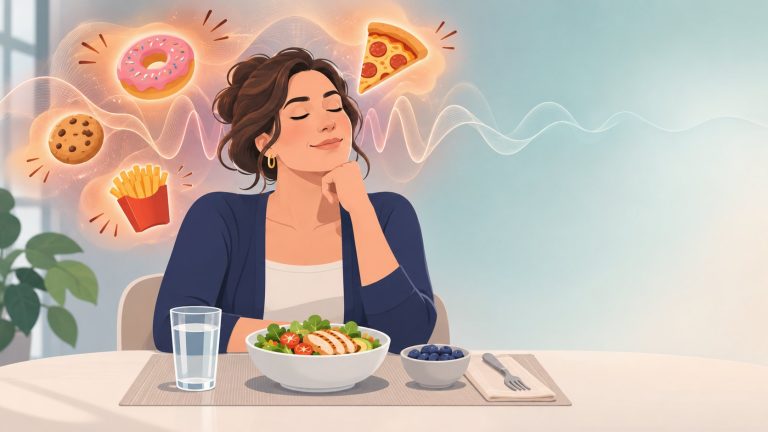
Disordered eating can start with good advice. “Eat whole foods.” “Cut down on sugar.” “Go plant-based.” For most people, these are healthy steps. For a vulnerable minority, however, the same words can harden into rigid rules, anxiety and guilt. At LM2026 in Orlando, a full session covered this topic. Every team that treats obesity needs to know about it.
The talk was given by Dr. Laura Machado, a lifestyle medicine psychologist at Kaiser Permanente in California. I did not have a transcript of the session. So I based this article on the official session summary and on current research in the field.
What is disordered eating?
Disordered eating is a spectrum of problematic eating patterns. It does not always meet the criteria for a diagnosed eating disorder. Examples include rigid restriction, regularly skipping meals, loss-of-control eating, or constant preoccupation with food and body. Sometimes it takes the form of orthorexia, a compulsive focus on eating “right.”
The dividing line is not the menu itself. The question is whether the habits cause distress, anxiety, social isolation or nutritional gaps. In other words, eating well with joy is not the same as eating well with fear.
What the session covered
According to the session summary, Machado started from a clear premise. Lifestyle medicine is highly effective at preventing, treating and even reversing chronic disease. Yet its advice to follow a whole-food, plant-predominant diet may trigger or worsen problematic eating in vulnerable people. This is true even for those without a diagnosed eating disorder.
She drew on experience in a large health system. There, she described how common this risk is in lifestyle programs. She also presented a structured framework for weighing risks and benefits: when a patient should stay in a program and when to refer them to specialized care. Finally, she offered guidance on language and group messaging. The goal is to keep lifestyle medicine principles while avoiding harm.
How common is it in our clinics?
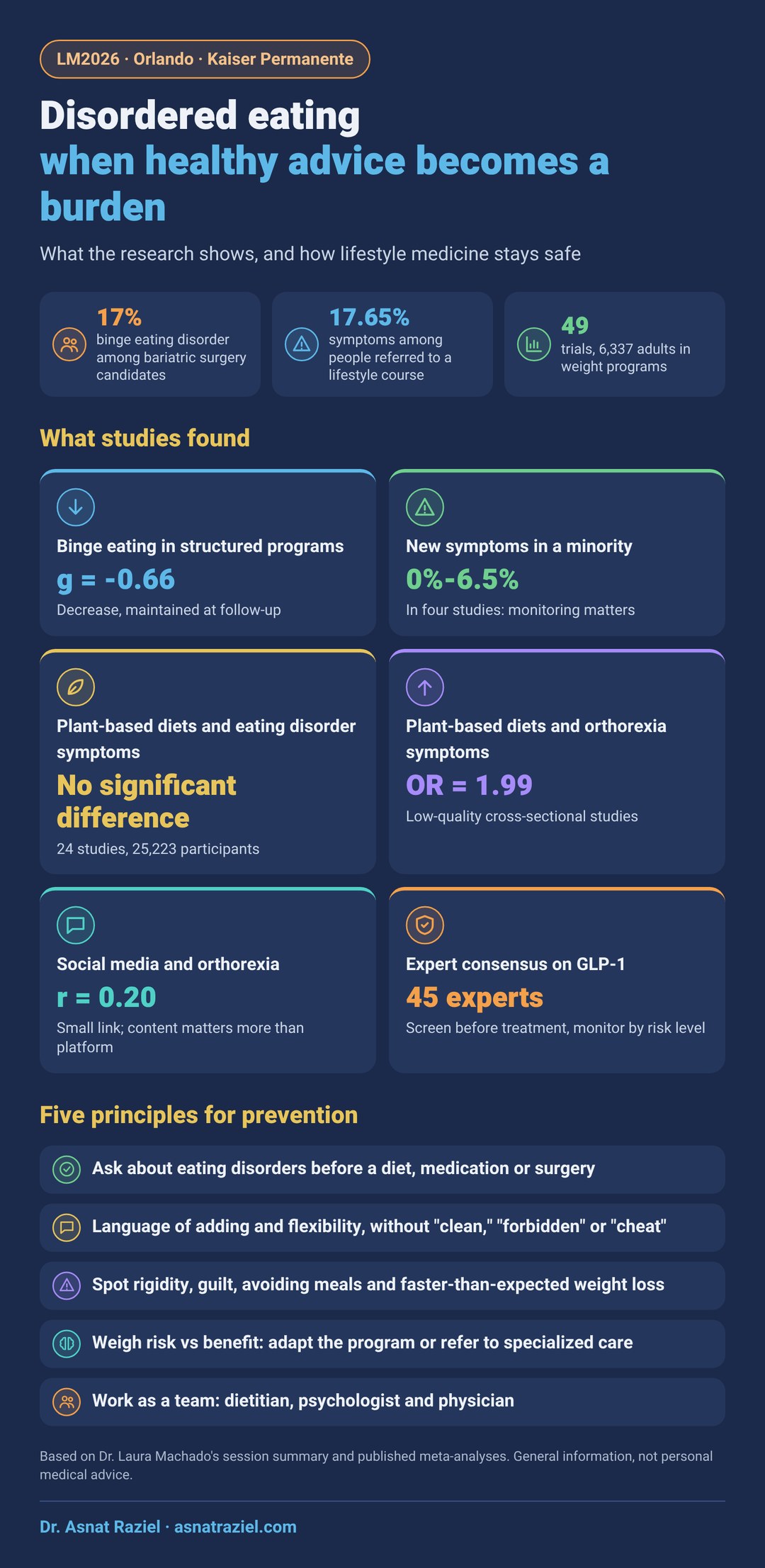
These patients are already sitting across from us. A meta-analysis in JAMA looked at mental health conditions in people seeking or having bariatric surgery. Researchers found binge eating disorder in 17% of them (range 13%-21%), and depression in 19%.
In addition, a study from Denmark examined 136 patients referred from hospital departments to a lifestyle course. Of these, 17.65% reported eating disorder symptoms, full or subclinical. By self-report, 11.03% met criteria for an eating disorder: 7.35% for binge eating disorder and 3.68% for bulimia. In other words, some people who come for weight loss first need a different kind of care.
Do weight loss programs cause disordered eating?
Here the news is reassuring. A systematic review in Obesity Reviews included 49 trials and 6,337 adults in behavioral weight management programs. By the end of the programs, global eating disorder scores fell (Hedges’ g = -0.27). Binge eating also dropped clearly (g = -0.66). Both improvements held at follow-up.
Still, four studies reported new symptoms in a small subset of participants, from 0% to 6.5%. So the conclusion has two sides. For most people, a structured, supported program lowers the risk. But monitoring matters, because a minority does get worse.
Plant-based diets and disordered eating: what the research shows
Is a plant-based diet itself harmful? A meta-analysis published in July included 24 studies and 25,223 participants. The researchers found no significant difference in eating disorder symptoms between vegetarians or vegans and omnivores.
On the other hand, another meta-analysis looked specifically at orthorexia symptoms. It included 26 studies and 23,783 adults. Vegetarians and vegans had moderately higher symptoms (Cohen’s d = 0.46). They were also about twice as likely to report them (OR = 1.99). Keep in mind that all of these studies were cross-sectional, of low quality and highly heterogeneous. In other words, rigid people may simply choose a narrower menu. The menu may not create the rigidity.
Social media plays a role too
A meta-analysis from October looked at social media. It found a small link with orthorexic tendencies (r = 0.20). According to the authors, the type of content people consume matters more than the platform or time spent. The certainty of the finding is very low.
Disordered eating in the GLP-1 era
This topic matters especially now. GLP-1 medications lower appetite and quiet food noise. For some patients, they even reduce binge eating. However, the same mechanism may reinforce restriction in people prone to it.
In October, World Psychiatry published the first expert consensus on this question. Forty-five experts and people with lived experience took part. They recommend screening for current and past eating disorders before starting treatment, using a brief validated tool. They also recommend monitoring by risk level and offering psychotherapy alongside the medication. In general, they advise against these drugs in active eating disorders. This applies especially to anorexia, atypical anorexia and bulimia with marked restriction. A past history also calls for caution.
Preventing disordered eating: five principles
Based on the session and the research, these are the principles I apply at our center:
1. Ask before you advise
Before a diet plan, a medication or surgery, ask about past eating disorders. Ask about restriction, vomiting and binge eating too. A short validated questionnaire is enough to flag who needs a deeper assessment.
2. Watch your language
Words like “clean,” “dirty,” “forbidden” and “cheat” feed fear. Instead, use the language of adding and flexibility: add vegetables, legumes and protein, rather than cutting out whole food groups. In groups, talk about health and function, not only the number on the scale.
3. Spot the warning signs of disordered eating
Rigidity that causes distress, avoiding family meals, guilt after eating, faster weight loss than expected, or constant label checking. These are signs to pause and check.
4. Weigh risk against benefit
Not every sign means a patient must leave the program. Sometimes you can adapt it and add psychological support. By contrast, when an active eating disorder is present, treat it before focusing on weight loss.
5. Work as a team
This is where multidisciplinary care proves its worth. When a dietitian, psychologist and physician talk, they catch signs early. Then they adjust care in time.
What this means for you
If you are in weight loss treatment and food has become a source of fear, tell your team. It is not weakness, and it is not failure. On the contrary, it is information that helps us build safe care. I have also written about mindfulness and emotional eating. It offers gentle tools for a calmer relationship with food.
The bottom line
Disordered eating is a real risk, but not a reason to give up on healthy lifestyle advice. Most patients benefit from a structured program, and some even improve their eating habits. The key is to ask, listen, choose words carefully and work as a team. That way lifestyle medicine stays healing, and does not become one more source of stress. After all, most chronic disease is preventable, and safe lifestyle care is how we get there.
This article is based on the conference session summary and on published research. It is general information, not personal medical advice. If you are worried about an eating disorder, speak with your physician or a qualified professional.
References
When Healthy Turns Harmful: Preventing Disordered Eating in Lifestyle Medicine
Mental Health Conditions Among Patients Seeking and Undergoing Bariatric Surgery: A Meta-analysis