By Dr. Asnat Raziel, bariatric surgeon specializing in obesity treatment, metabolic health and healthy longevity; Director of the Multidisciplinary Center for Obesity Treatment, Assia Medical, Assuta Ramat HaChayal, Tel Aviv
Mindfulness and emotional eating: what I heard this morning at LM2026
Mindfulness and emotional eating sound like two separate topics. This morning, at seven o’clock, they came together for me in a single story. I am attending LM2026, the annual conference of the American College of Lifestyle Medicine (ACLM) in Orlando. One of the first sessions of the day was about mindfulness in lifestyle care. Its core message was simple. A pause of one or two seconds between an event and our reaction can change what we eat, the workout we skip, and the rest of the day.
In this article I share what the speakers said. I also pulled together a review of the published research on mindfulness, eating habits, weight and diabetes. That way you can see what the evidence supports, and where it is still thin.
Who spoke, and what about
The session was led by Dr. Prerana Rudrapatna, a board-certified lifestyle medicine physician and Chief Medical Liaison at My Viva, and Erica Matechuk, a mindfulness educator and yoga teacher who has built My Viva’s mindfulness content for more than eleven years. My Viva is a digital platform for chronic disease care, with nutrition, fitness and mental health programs. The talk was titled “The Awareness Advantage: Turning Reflection into Personalized Lifestyle Prescriptions.” To be transparent, this was a session sponsored by My Viva, so part of it presented their product. Here I focus on the ideas and the science.
They opened with a point I strongly agree with. Mindfulness is usually presented as a stress management tool. However, its reach is much wider. When we notice patterns in our thoughts and emotions, we also change how we act around food, movement, sleep and relationships.
Maya’s story: mindfulness and emotional eating in real life
Dr. Rudrapatna introduced Maya, a woman she had coached. Maya is 40, with type 2 diabetes and a normal body mass index (BMI), but with visceral belly fat and a high level of stress. In other words, a normal number on the scale did not tell the whole story.
This is a classic example of the link between mindfulness and emotional eating. One evening, after dinner, Maya was ready to take the train downtown to a comedy show with a friend. Just as she walked out the door, her friend cancelled by text. Maya felt a wave of panic, but she decided to go anyway. Right away she started searching her phone for donut shops along the route. Then she discovered that the train schedule had changed. She had to sit back down on the couch and replan her trip.
That forced pause revealed something. Maya asked herself: “Hold on a second. I’m not actually hungry, I just ate dinner. Why am I looking up donut shops?” Only later, when they broke the evening down step by step, did she understand what had happened. She had been trying to rebuild that friendship, so the cancellation triggered a fear that her friend did not want her. She also worried that people would judge her for showing up alone. Her body responded with a racing heart, heat and frustration. The donuts were meant to offset that rush of negative feelings with something pleasant.
Two paths: an automatic reaction or a conscious response
Erica described two possible paths. On the first, an outside event becomes an internal alarm. The fight-or-flight system switches on, the heart races and blood rushes to the limbs. We run on autopilot, react impulsively and reach for an instant reward. It can be a donut, a cigarette or any other coping habit that helps for a moment and hurts over time.
On the second path, the event is the same, and the stress response may still show up. The difference is that we have trained ourselves to pause. Within that pause we feel the thoughts and the sensations in the body, and we give them room. Then we choose a response. Maya, for example, could have acknowledged her disappointment, then chosen to go to the show and call her friend to ask what happened.
Dr. Rudrapatna mentioned Hans Selye, the Canadian endocrinologist who brought the concept of stress into medicine. According to his theory, the stress response helps us meet an immediate threat. But when the system works nonstop, the body reaches exhaustion. So the goal is not to eliminate stress, but to recognize the pattern and choose a better response.
It happens to clinicians too
One of the speakers shared a personal example. A patient booked a last-minute appointment, and she felt irritated and pressured by unfinished chart notes. Because she felt she had lost time, she skipped the kickboxing class she had planned. Then she got stuck in traffic, decided it was too late to cook, and stopped at a fast-food drive-through. None of these decisions was conscious. Each one simply led to the next.
What mindfulness is, in plain terms
The speakers presented mindfulness-based stress reduction (MBSR), the program developed by Prof. Jon Kabat-Zinn. His definition is simple: “moment-to-moment, non-judgmental awareness.” We notice what is happening now, without getting stuck in stories from the past or worries about the future. The aim is to widen the space between the stimulus and the response.
Erica stressed an important point. Meditation is not an attempt to silence your thoughts. Your mind will wander, “like a plastic bag in the wind,” as she put it. The practice is noticing that you drifted and gently coming back to your point of focus. At the end of the session, Dr. Rudrapatna admitted that during the group meditation she caught herself trying to “do it perfectly.” That is exactly the trap. Coming back is the practice, not perfect silence.
Mindfulness and emotional eating: what the research shows
The speakers presented one study. So I looked at what else we know about mindfulness and emotional eating. Here is an up-to-date overview based on reviews and trials published in the scientific literature.
Students: 29 controlled trials
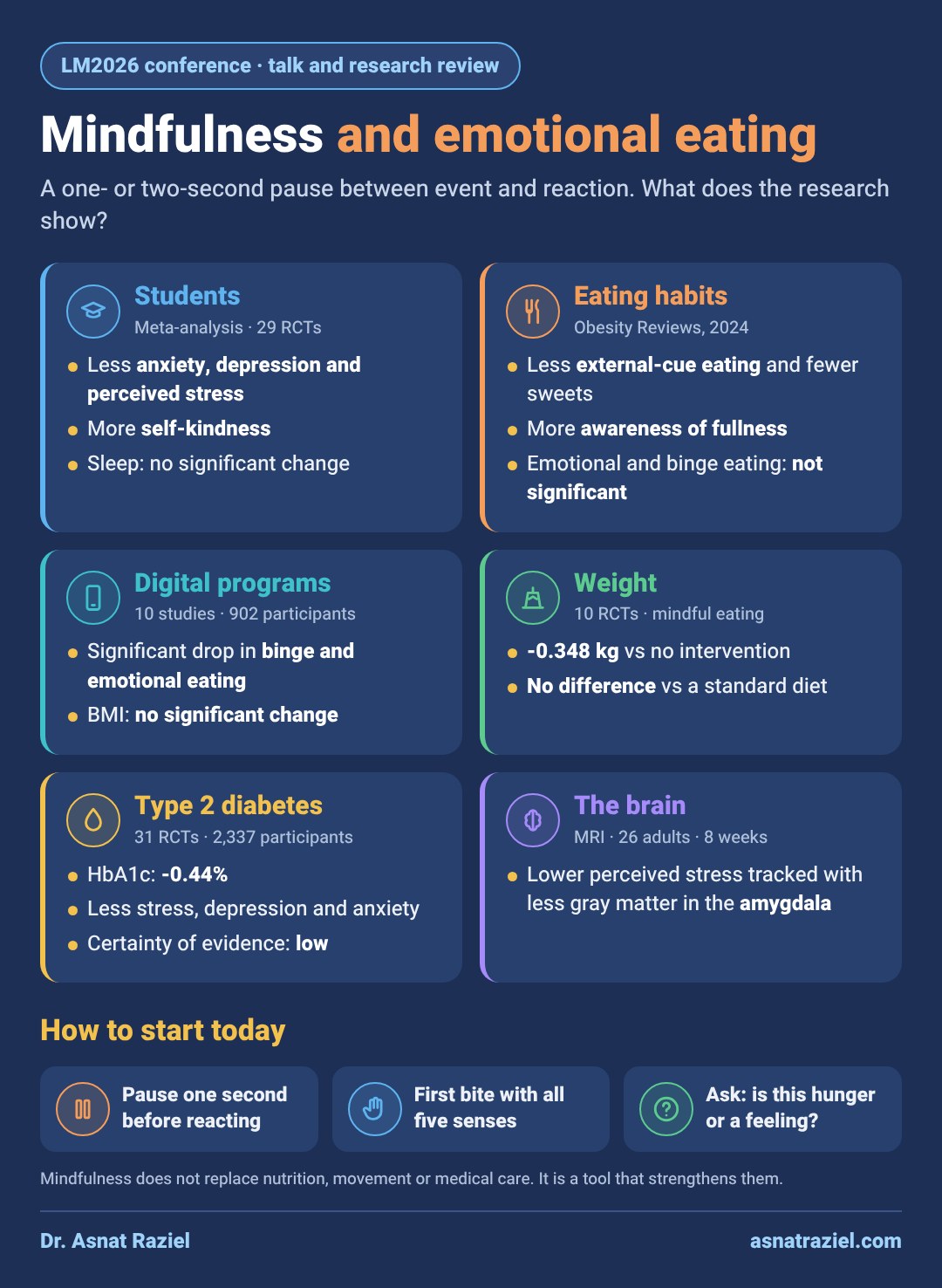
The study shown in the session was a systematic review and meta-analysis of 29 randomized controlled trials in students, including medical and nursing students. The researchers searched the literature in November 2023, and the review was published in February 2024. The programs lasted two to ten weeks and were delivered in person, online or by app. Compared with control groups, mindfulness reduced anxiety, depression and perceived stress, and improved self-kindness. In contrast, there was no significant improvement in sleep quality. The quality of evidence for sleep and physical health was low.
Mindfulness and emotional eating: a strong effect on “autopilot” eating
A 2024 meta-analysis in Obesity Reviews examined how mindfulness programs affect eating habits that promote obesity. The programs improved controlled eating, reduced eating in response to external cues, improved awareness of fullness, and lowered energy and sweet intake. However, the effect on emotional eating and binge eating was small and not statistically significant. Interestingly, the effect on emotional eating was much stronger in clinical settings than in schools.
On the other hand, a 2026 meta-analysis of digital mindfulness programs included 10 studies and 902 participants. Here the results showed significant improvement in both binge eating and emotional eating. But this study, too, found no significant drop in BMI. In other words, mindfulness and emotional eating are connected, but mindfulness alone is not a weight loss program.
Weight: similar to a diet, not a replacement for one
A meta-analysis of 10 randomized trials looked at weight loss programs based on mindful or intuitive eating. Compared with no intervention, weight loss was significant but small: 0.348 kg on average. Compared with conventional diet programs, there was no difference. So mindful eating is a legitimate approach, but not a magic one.
Stress, cortisol and belly fat
Maya’s profile, a normal weight with belly fat, connects to a randomized trial of a mindfulness program for stress eating in 47 women with overweight or obesity. Overall, the groups did not differ in weight, belly fat or the morning cortisol response. However, women with obesity in the mindfulness group lowered their cortisol response and kept their weight stable, while those in the control group gained weight. In addition, improvements in mindfulness and chronic stress went together with reductions in belly fat. It is a small, early study, but the direction is interesting.
Type 2 diabetes
A systematic review of 31 trials with 2,337 participants examined mindfulness in people with type 2 diabetes. The programs reduced stress, depression and anxiety. They also produced a small drop of 0.44% in HbA1c (average blood sugar over the past three months) and in blood pressure. But the certainty of evidence was low to very low. When mindfulness was added to a lifestyle program, there was no extra benefit for blood sugar or weight.
The brain: a calmer amygdala
The slides showed how the brain changes with regular practice: more activity in the prefrontal cortex, which handles planning and emotional regulation, more gray matter density in the hippocampus, the learning and memory center, and less activity in the amygdala, the region that drives the fear response. “Neurons that fire together, wire together,” they reminded us, which is why new pathways can form at any age. In an MRI study from Massachusetts General Hospital, 26 stressed adults completed an eight-week MBSR program. The more their perceived stress dropped, the more gray matter density declined in the right amygdala. It is a small study, but it shows that the brain changes along with our mental state.
After bariatric surgery
This topic is close to my heart. A systematic review of eight studies looked at mindfulness before and after bariatric surgery. Most studies showed a positive effect on weight and eating habits, as well as improvements in anxiety and depression. However, the studies differed widely, and the authors did not perform a meta-analysis.
What it means for you: mindfulness and emotional eating day to day
Erica suggested a simple way to start. It costs no money and no extra time. You just attach the practice to something you already do:
While washing your hands. Notice the warmth of the water, the smell of the soap and the feeling on your skin, with all five senses.
With the first bite. Before you swallow, notice the taste, texture and smell of the food.
In a moment of craving. When you find yourself reaching for something sweet, stop for a second. Ask: am I hungry, or am I feeling something else? That is the difference between physical hunger and emotional hunger.
With a short daily check-in. Spend a few minutes a day noting your energy, sleep, stress and food. After a few weeks you will spot patterns, such as fatigue at 4 p.m. on days without a morning workout, or fast food on stressful days.
The speakers also showed a “battery chart” that rates habits as low, partial or full charge, with no labels and no shame. They emphasized that it is never too late. Just like quitting smoking, new thinking patterns can be built at any age. If you want to go deeper, I have also written about self-compassion and mindfulness.
Mindfulness and emotional eating in the era of weight loss drugs
I see this in my clinic every day. The new weight loss medications largely quiet “food noise” and reduce hunger. Even so, the emotional reasons we ate do not disappear. This is exactly where mindfulness can help, as part of the treatment and not instead of it. That is why care at our center combines a dietitian and mind-body professionals, not just a prescription.
It is also the approach discussed yesterday at the conference opening: lifestyle medicine as a standard of care, with stress management as one of its six pillars.
The bottom line on mindfulness and emotional eating
Mindfulness and emotional eating are more closely linked than they seem. Research shows that mindfulness reduces stress, anxiety and depression, and improves “autopilot” eating, awareness of fullness and sweet intake. The effect on emotional eating is mixed, and the effect on weight is small. So mindfulness does not replace nutrition, movement or medical treatment. But it is a cheap, accessible and safe tool that strengthens all the rest. In the end, as Maya discovered, sometimes all it takes is a small pause.
This article provides general information and is not personal medical advice. Before changing your treatment, talk with your doctor.
References
Stress reduction correlates with structural changes in the amygdala