By Dr. Asnat Raziel, bariatric surgeon specializing in obesity treatment, metabolic health and healthy longevity; Director of the Multidisciplinary Center for Obesity Treatment, Assia Medical, Assuta Ramat HaChayal, Tel Aviv
Self-compassion starts at six in the morning
Self-compassion sounds like a soft idea. However, Dr. Ronald Siegel explains that it is one of the most powerful tools we have for calming the nervous system. Siegel is a clinical psychologist at Harvard Medical School, and he has taught mindfulness for decades. Even so, at the Nervous System Reboot summit he opened with a confession: he was an anxious guy, and he still is.
To show what he means, he described one morning. He woke up at six, his heart started pounding, and his thoughts began to race. What if I can’t fall back asleep? What if I’m exhausted on an important day? Instead of fighting the anxiety, he turned toward it gently. He brought his attention back to his breath and accepted the arousal as it was. In the end, he fell asleep for another hour and a quarter.
Mindfulness is not a relaxation technique
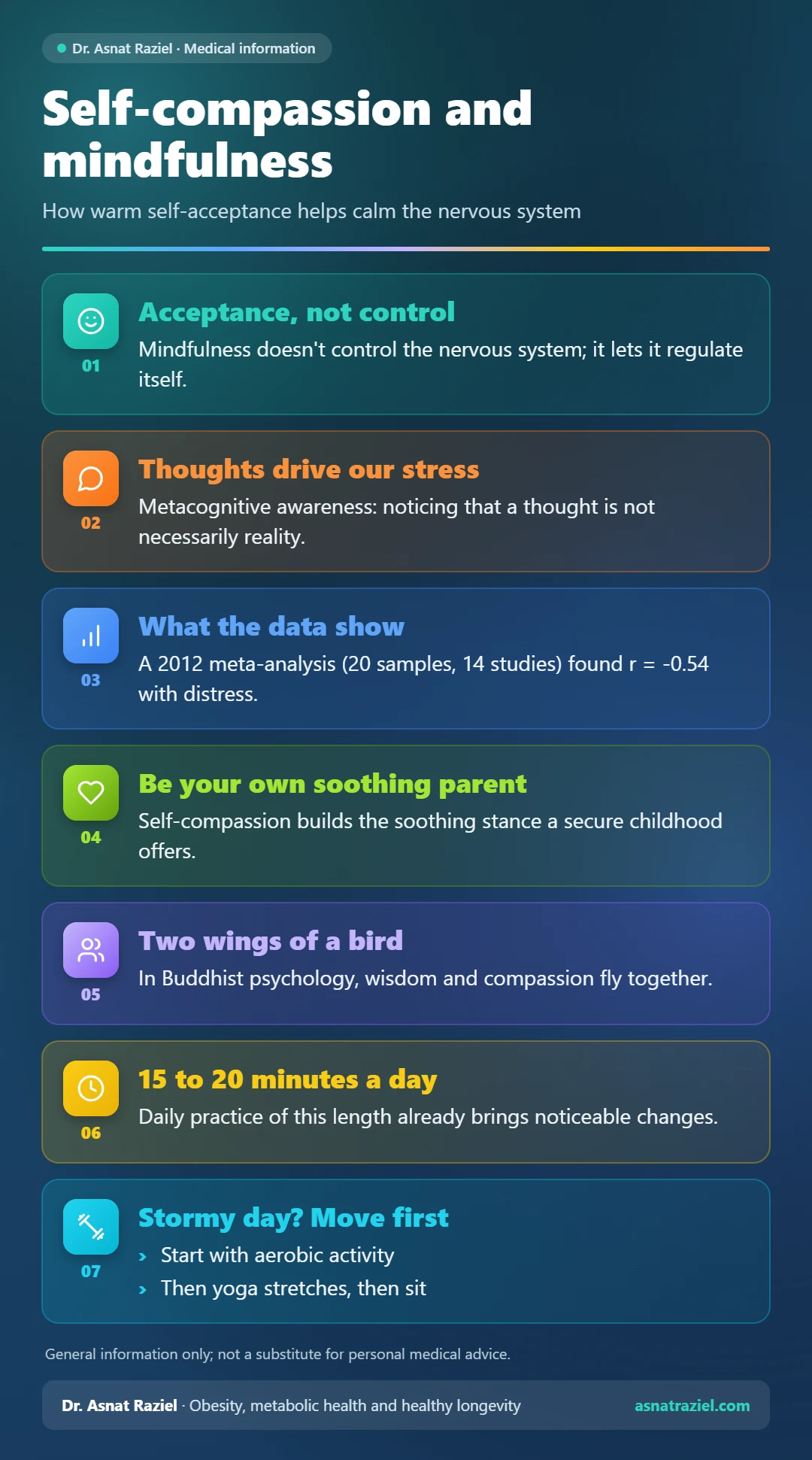
Many people confuse mindfulness with relaxation. Relaxation techniques, such as a long exhale, aim to switch on the calming branch of the nervous system. There is nothing wrong with that. But according to Siegel, mindfulness works differently. It does not control the nervous system. Instead, it creates the conditions in which the nervous system can regulate itself.
What’s more, this approach has an important advantage. When a relaxation technique fails, we tend to panic even more. My tool isn’t working, so now what? By contrast, when the foundation is acceptance, there is no failure. The arousal is simply there, and we stay with it.
It’s our thoughts that stress us out
Siegel points out that most of us are not in real danger most of the time. What stresses us out are our thoughts: what if this fails, what if people judge me? Mindfulness builds a skill psychologists call metacognitive awareness. In other words, it is the ability to notice that this is a thought, and not necessarily reality. As that ability grows stronger, we react less to every thought, and the nervous system settles down. For a look at stress from the genetic side, see my article on epigenetics and stress.
Self-compassion matters more than concentration
Early on, Siegel said, he and his colleagues focused on training attention. The clinical research, however, painted a different picture. The factor that best predicts improvement in anxiety, depression and post-traumatic stress is mainly a warm, loving acceptance of ourselves. So even people who are convinced they lack the focus to meditate can benefit.
The data support this. A 2012 meta-analysis pooled 20 samples from 14 studies. The researchers found a strong inverse link between self-compassion and symptoms of psychological distress (r = -0.54). Put simply, people who are kind to themselves suffer less from emotional distress.
Becoming our own soothing parent
Siegel offers a fascinating comparison. Secure attachment in childhood is linked to almost everything good in mental health. A child whose parent soothed them when they were scared learns that the world is safe. We cannot change the past. Still, he says, self-compassion lets us develop that same soothing stance toward ourselves as adults. The phrase he keeps coming back to is simple: it’s okay, sweetheart. I also explore this kind of calming between people in my article on co-regulation.
Watch the full talk: Dr. Ronald Siegel on self-compassion
The interview is from the Nervous System Reboot 2026 summit hosted by the Heart Mind Institute. At the end, Siegel guides a short breathing practice.
Self-compassion and what annoys us in others
Siegel argues that most of what irritates us in other people is a part of ourselves we find hard to accept. For that reason, he suggests a surprising exercise for polarized times. Picture a political figure from the other side whom you truly can’t stand. Then ask yourself: how am I like this person? According to him, that question softens the heart. It doesn’t cancel the fight for what matters to us. Instead, it lets us act from clarity rather than from contempt.
He also recalls a parable from Buddhist psychology: wisdom and compassion are the two wings of a bird, and the bird can’t fly without both. Siegel admits that he came to the field as a man of ideas. Over the years, he said, love has taken a central place in what he teaches.
A self-compassion exercise: the breath that soothes us
This is the practice Siegel guided. It takes only a few minutes:
Step one: Sit upright and at ease. Close your eyes, or lower your gaze.
Step two: Notice that your body is already breathing on its own. Don’t change the pace.
Step three: Feel the breath in your nose, chest and belly, with every inhale and every exhale.
Step four: Imagine the breath rocking you, like a parent soothing a child. Each breath says: it’s okay; this moment is fine, exactly as it is.
Thoughts will come and go, and that’s perfectly fine. According to Siegel, practicing for 15 to 20 minutes a day already brings noticeable changes.
Choosing a practice to match your mood
Siegel also recommends fitting the practice to your state of mind. On a particularly stormy day, sitting quietly may feel impossible. In that case, start with aerobic activity, move on to yoga stretches, and only then sit down. That way the body lets go first, and sitting becomes much easier.
The link to physical health and longevity
Chronic stress and harsh self-criticism affect sleep, habits and health over the years. In addition, for many of my patients they lead to emotional eating. In my guide to meditation and stress relief, I wrote about how practice relates to metabolic balance. If you wake up early with racing thoughts, you will find more tools in my guide on how to improve your sleep naturally. Finally, Siegel’s words about love and connection echo the research on human connection and longevity.
The bottom line
Self-compassion is neither self-indulgence nor a way of dodging responsibility. It is the foundation that allows the nervous system to calm itself. You don’t need perfect concentration or hours of meditation. It’s enough to return to the breath again and again, and to gently tell yourself that it’s okay.
The information in this article is general information only and is not a substitute for personal medical or mental health advice.
Sources and further reading
Exploring compassion: a meta-analysis of the association between self-compassion and psychopathology




