By Dr. Asnat Raziel, bariatric surgeon specializing in obesity treatment, metabolic health and healthy longevity; Director of the Multidisciplinary Center for Obesity Treatment, Assia Medical, Assuta Ramat HaChayal, Tel Aviv
Co-regulation: we don’t calm down alone
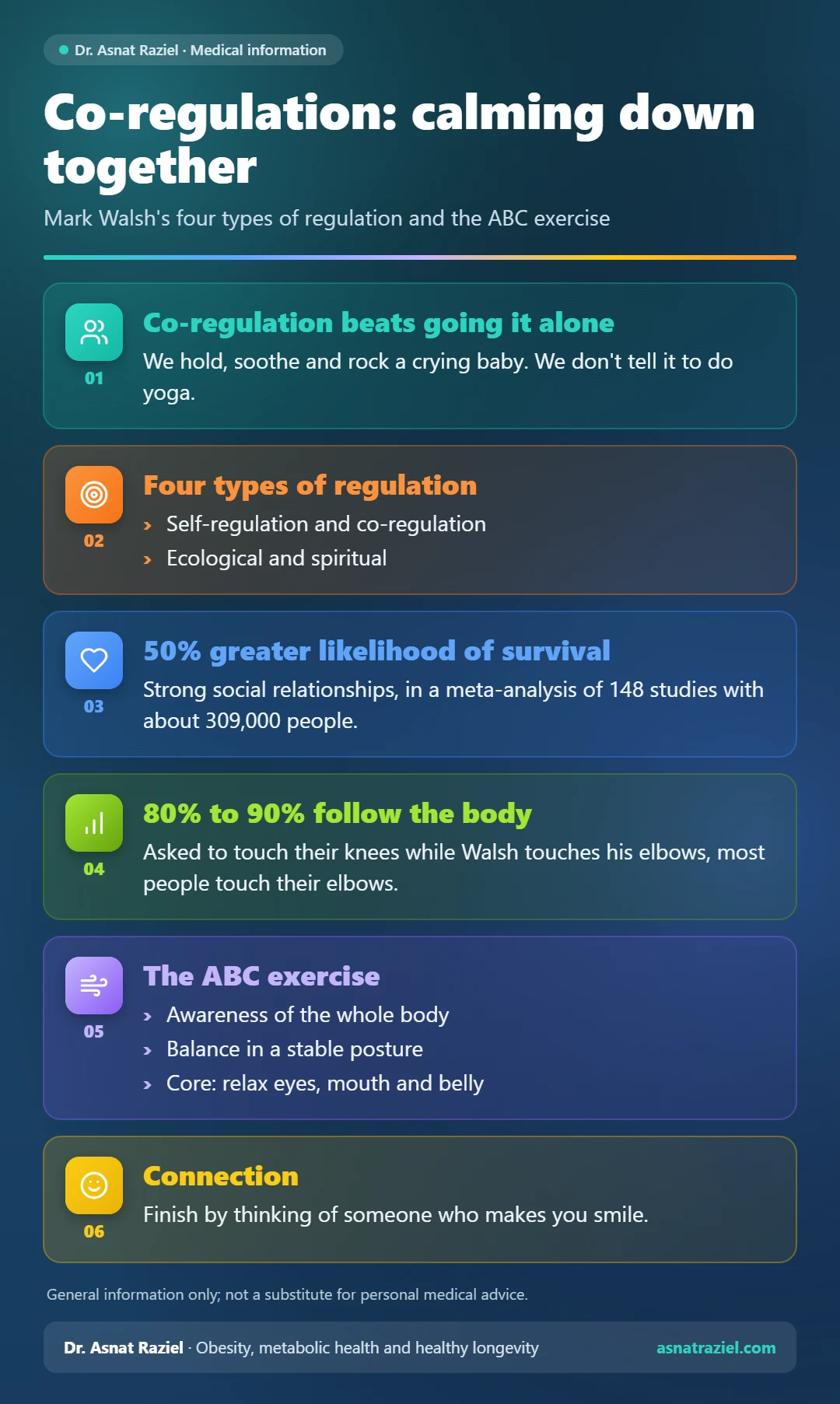
Co-regulation is the ability of nervous systems to calm one another. When a baby cries, nobody tells it to do yoga. Instead, we hold it, speak to it in a soft voice and rock it. According to Mark Walsh, this is what natural human regulation looks like. In his view, self-regulation matters, but co-regulation is far more effective.
Walsh is the founder of the Embodied Facilitator Course and the creator of the Embodiment Conference, as well as a longtime aikido practitioner. He also founded the charity Sane Ukraine, which teaches psychological first aid in war zones. At the Nervous System Reboot 2026 summit, he spoke with Michael Stone, founder of Neurodynamic Breathwork. Here are the highlights of their conversation.
A head on a stick: Walsh’s story
Walsh says that as a young man he was very clever in his head, and he read every book in his high school library. But after his first love ended, he was left heartbroken. He says he was also addicted to alcohol and depressed. When he began studying psychology at university, he realized that the answers were not in the library. So he walked into an aikido dojo for the first time. From there, he went on to dance, yoga and trauma work. Today, he says, he has been sober for many years.
Four types of regulation
Walsh argues that modern life has cut us off from four sources of balance. That is why he teaches a model of four types of regulation:
Self: the connection with your own body.
Co-regulation: the connection with people, family and community.
Ecological: the connection with nature and place.
Spiritual: the connection with faith, meaning or a higher power, in whatever way is right for you.
In his view, trauma is a disconnection from these four sources, and healing also comes through them. During the conversation, he also voices sharp and controversial social and cultural opinions. In this article, I will focus on the parts related to the body and to health.
Co-regulation and the research on relationships and longevity
Walsh’s idea is well supported by data. A meta-analysis of 148 studies with about 309,000 participants found that people with strong social relationships had about a 50% greater likelihood of survival. In other words, connection with other people is not a luxury. It is part of health.
According to Walsh, many people in big cities don’t know their neighbors. As far as the body is concerned, this is a state of deprivation. He calls it co-regulation poverty. So he recommends deliberately seeking out community, family and friends, rather than settling for practicing alone.
Leadership that starts in the body
Walsh describes an experiment he runs in talks all over the world. He asks the audience to touch their knees, and at the same moment he touches his own elbows. He says 80% to 90% of people touch their elbows. In other words, people follow the body, not the words.
He also tells the story of the first air-raid siren he heard in Ukraine, on the first day of a workshop. He was very frightened. But he took a deep breath, felt his feet on the floor and did a short centering exercise. Then he told the group they would walk to the shelter, not run. He says they trusted him then because he was a little more regulated than they were. This is the moment when self-regulation becomes co-regulation.
Here in Israel, we know these moments all too well. I have also written about wartime stress and about loneliness among older adults in wartime.
Not just calming down
According to Walsh, a good leader, a good parent or a good dog trainer knows how both to calm and to energize. When he plays with children, he “chases” them, and they run away laughing and come back asking for more. So, in his view, co-regulation is a dance between excitement and calm, not just soothing.
The ABC exercise: centering in a few seconds
Walsh led a short exercise you can do anywhere:
A – Awareness: Feel your whole body. If that is too much, listen to the sounds around you.
B – Balance: Find a stable posture that feels comfortable in every direction.
C – Core relaxation: Relax your eyes, your mouth and your belly.
Connection: Think of someone who makes you smile.
He also offers shorter versions. Lengthening your back and softening your front takes three seconds. In addition, there is an exercise for connecting with nature: as you breathe in, thank the trees for the oxygen. As you breathe out, give them back carbon dioxide. I wrote about a similar practice in my article on body awareness that calms the nervous system.
Flow with service
Walsh is critical of the pursuit of flow experiences (complete focus and enjoyment of the moment). He says he himself gets into such states while lifting weights and taking cold plunges. But if the goal is only to feel good, it is just another form of addiction. So he asks: Where is the service? What are we giving to our community?
Watch the full conversation: Mark Walsh on co-regulation
The conversation is in English and runs about 41 minutes. It was recorded at the Heart Mind Institute’s Nervous System Reboot 2026 summit.
Co-regulation, weight and healthy longevity
In my clinic, I see that people succeed more when they are not alone. Support from a partner, a group or a care team changes the outcome. I wrote about this in my article on social connections and longevity and in my article on talking with your family about obesity treatment.
The bottom line
Co-regulation reminds us that the nervous system was not built to work alone. According to Mark Walsh, the body, the people around us, nature and meaning are four anchors of balance. Some of the claims in the conversation rest on research, while others reflect his personal worldview. Either way, a good conversation with someone close to you is an excellent place to start.
The information in this article is general and does not replace personal medical or therapeutic advice.
Sources for further reading
Social Relationships and Mortality Risk: A Meta-analytic Review




