By Dr. Asnat Raziel, bariatric surgeon specializing in obesity treatment, metabolic health and healthy longevity; Director of the Multidisciplinary Center for Obesity Treatment, Assia Medical, Assuta Ramat HaChayal, Tel Aviv
Body awareness: the simple way to calm the nervous system
Body awareness may be the most accessible tool we have for calming the nervous system. Most of us live “from the neck up.” We think, plan and worry, and we forget that we have a body. Dr. Fleet Maull, who has taught meditation for about 50 years, argues that returning to the body is the first step toward real calm.
On the second morning of the Nervous System Reboot summit, he led a guided practice. Here I summarize the key ideas, and below you will find the full recording.
Why are we disconnected from our bodies?
According to Maull, our brain is a wonderful supercomputer. However, it is also very thrifty with energy. So it often replaces direct experience with a “concept” of the experience. For example, when we walk past a tree, the brain presents us with the idea “tree.” We don’t really meet the living tree in front of us.
The same thing happens with the body. We know the word “body” and the word “breath.” But we only rarely feel the sensations themselves: tingling, warmth, pressure, movement. In addition, modern life pulls our attention outward, toward screens and noise. As a result, our heads are full of endless thoughts.
What is body awareness, and why is it calming?
The scientific term is interoception, the body’s ability to sense itself from the inside. It is the ability to feel your heartbeat, your breath, your belly and your muscles. Researchers now see it as an important field of mental health research.
According to Maull, when we bring our attention back to the body, the nervous system naturally settles. For more on the body’s calming system, see my article on the parasympathetic nervous system. He describes a kind of “inner coherence”: heart rate, breathing and brain waves begin to work in sync. In his view, there is no limit to how deep we can go. Every part of the body is alive and feeling, including the bones and the internal organs.
Watch the full practice: a body awareness meditation with Fleet Maull
The practice is in English and lasts about half an hour. It was recorded at the Nervous System Reboot 2026 summit of the Heart Mind Institute. Maull also spoke there with Harry Massey, and I took a critical look at that conversation in my article on energy medicine.
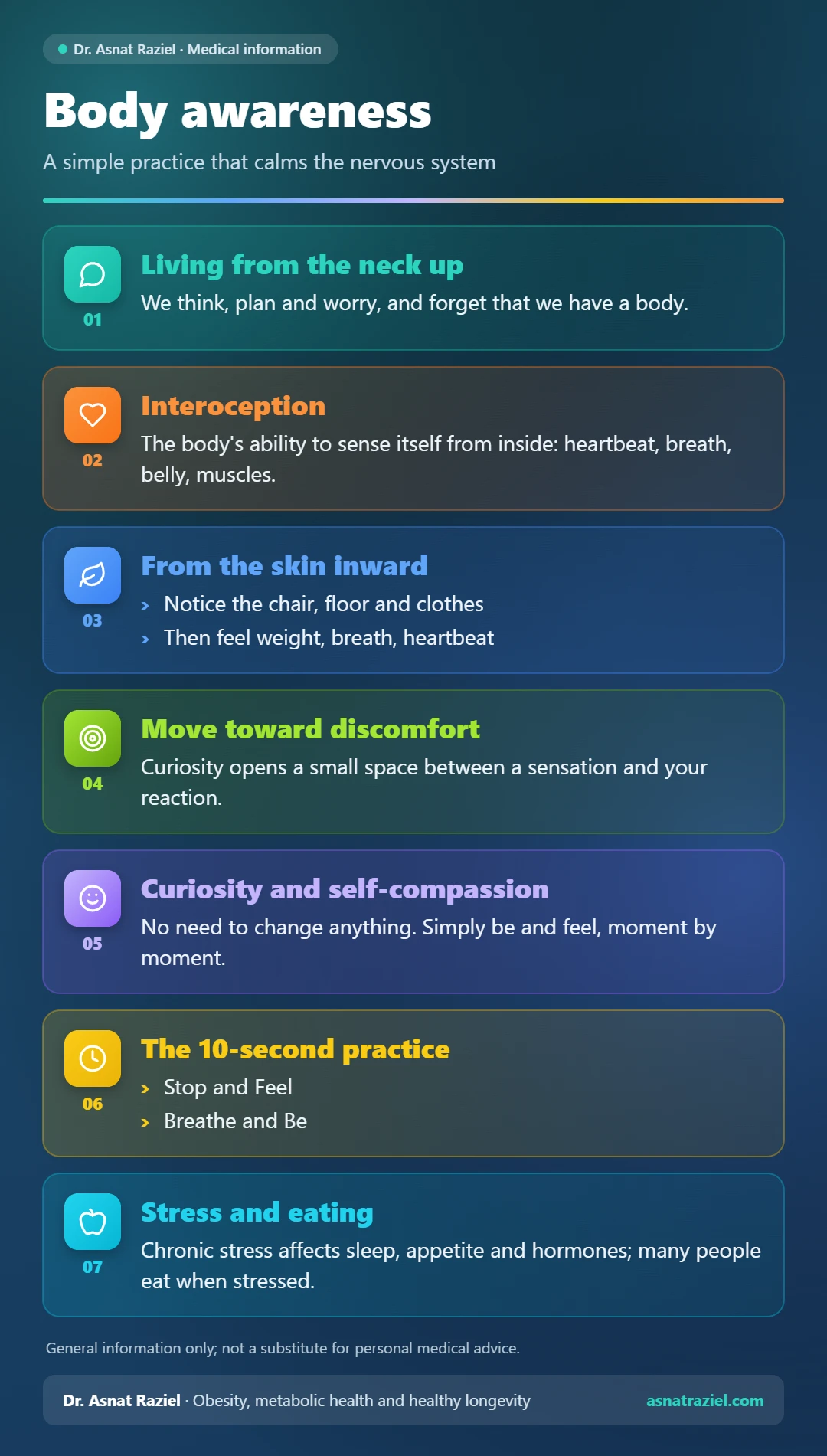
How to practice body awareness: from the skin to the inside of the body
Maull suggests starting from the outside. First, sit in an upright, relaxed posture, or lie down if that is more comfortable. Close your eyes and let your shoulders drop.
Next, notice the sensations on the surface of your skin. Feel the contact with the chair, your feet on the floor and your clothes on your skin. Even the air passing through your nostrils is a sensation. According to Maull, the skin is a huge sensory organ, and touch travels through especially fast nerve pathways.
Then move inward. Feel the weight of your body, the movement of your diaphragm as you breathe and, if you can, your heartbeat. Maull also suggests briefly picturing your skeleton. Imagination “primes the pump,” and the sensation follows.
Moving toward discomfort
One of the surprising ideas in the practice is how to relate to unpleasant sensations. Usually we run away from them. Maull invites us to do the opposite: to approach them with curiosity and without judgment. In his view, this is a way to wake up from automatic reactivity. That way, a small space opens between the sensation and our response. For more ways to train the mind, see my article on mental fitness.
Three automatic reactions worth knowing
Maull explains that every sensation comes with a “flavor”: pleasant, neutral or unpleasant. Each flavor triggers a familiar reaction. A pleasant sensation pulls us to cling to it and want more. A neutral sensation, on the other hand, makes us tune out and drift into thought. Meanwhile, an unpleasant one triggers the urge to push it away, and sometimes anger too.
In the Buddhist tradition, these three reactions are called “the three poisons.” According to Maull, the doorway to change lies in the small space between sensation and reaction. Of the three, discomfort is the best teacher. When we embrace it instead of running away, we “swim against the current” of habit. That is why it is energizing and strengthening.
The right attitude: curiosity and self-compassion
Technique matters, but attitude matters just as much. Maull recommends practicing body awareness with curiosity, acceptance and self-compassion. There is no need to change anything. The goal is simply to be with what is there, moment by moment.
He also describes the space around the body as supportive rather than empty. In his words, we can feel ourselves “held” within it, and that makes it easier to sit upright and calm. At the end of the practice, he sums up its essence in two words: be and feel. By the way, curiosity is also a workout for the brain, which is one more reason to cultivate it.
A 10-second practice for the middle of the day
Maull also offers a very short practice that suits any stressful moment. It is built on four words:
Stop: Quietly tell yourself “stop” or “pause.” This interrupts the automatic pattern.
Feel: Feel what is present right now in your body and emotions, even if it is frustration or sadness.
Breathe: Release your breath and let it flow.
Be: Open your eyes and widen your attention to the room and the world around you.
The whole sequence takes a few seconds. Even so, repeating it throughout the day builds a habit of body awareness.
Body awareness, stress and metabolic health
As a physician, I see a clear link to health. Chronic stress affects sleep, appetite and hormonal balance. Many patients eat when they are stressed, sometimes without noticing. That is why the ability to recognize tension in the body in time is an important tool.
I covered this in more detail in my article on stress and weight. I have also written about meditation and its link to metabolic balance and about improving sleep naturally. If you are looking for more tools, you will find them in my practical guide to stress relief techniques.
The bottom line
Body awareness requires no equipment and little time. All it takes is a willingness to stop and feel. According to Fleet Maull, surrendering to bodily experience is the foundation of self-regulation, and better health starts from there. It is worth trying the full practice, and coming back to the four words throughout the day.
The information in this article is general and does not replace personal medical or therapeutic advice. If you are dealing with anxiety, trauma or emotional distress, please reach out to a qualified professional.




