By Dr. Asnat Raziel, bariatric surgeon specializing in obesity treatment, metabolic health and healthy longevity; Director of the Multidisciplinary Center for Obesity Treatment, Assia Medical, Assuta Ramat HaChayal, Tel Aviv
Energy medicine: a personal recovery story and what research actually knows
Energy medicine is a field that promises to heal the body through “energy fields” and special devices. Harry Massey is a British entrepreneur, filmmaker and the founder of Energy4Life, a company that develops and markets devices of this kind. At the Nervous System Reboot 2026 summit, he spoke with Dr. Fleet Maull, founder of the Heart Mind Institute.
The conversation is interesting, but it deserves a critical read. Some of its claims are not supported by controlled medical research. So in this article I will separate the personal story, the claims about the devices, and the parts that truly rest on evidence.
The story: seven years in bed
At 21, Massey says, he went through three accidents: a fall from an ice wall in Scotland, a paragliding accident and a viral illness while climbing in the Alps. Afterward, he developed chronic fatigue syndrome (ME/CFS). He finished a master’s degree in a wheelchair, and for about seven years he barely left his bed.
He says he tried almost everything: a paleo diet, a vegan diet, fasting, infusions and ozone. Nothing helped. At some point, he decided to study not the disease but the source of energy in a healthy person. That is how he met an Australian scientist, who gave him liquid remedies that, he says, carry corrective “information.” Massey reports that within about two years he was functioning again.
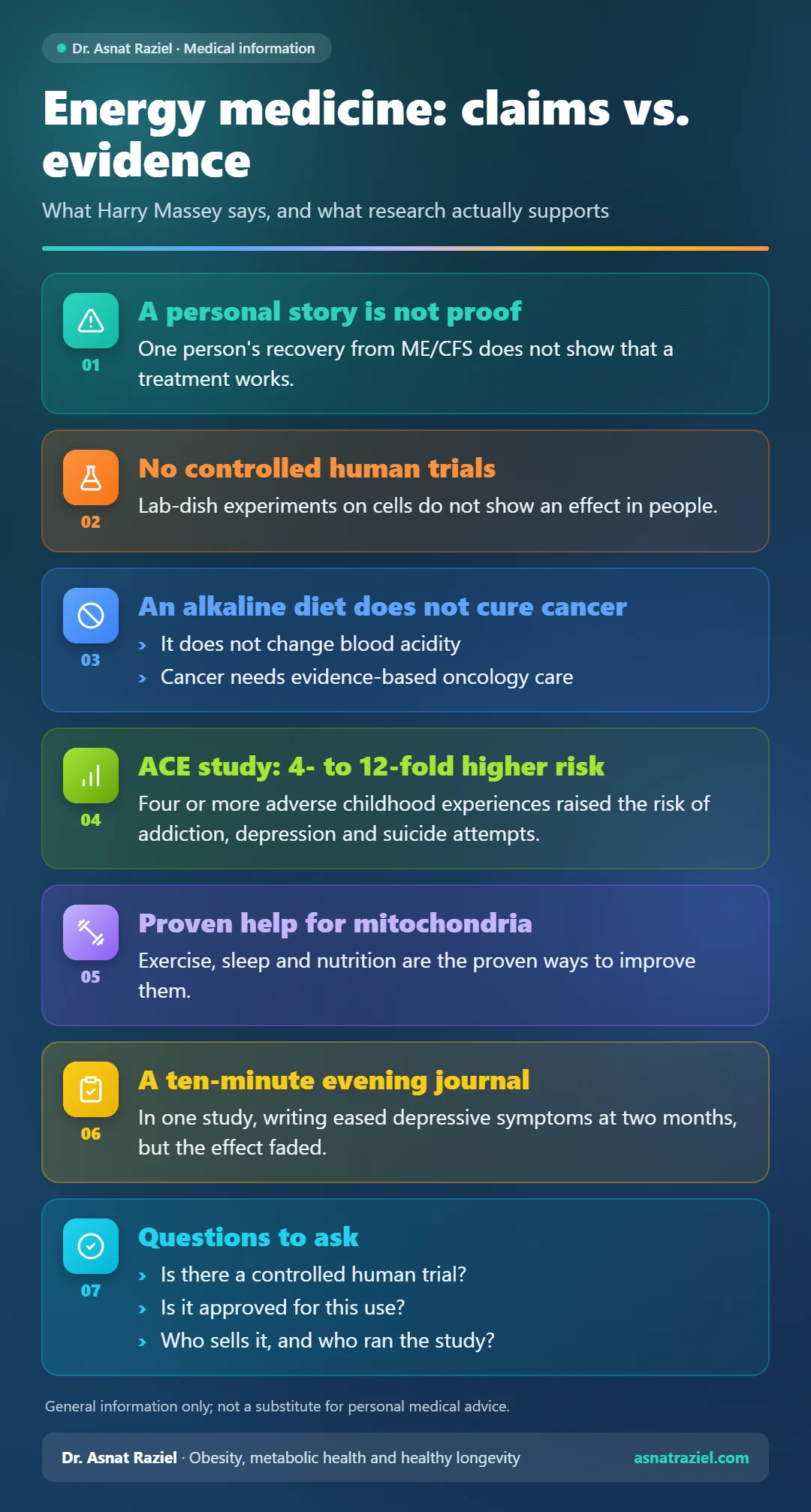
His personal story is moving, and there is no reason to doubt how much he suffered. Still, one person’s story is not proof that a treatment works. Chronic fatigue syndrome is a complex illness, and the road to recovery varies from person to person.
The claims about the devices: what we know
Massey describes three products. The first is a clinical device that combines a weak electrical current with red light. The second is a wristband that reads the “29 pulses” of Chinese medicine and transmits “corrective information.” The third is a line of liquid remedies he calls “infoceuticals.” According to him, the company ran laboratory experiments on cells and found an increase in mitochondrial density.
Here it is important to be precise. I did not find controlled clinical studies, published in medical journals, showing that the wristband or the remedies cure disease. Experiments in a lab dish do not show an effect in people. In addition, Massey himself noted that the clinical device is still going through the FDA approval process.
Cell voltage and cancer
Massey claims that when a cell’s electrical voltage drops below a certain threshold, the cell “forgets” its neighbors and turns into a tumor. He says cancer can be treated by raising that voltage, for example with an alkaline diet or with ozone. I want to say this clearly: there is no research evidence for this. An “alkaline” diet does not change the acidity of your blood, and it does not cure cancer. Anyone facing cancer needs evidence-based oncology care.
What in energy medicine does rest on evidence
Alongside the controversial claims, the conversation includes a few ideas that research does support.
Childhood trauma and health: Massey mentions the link between adverse childhood events and disease. The classic ACE study found that people who had experienced four or more categories of adverse childhood experiences had a 4- to 12-fold higher risk of alcoholism, drug abuse, depression and suicide attempts.
Negative emotion as an “energy leak”: According to Massey, anxiety and intrusive thoughts raise cortisol and switch on the fight-or-flight system. This is, in fact, well-known stress physiology. I wrote about it in my article on stress and obesity.
Mitochondria: Mitochondria are the power plants of the cell, and their health matters for healthy aging. However, the proven ways to improve them are exercise, sleep and nutrition. I wrote about this in my article on mitochondria and aging.
The simplest tool: a ten-minute journal
In fact, Massey’s simplest recommendation is also the most accessible one. Every evening, write down when you felt a negative emotion and why. Then ask yourself: How could I have reacted differently? What will I do next time? He says ten minutes a day is enough.
The research on expressive writing is encouraging, but modest. For example, a study of college students found that writing reduced depressive symptoms after two months, but the effect faded later on. In other words, you probably need to keep at it to benefit.
In addition, Fleet Maull describes a body-based meditation practice that gradually deepens your inner sense of the body. I wrote about a similar practice in my article on body awareness.
How to evaluate energy medicine treatments
Many patients ask me about devices and remedies of this kind. Here are a few questions worth asking:
Research: Is there a controlled trial in humans, published in a medical journal?
Approval: Has a regulatory agency approved the device for this use?
Interests: Who sells the product, and who ran the study?
Cost: Does the treatment replace proven care, or only add to it?
I wrote about similar questions in my article on the peptide craze.
The bottom line
Energy medicine tells an appealing story about a body that heals through information and energy fields. But based on what we know today, the claims Harry Massey makes about his devices, his remedies and curing cancer are unproven. On the other hand, some of his advice, such as paying attention to your emotions and keeping a journal, is simple, safe and worth a try.
The information in this article is general and does not replace personal medical advice.
Sources for further reading
The durability of beneficial health effects associated with expressive writing




