By Dr. Asnat Raziel, bariatric surgeon specializing in obesity treatment, metabolic health and healthy longevity; Director of the Multidisciplinary Center for Obesity Treatment, Assia Medical, Assuta Ramat HaChayal, Tel Aviv
Mental fitness: training the brain the way we train a muscle
Mental fitness is the ability to train the brain and the nervous system, just as we train a muscle. That is the view of John Assaraf, a behavior and mindset expert and the founder of NeuroGym. Assaraf has written several books, including the bestsellers Having It All and The Answer. At the Nervous System Reboot 2026 summit, he spoke with Dr. Fleet Maull, founder of the Heart Mind Institute. Their topic was resilience, flow and performance. Here are the highlights, along with what the research says about them.
A personal story: alcohol, sugar and a fatty liver
Assaraf opens with a candid admission. He says that he was once addicted to alcohol and sugar and carried about 20 kg (45 pounds) of excess weight. On top of that, he had a fatty liver from alcohol and sugar, and he had prediabetes. He slept poorly, felt exhausted and struggled to function at work.
Later, he went through a painful split with a business partner who was also his best friend. In his words, events like these are big waves that knock the boat off course. Sometimes for an hour, and sometimes for a year or more. That is part of why he has spent four decades studying the brain and the nervous system.
I know this story well from my clinic. Fatty liver and prediabetes often come together with poor sleep and fatigue. That’s why treatment has to address both body and mind.
The brain works the same way in all of us
Assaraf compares the brain to a car. Every electric car works the same way anywhere in the world. Likewise, he says, the brain works in much the same way in almost all of us. In other words, most of the tools can be learned, just as we learn to drive. In his view, most suffering comes from a lack of knowledge, not a lack of ability.
Fleet Maull adds a sharp distinction. Some people know that the nervous system can be regulated, and some don’t know it yet. For those who don’t, he says, their nervous system is regulated by everyone except themselves.
Einstein and Frankie: three networks in the brain
Assaraf describes three major brain networks. The first is the executive network, which he nicknames Einstein. It handles decision-making, goal setting and planning. The second is the salience network, which flags what matters to us at any given moment.
The third is the default mode network, which is active when the mind wanders. Assaraf calls it Frankie, after Frankenstein’s monster. According to him, this is the network that conjures up horror scenarios: what if I fail, what if things get worse? The more we repeat negative self-talk, the more the body releases chemicals that make us feel bad.
How many thoughts pass through our minds each day?
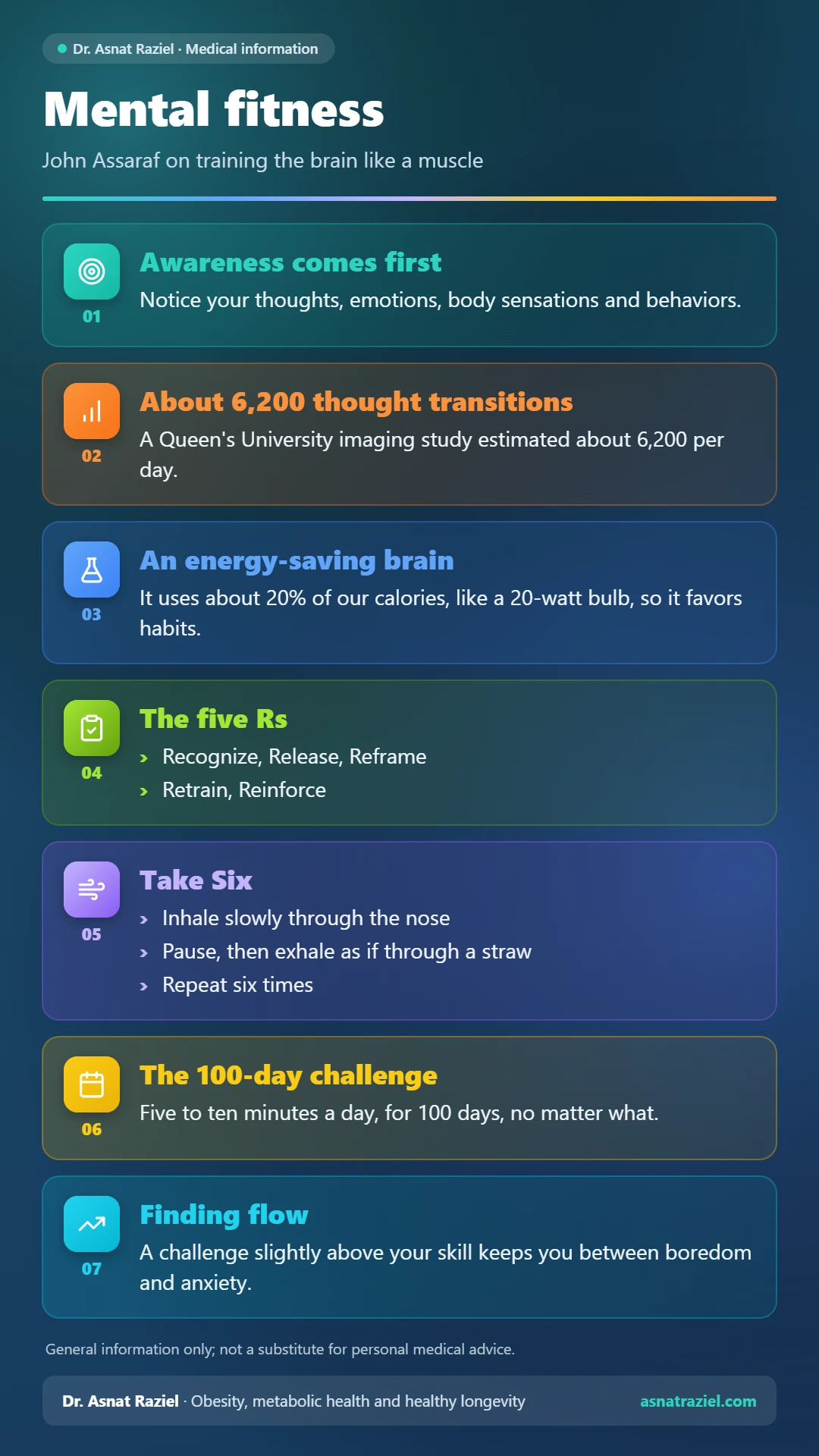
Assaraf cites a Canadian study that estimated about 6,200 to 6,500 thoughts a day. Indeed, a brain imaging study from Queen’s University estimated about 6,200 transitions between thoughts per day. According to Assaraf, about 80% of the average person’s thoughts are negative. However, the study itself did not look at the content of thoughts, so I did not find the negativity figure in it.
Automaticity: why mental fitness takes practice
Assaraf brings up Pavlov’s dog. At first, the bell meant nothing. Then the bell came together with food. Eventually, the bell alone made the dog salivate. He says that we, too, run on earlier training for most of the day, rather than on our goals.
The reason, he explains, is energy saving. The brain is small relative to the body, yet it uses about 20% of our calories. Its power output is similar to a small 20-watt light bulb. As a result, the brain is an energy miser, and that is why mental fitness is built only through repetition. Every pattern we repeat becomes automatic, including worry and negative thinking. In neuroscience, this is called automaticity.
Mental fitness starts with awareness
According to Assaraf, the first muscle worth training is awareness. He doesn’t mean only what happens outside us, but above all what happens inside: thoughts, emotions, body sensations and behaviors. Assaraf calls this practice an Innercise, a play on the word exercise.
Many people say they can’t meditate. Assaraf doesn’t accept that. He points out that when we are absorbed in a movie, a book or a walk in nature, we are already in a meditative state. So he suggests spending five to ten minutes a day on this training, much like a daily walk for the heart. I have also written about a simple practice that calms the nervous system.
The spin in front of the screens
Assaraf describes a bad workday. His assistant sat next to him while he shuffled files between four screens for half an hour. Suddenly he realized he was stuck in a loop. He went upstairs, looked out at the ocean and breathed for six or seven minutes. Then he came back, and within an hour the two of them had finished all the work.
He says that the ability to spot a pattern like this is an advanced skill. Meditation leads to mindfulness, that is, awareness without judgment. Mindfulness, in turn, puts us back behind the wheel.
The five Rs method
Assaraf teaches a five-step process, and each step starts with the letter R:
Recognize: notice the thought, emotion, sensation and behavior.
Release: lower the arousal, for example with your breath, before the loop gets stronger.
Reframe: when there is time to think, choose an interpretation that doesn’t weaken you.
Retrain: practice a new response.
Reinforce: repeat it until it becomes a habit.
The mental fitness breathing exercise: Take Six
One of the first exercises Assaraf teaches is called Take Six. Here is how to do it:
Inhale: breathe in slowly and deeply through your nose.
Pause: hold the air for a second or two.
Exhale: breathe out slowly through your mouth, as if you were blowing through a straw.
Repeat: do this six times.
According to him, this lowers the activity of the sympathetic nervous system, the fight-or-flight system. Fleet Maull adds that straw breathing is one of the first tools he teaches first responders. In his experience, it changes their lives. I’ve also written about another body-based technique, EFT tapping.
The research does support the idea. In a controlled study from Stanford University, participants practiced for five minutes a day for a month. Breathing that emphasized a long exhale improved mood and lowered breathing rate more than mindfulness meditation did. In addition, a systematic review of slow breathing linked it to higher heart rate variability and a sense of calm. If you feel dizzy, stop and return to normal breathing.
The 100-day challenge and the brain’s persistence muscle
Assaraf suggests a simple experiment. Commit to five to ten minutes a day, for 100 days, no matter what. He says the decision itself already changes the chemistry of the brain. He describes a brain region called the aMCC, the anterior midcingulate cortex, and calls it the muscle we use when we don’t feel like doing something. A review by researchers from Harvard does suggest that this region weighs effort against reward and is linked to persistence. Even so, this is still a research hypothesis.
Three years ago, at 61, Assaraf decided to brush his teeth with his left hand. At first, he says, there was toothpaste everywhere. Even now, after about two thousand repetitions, his right hand still “wants” to grab the brush. Meanwhile, Fleet Maull says he ends every shower with cold water. His main reason, he explains, is to show the laziness circuit who’s in charge. So try writing your name with your other hand, and notice how much your brain resists.
Flow: between challenge and skill
Assaraf explains when we enter a state of flow, a state of full focus and enjoyment of the task. It happens when the challenge rises a little and our skill is just enough to meet it. When arousal is too high, we slide into stress and anxiety. On the other hand, when the challenge is too low, we get bored.
According to his slide, several neurotransmitters take part in flow: norepinephrine for alertness, dopamine for drive and reward, oxytocin for trust and connection, and serotonin for mood. Hence his practical advice: choose a challenging goal, give it a deadline, and start taking action.
Assaraf also stresses curiosity. He says that curiosity and a passion for learning reignite the brain’s plasticity. I wrote about this at length in my article on curiosity and brain health. Failure has a role, too. In his view, you are not a failure; it is only what you did that failed. So it’s worth pausing to ask what we learned.
Watch the full conversation: John Assaraf on mental fitness
The conversation runs about 56 minutes. It was recorded at the Heart Mind Institute’s Nervous System Reboot 2026 summit. Fleet Maull also spoke there with Harry Massey, and I review that conversation in my article on energy medicine.
What this means for weight and healthy longevity
For me, the most important part of the conversation is the link between mind and body. Ongoing stress affects our sleep, our appetite and our food choices. I wrote about this in my article on the biological mechanism linking stress and obesity, and in my practical guide to overcoming emotional eating.
At our center, obesity treatment also includes support for the mind. Alongside the physician and the dietitian, I refer patients as needed to psychologists, yoga and stress-reduction techniques. As Assaraf says, the goal is to live better over the long term.
The bottom line: mental fitness is a daily habit
Mental fitness is not an inborn talent. According to John Assaraf, it is a skill you practice for a few minutes a day. You start with awareness, continue with breathing, and strengthen it with persistence. Some of the claims in the conversation rest on research, and some on his personal experience. Either way, a small, consistent step is a good place to start.
The information in this article is general and does not replace personal medical or therapeutic advice.
Sources and further reading
Brief structured respiration practices enhance mood and reduce physiological arousal
The Tenacious Brain: How the Anterior Mid-Cingulate Contributes to Achieving Goals




