By Dr. Asnat Raziel, bariatric surgeon specializing in obesity treatment, metabolic health and healthy longevity; Director of the Multidisciplinary Center for Obesity Treatment, Assia Medical, Assuta Ramat HaChayal, Tel Aviv
Fatty liver disease: a silent, common condition that can be reversed
Fatty liver disease is a condition in which fat builds up in the liver cells, and it is usually discovered by chance on an ultrasound or a blood test. There are almost never any symptoms, so many people have no idea they have a problem. The good news is that weight loss, physical activity and the right medication can turn the liver around. In this article I will explain the disease’s new name, how to diagnose it correctly and which treatments have been proven in studies.
What is fatty liver disease, and what do MASLD and MASH mean?
For years the disease was called NAFLD, nonalcoholic fatty liver disease. In 2023 the world’s major liver societies agreed on new names that emphasize the link to metabolism. The new name is MASLD, metabolic dysfunction-associated steatotic liver disease. To diagnose it, there must be fat in the liver plus at least one of five cardiometabolic risk factors: overweight or a large waist circumference, high blood sugar or diabetes, high blood pressure, high triglycerides, or low HDL.
It is also important to know about MASH, metabolic dysfunction-associated steatohepatitis (formerly NASH). In this condition the fat causes inflammation and damage to liver cells. Over time, the inflammation can lead to fibrosis, meaning scarring of the liver tissue, and at an advanced stage to cirrhosis. The US National Library of Medicine also explains the new names in plain language.
How common is it?
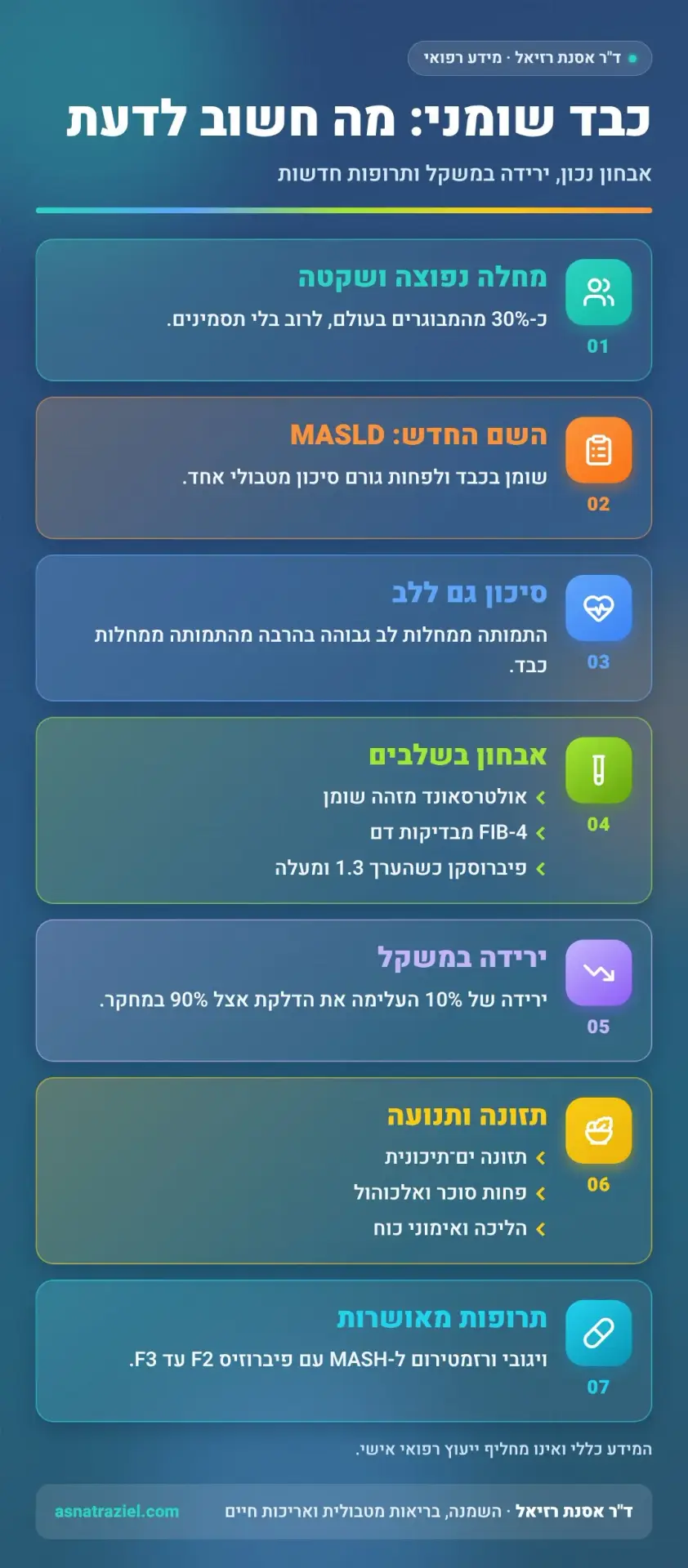
According to a large global review, about 30% of adults worldwide live with the disease. What’s more, prevalence rose to 38% in 2016-2019. In other words, nearly one in three adults. Prevalence is especially high among people with obesity and type 2 diabetes. You can find more general information in the encyclopedia entry on fatty liver disease.
Why fatty liver disease is dangerous for the heart too
Most people with the disease will not develop cirrhosis. Their risk of cardiovascular disease, however, rises significantly. For example, the global review found that the death rate from heart disease in this population was more than four times the death rate from liver disease. I have discussed this link in more depth in my article on the liver and cardiac risk.
What determines the outlook for the liver itself is the degree of fibrosis. A liver with fat alone is a relatively stable condition. Moderate or more advanced scarring, on the other hand, raises the risk of cirrhosis and liver cancer. So the goal of the workup is to identify, in time, anyone who already has fibrosis.
Diagnosing fatty liver disease: ultrasound, FIB-4 and FibroScan
Diagnosis usually starts with an abdominal ultrasound. This test detects fat, but it does not measure scarring. That is why the guidelines of the American Association for the Study of Liver Diseases (AASLD) recommend a stepwise workup:
- Step one: calculate the FIB-4 score, an index calculated from age, liver enzymes (AST and ALT) and platelet count.
- A score below 1.3: the risk of significant fibrosis is low, and monitoring continues.
- A score of 1.3 or higher: the next step is a FibroScan, an elastography test that measures liver stiffness without a needle.
- A high-risk finding: referral to a hepatologist, a liver specialist, for further evaluation.
A liver biopsy is needed today in only a few cases. I have set out the full protocol I follow in my guide to the FIB-4 and FibroScan workup.
Treating fatty liver disease: weight loss is the foundation
The most important treatment is still weight loss. A study with repeat biopsies followed 293 patients with steatohepatitis for one year. All patients who lost 10% or more of their body weight improved their disease activity score. In addition, inflammation resolved in 90% of them, and scarring regressed in 45%. In other words, even a 5% to 7% loss already reduces fat and inflammation, but 10% changes the picture.
Nutrition and exercise
A Mediterranean-style diet is especially well suited here: vegetables, legumes, fish, olive oil and whole grains. It is advisable to cut back on sugary drinks, processed food and alcohol. Physical activity also reduces liver fat even without major weight loss, so it is worth combining brisk walking and strength training several times a week.
Changing habits works when it becomes part of your daily schedule, just like any other regular commitment. So it helps to plan the week’s meals and workouts in advance. And if thoughts about food just won’t let up, it is worth reading about “food noise” and how it is treated. I have also written about the link between weight loss and liver improvement in my article on treating fatty liver through weight loss.
Medications for fatty liver disease with fibrosis
Until recently there was no approved drug for the disease. Today there are two, both for adults with MASH and moderate to advanced fibrosis (F2 to F3), without cirrhosis:
Wegovy
On August 15, 2025, the FDA approved Wegovy, that is, semaglutide 2.4 mg once a week, for treating the disease. This is an accelerated approval, based on the ESSENCE trial. After 72 weeks, inflammation resolved in 62.9% of patients on the drug, compared with 34.3% on placebo. Scarring also improved in 36.8%, compared with 22.4% on placebo. More details are in my guide to Wegovy for MASH.
Rezdiffra
Rezdiffra, or resmetirom, is a daily pill that acts directly on the liver. The FDA approved it in March 2024, and the European Commission approved it in August 2025 under a conditional approval. In the MAESTRO-NASH trial, inflammation resolved in 25.9% to 29.9% of patients, compared with 9.7% on placebo. Scarring improved in 24.2% to 25.9%, compared with 14.2% on placebo.
Other drugs are being studied in parallel, such as survodutide and medications from the GLP-1 family. There is also interest in supplements such as berberine, but the evidence for them is limited. I bring together all the drug options on the page Medications for obesity and metabolic disease.
The bottom line
Fatty liver disease is common and silent, but it is not a life sentence. The first step is a simple workup: blood tests, a FIB-4 calculation and, if needed, a FibroScan. After that, losing 7% to 10% of body weight is the most effective treatment. For those who already have fibrosis, approved medications are now available too. If you have fat in your liver and excess weight, it is worth building a structured treatment plan with a doctor who knows the field. In our clinic, led by Dr. Asnat Raziel, the workup and treatment are carried out by a multidisciplinary team.
The information in this article is general and does not replace personal medical advice.
Frequently asked questions
Can fatty liver disease go away?
Yes, in many cases. In the biopsy study, a 10% weight loss cleared the inflammation in 90% of patients, and in about half, scarring regressed.
Is an ultrasound enough for diagnosis?
No. An ultrasound detects fat, but not the degree of scarring. That is why a FIB-4 calculation is added and, if needed, a FibroScan.
Can you have the disease at a normal weight?
Yes. It also occurs in lean people with diabetes, high blood pressure or high blood lipids. So the workup is appropriate for anyone with a metabolic risk factor.
Who receives medication for the disease?
The approved drugs are intended for adults with steatohepatitis and F2 to F3 fibrosis, without cirrhosis. The decision is made after a full workup by a doctor.
Sources
A multisociety Delphi consensus statement on new fatty liver disease nomenclature
Phase 3 Trial of Semaglutide in Metabolic Dysfunction-Associated Steatohepatitis
A Phase 3, Randomized, Controlled Trial of Resmetirom in NASH with Liver Fibrosis