By Dr. Asnat Raziel, bariatric surgeon specializing in obesity treatment, metabolic health and healthy longevity; Director of the Multidisciplinary Center for Obesity Treatment, Assia Medical, Assuta Ramat HaChayal, Tel Aviv
The parasympathetic nervous system: getting back to rest
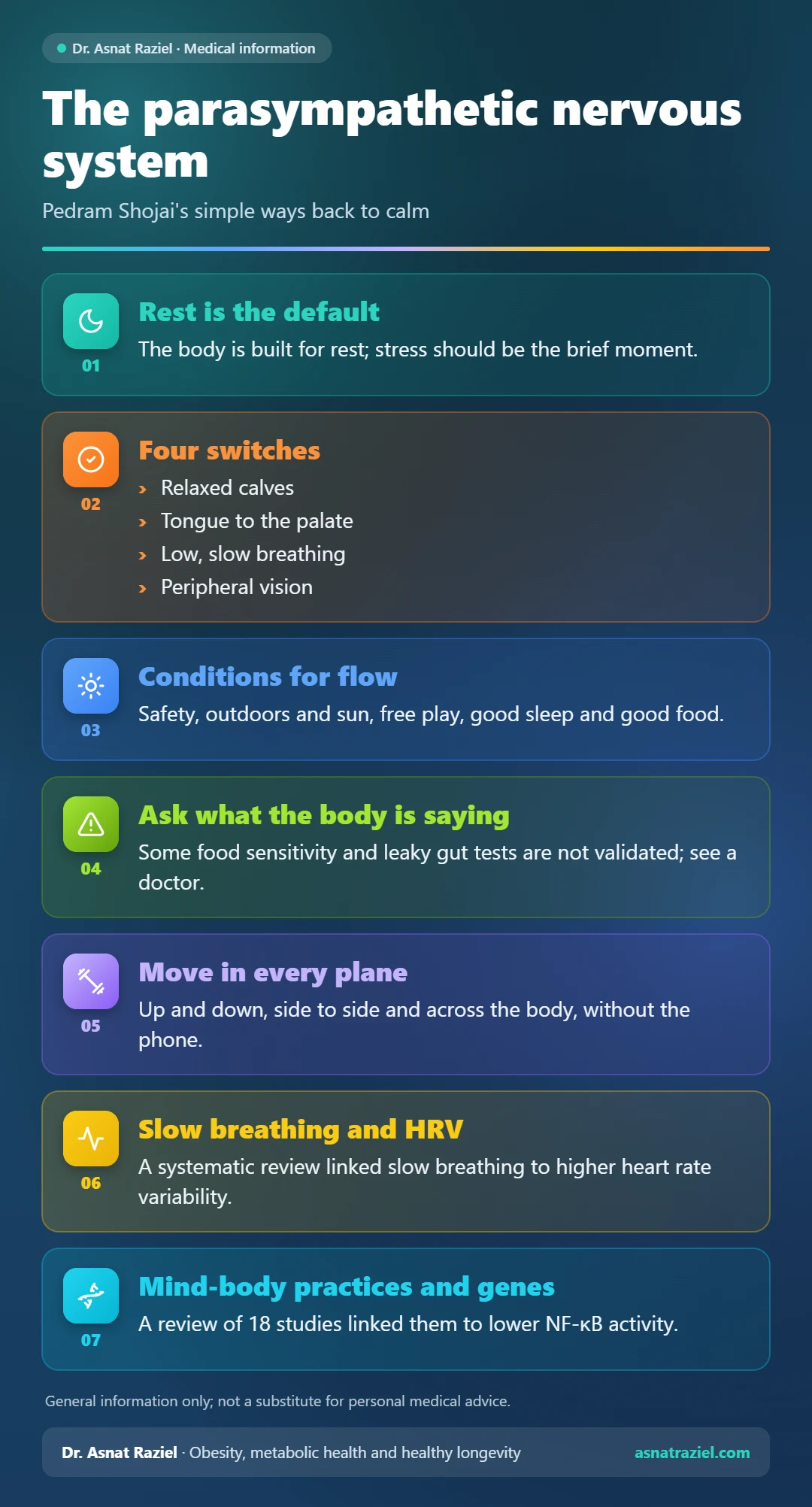
The parasympathetic nervous system is the part of the nervous system in charge of rest, digestion and recovery. By contrast, the sympathetic nervous system drives the fight-or-flight response. According to Dr. Pedram Shojai, most of us live in stress mode almost all the time. Yet in his view, the body was designed to live in a state of rest. In other words, stress is supposed to be the brief moment, not the default.
Shojai is a doctor of Oriental medicine, a qigong master and the author of the bestseller The Urban Monk. At the Nervous System Reboot 2026 summit, he spoke with a psychologist who specializes in anxiety. Here are the highlights of their conversation, along with what the research says.
The urban monk: no need to run away to the mountains
Shojai spent years studying in monasteries. There, he says, there was time for four hours of meditation and yoga a day. But when he returned to the city to raise a family and work as a physician, he realized that his patients had no such time. So he looked for a way to live mindfully in the middle of a busy life, without escaping to the mountains.
He also distinguishes between two kinds of help. One is a Band-Aid, a technique that eases anxiety for the moment. The other is treating the root cause. According to him, anxiety sometimes stems from poor lighting, from food the body doesn’t tolerate, or from a conversation we dread having with our partner. That’s why it’s worth asking what is causing the anxiety, and not just how to silence it.
Four switches that turn on the parasympathetic nervous system
Shojai describes several simple levers that the body understands right away. He says each one signals to the nervous system that we are safe:
Relaxed calves: bend your knees slightly and relax your calf muscles.
Tongue to the palate: rest the tip of your tongue against the roof of your mouth.
Diaphragmatic breathing: breathe slowly and low, into your lower belly.
Peripheral vision: widen your gaze to the sides instead of focusing on a single point.
He explains peripheral vision with the example of an antelope. When it grazes peacefully, its gaze is wide. When a lion appears, its gaze narrows to a single point and the body goes into stress. We, on the other hand, spend hours staring narrowly at a small screen. He compares this to training only your chest muscles and neglecting your back. So it’s worth lifting your head from time to time and looking at the horizon, a tree or the sea.
Small moments that add up
The host calls these moments micro-moments of regulation. Shojai flips the equation. In his view, moments of calm should be the main thing, and stress should be the brief moment. Think of early humans, who ran from a tiger and then went back to resting. Dr. Ronald Siegel offers a gentle approach to the same goal, which I cover in my article on self-compassion and mindfulness.
When the parasympathetic nervous system makes room for flow
Shojai asks us to recall a happy childhood summer. He remembers a summer at his uncle’s place, by a lake. What was there? We felt safe, we were outdoors in the sun, we played freely, we slept well and we ate good food. According to him, these are the conditions for a state of flow, that is, full focus and enjoyment of the moment.
That’s why, he says, there is no single thing that fixes everything. He compares it to growing a tomato. The seed matters, but you also need good soil, water and sunshine. In the same way, the body needs a healthy gut, good breathing, movement, sunlight and community, all together.
When the body speaks the language of anxiety: the gut and the nervous system
Shojai says that in the past, as a tough monk, he told patients who couldn’t meditate that they were simply lazy. Later he decided to believe them and sent them for tests. In most cases, he says, he found signs of a damaged gut barrier and food sensitivities. After two or three months of treatment, they were sleeping and meditating again.
One of his lines has stayed with me: the body doesn’t speak English. Instead, it speaks the language of anxiety, insomnia and illness. We, meanwhile, answer it with an espresso, a painkiller or a sedative. So he suggests pausing to ask what the body is trying to say.
Still, it’s important to be precise here. Some “food sensitivity” and “leaky gut” tests are not validated in mainstream medicine, and their results are hard to interpret. So it’s best to look into gut symptoms and fatigue with a doctor. I have also written about the microbiome and biological age, and about the gut barrier and aging.
Switching the senses back on
According to Shojai, we have far more than five senses. There is a sense of what is happening inside the body, a sense of where our limbs are, and a sense of balance. In addition, there is what he calls a sense of safety, meaning the nervous system’s ability to detect whether we are protected. He says we have handed most of these senses over to our screens. Mark Walsh, by contrast, looks at safety through our connection with other people, as I describe in my article on co-regulation.
Here is the morning exercise he suggests. Hold your cup of coffee or tea. Feel its warmth and the texture of the cup. Next, smell the aroma. Finally, drop your breath into your belly and feel your feet on the floor. This way, he says, you turn the lights back on one at a time. I wrote about a similar practice in my article on stress relief techniques that calm the nervous system.
Movement in every plane, with presence
Shojai doesn’t ask everyone to take up martial arts. Yoga, dance or basketball work just as well. What matters, he says, is moving up and down, side to side, and across the body. For example, touch your right elbow to your left knee, crawl and rotate.
But the more important question, according to him, is where we are while we move. Stretching while scrolling Instagram isn’t really stretching. So he suggests putting the phone down and breathing into your big toe. He compares it to the Normandy landings. A single moment of awareness is a beachhead, and from there you can expand into the whole day.
A guided exercise to activate the parasympathetic nervous system
During the conversation, Shojai guided a short exercise. You can do it sitting down, for a few minutes:
Tongue: rest the tip of your tongue against the roof of your mouth.
Belly balloon: as you inhale, inflate an imaginary balloon in your lower belly, and as you exhale, let it empty.
Posture: sit on your sit bones and lengthen your spine, as if a string were pulling the crown of your head upward.
Release: relax your face, jaw, shoulders and calves.
Balance: notice a gentle sway of the body forward and back.
Listening: try to hear your heartbeat, and then the sounds in the room.
Research on slow breathing supports the idea. A systematic review of slow breathing found that it raises heart rate variability, a marker of activity in the calming branch of the nervous system. In addition, it was linked to relaxation and lower anxiety.
What happens at the level of our genes?
Shojai claims that mind-body practices reduce inflammation. Indeed, a systematic review of 18 studies found that practices such as meditation, yoga and qigong are linked to lower activity of NF-κB. This is a genetic switch that turns on the inflammatory response during stress. However, the researchers note that more research is needed. Shojai also describes a clinical trial he is running now. The trial measures heart rate variability, sleep, salivary cortisol and inflammatory markers. He says he won’t publish any numbers until the trial ends.
Awareness at any speed
Slowness is not the goal in itself. Shojai runs three times a week, four miles (about 6.4 km) each time, with two Labradors in the woods. He also skis through the trees. At that speed, he says, he doesn’t have the luxury of thinking. That’s why awareness needs to stay with us at every speed.
He compares it to a manual transmission. To change gears, you press the clutch. In his view, the breath is the brain’s clutch, and it lets us shift between stress, calm, creativity and focus. John Assaraf also talks about breathing and habits, as I describe in my article on mental fitness.
Watch the full conversation: Pedram Shojai on the nervous system
The conversation runs about 49 minutes. It was recorded at the Heart Mind Institute’s Nervous System Reboot 2026 summit.
The parasympathetic nervous system, weight and healthy longevity
I see this connection in my clinic every day. Ongoing stress disrupts sleep, increases appetite and makes good choices harder. I wrote about this in my article on stress and obesity, and about meditation, emotional eating and weight.
That’s why obesity treatment at our center also includes the mind. Alongside the physician and the dietitian, I refer patients as needed to psychologists, yoga, Pilates and stress-reduction techniques. As Shojai says, the answers begin with listening to the body.
The bottom line
The parasympathetic nervous system is the baseline state our bodies were built for. According to Pedram Shojai, we can return to it with a few simple steps: low breathing, a wide gaze, relaxed muscles and attention to the senses. Some of the claims in the conversation rest on research, and some on his personal experience. Either way, a few minutes a day is a good start.
The information in this article is general and does not replace personal medical or therapeutic advice.




