By Dr. Asnat Raziel, bariatric surgeon specializing in obesity treatment, metabolic health and healthy longevity; Director of the Multidisciplinary Center for Obesity Treatment, Assia Medical, Assuta Ramat HaChayal, Tel Aviv
Microbiome and biological age: it is not only genes that set the pace of aging
The link between the microbiome and biological age is one of the most intriguing directions in aging research today. For years, research focused on genes, epigenetics and lifestyle. Now another player is joining in: the population of bacteria living in the gut. A new study from the University of Hawaii, published in July 2026 in the journal Scientific Reports, found a link between the makeup of gut bacteria and the pace of biological aging. The link held even after the researchers accounted for chronological age.
The findings support a growing understanding. The gut is not just a digestive organ. Rather, it is a biological system that affects inflammation, metabolism, the immune system and perhaps aging itself. I also wrote about the link between gut bacteria and inflammation in my article on obesity, inflammation and gut bacteria.
What did the study look at?
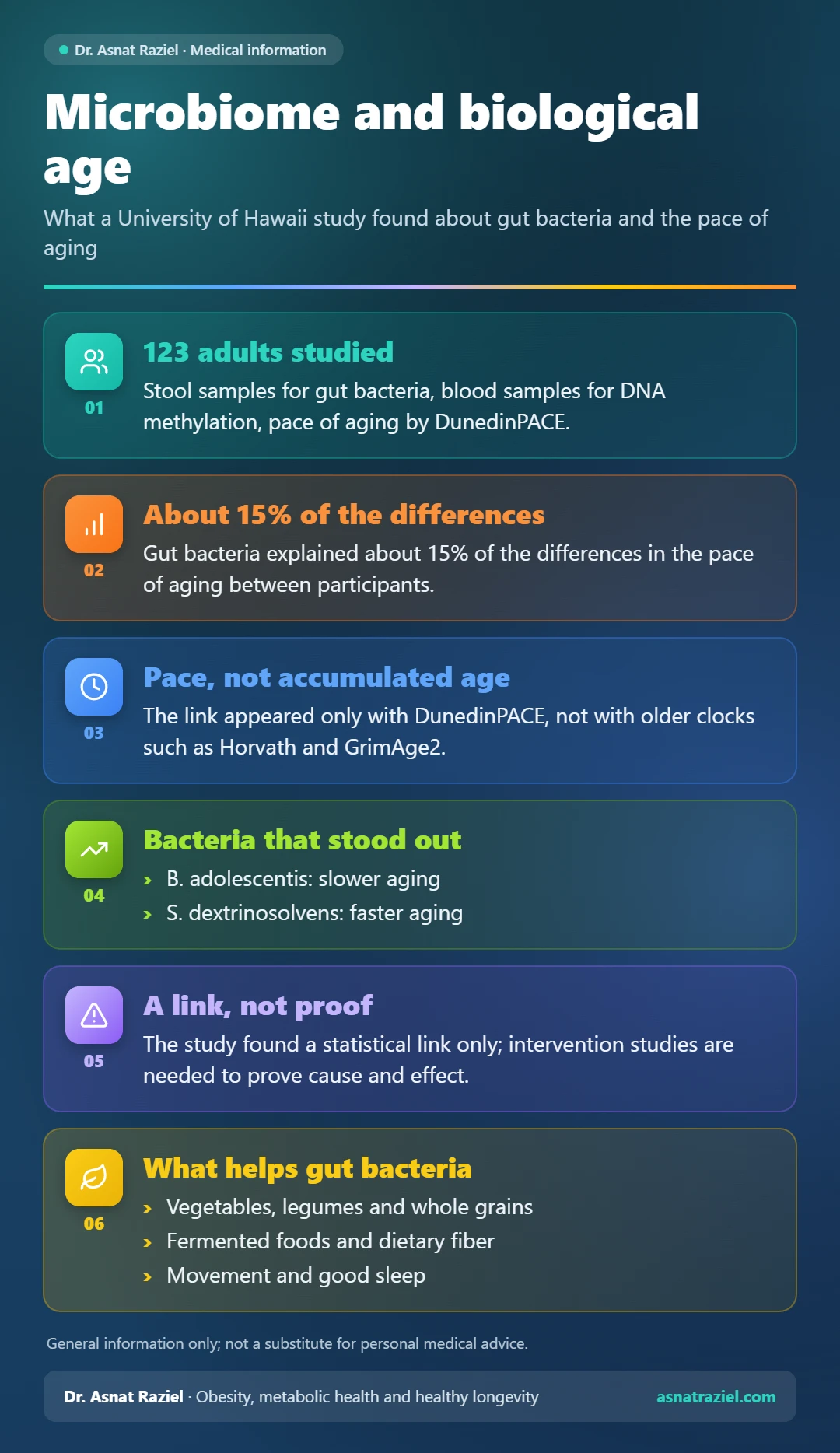
The study included 123 adults of different ages, among them Native Hawaiians and Pacific Islanders. The researchers collected stool samples to profile the gut bacteria. At the same time, they tested blood samples and analyzed chemical marks on the DNA, known as DNA methylation. From these data, they calculated the pace of aging using a measure called DunedinPACE.
Next, the researchers built machine learning models. These models tried to predict each participant’s pace of aging from their gut bacteria alone.
Microbiome and biological age: about 15% of the differences
The result was surprising. According to the university’s announcement, differences in gut bacteria explained about 15% of the differences in the pace of aging between participants. That is a meaningful share for a single biological system. In addition, adding chronological age to the model did not improve the prediction. In other words, the link is not simply because older people carry different bacteria.
However, there is an important detail. The models could not predict the older epigenetic clocks, such as the Horvath clock and GrimAge2. The link appeared only with DunedinPACE, which measures pace rather than accumulated age.
Not all bacteria are equal
One of the standout findings involved the bacterium Bifidobacterium adolescentis. It belongs to the bifidobacteria family, which is also known from fermented foods and probiotic supplements. It was the strongest predictor of slower aging. By contrast, the bacterium Succinivibrio dextrinosolvens showed the strongest link to faster aging.
This does not mean that a single bacterium determines life expectancy. The researchers themselves stress that these are candidates for further research, not a diagnostic test for an individual. The broader message is that the makeup of the microbiome as a whole reflects, and may even influence, the biological state of the body.
Why the microbiome?
Unlike our genes, the population of gut bacteria changes throughout life. Diet affects it, and so do physical activity, sleep, psychological stress, medications and antibiotics. Therefore, according to the researchers, it is precisely the ability to change the microbiome that makes it a promising target for future interventions.
Earlier studies also support this direction. A study of more than 9,000 people found that in healthy people, the microbiome becomes more unique with age. Moreover, a certain bacterial pattern predicted better survival compared with others over four years of follow-up.
Biological age is not the same as chronological age
We all know how old we are from our ID card. Yet the body does not always age at the same pace. The DunedinPACE measure does not count how many years we have lived. Instead, it estimates how fast the aging processes in the body are moving right now. A 60-year-old may be aging at the pace of a 50-year-old, or the other way around.
That is why many longevity studies today focus on biological measures and not only on chronological age.
Can changing your diet slow aging?
This is the big question, and there is still no answer. The study found only a statistical link. It did not prove that gut bacteria cause faster or slower aging. It is possible that the microbiome affects aging. On the other hand, it may simply reflect other factors, such as diet, physical activity or chronic diseases.
To prove cause and effect, intervention studies are needed. In such studies, researchers will deliberately change the gut bacteria and check whether the pace of aging changes too. In the meantime, there are encouraging hints. For example, a small trial at Stanford University showed that a diet rich in fermented foods increased the diversity of gut bacteria and reduced markers of inflammation.
In addition, dietary fiber is the main food of the good gut bacteria. The bacteria break it down into short-chain fatty acids, which help balance blood sugar and reduce inflammation. I wrote about this at length in my article on fiber and insulin sensitivity. Certain medications are also being studied today for their effect on the pace of aging, as described in my article on weight loss drugs and the pace of aging.
Microbiome and biological age in longevity medicine
Despite the caution, the study fits into a broader trend. Alongside epigenetic clocks, metabolic tests, fitness measures and artificial intelligence, microbiome analysis may also become part of assessing biological age. If future studies confirm the link, we may see personalized programs. These could include diet, prebiotics, probiotics and perhaps even novel treatments.
What Dr. Asnat Raziel says
“This study shows how much the body works as one system. Gut bacteria do not just help with digestion. They are in constant communication with the immune system, the brain and metabolism. It is still too early to say that we can slow aging just by changing the microbiome. Even so, it is already clear today that a healthy lifestyle supports both a diverse microbiome and optimal aging. By that I mean a fiber-rich diet, physical activity, good-quality sleep and less stress. The future of longevity medicine will probably combine genetics, epigenetics, the microbiome and lifestyle.”
The bottom line on microbiome and biological age
The link between the microbiome and biological age gets support from a small but interesting study. It points to certain bacteria that are linked to slower or faster aging. Ultimately, the finding is still preliminary and needs follow-up research. In the meantime, the steps that benefit gut bacteria are well known: plenty of vegetables, legumes and whole grains, fermented foods, movement and good sleep. You will find practical ideas in my article on nutrition for healthy aging.
The information in this article is general and does not replace personal medical advice.
References
Gut microbiome signatures associate with DNA methylation-based biological aging
Gut bacteria tied to biological aging, new UH study finds
DunedinPACE, a DNA methylation biomarker of the pace of aging
Gut microbiome pattern reflects healthy ageing and predicts survival in humans




