By Dr. Asnat Raziel, bariatric surgeon specializing in obesity treatment, metabolic health and healthy longevity; Director of the Multidisciplinary Center for Obesity Treatment, Assia Medical, Assuta Ramat HaChayal, Tel Aviv
Social connections and longevity: more than flowers and chocolate
Social connections and longevity go hand in hand, and Tu B’Av is a good opportunity to remember this. Tu B’Av, the 15th day of the Hebrew month of Av, usually falls in July or August. It is an ancient Jewish festival that Israelis celebrate today as their own Valentine’s Day. But behind the old tradition lies a much deeper message. In longevity medicine, there is growing evidence that a good relationship, family, friendship and a sense of belonging are not only a source of happiness. They are a biological factor that affects health and life expectancy.
We invest in nutrition, exercise, innovative drugs and advanced tests. However, it is easy to forget that one of the strongest drivers of our health is not sold in any pharmacy. It is a good human connection.
Love changes the body’s chemistry
In a warm and secure relationship, the body releases oxytocin, the “bonding hormone,” which eases tension and anxiety. At the same time, levels of cortisol, the stress hormone, tend to drop. Studies also link supportive closeness to lower blood pressure, better sleep and a well-functioning immune system.
In other words, love is not just a feeling in the heart. It affects the brain, the blood vessels, the immune system and metabolism. The link between mood, sleep, movement and long-term health also appears in my article on mood, lifestyle and longevity.
Loneliness: a real medical risk factor
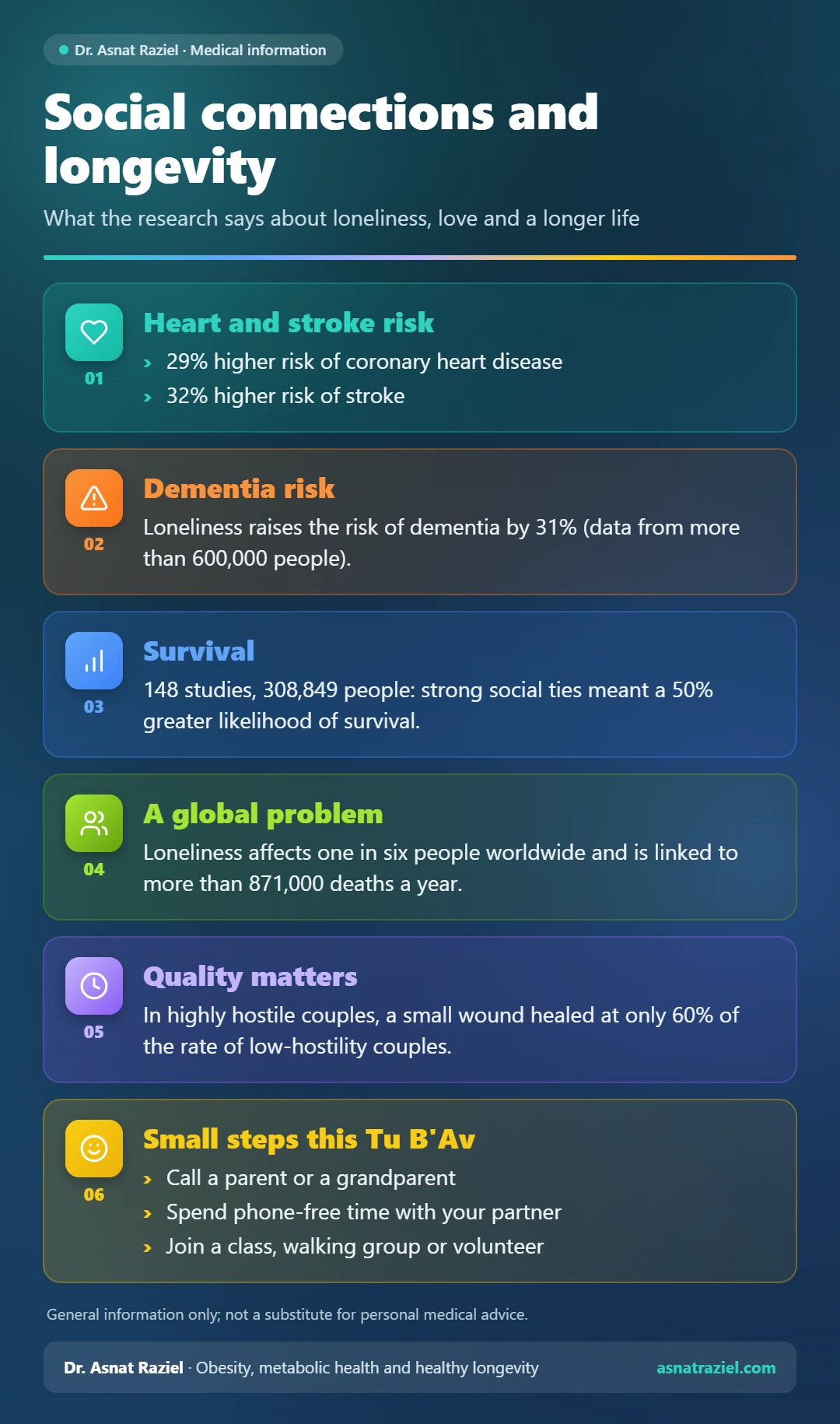
Chronic loneliness raises the risk of heart disease, depression, cognitive decline and early death. A systematic review of longitudinal studies found that poor social relationships were linked to a 29% higher risk of coronary heart disease and a 32% higher risk of stroke. In addition, a meta-analysis of more than 600,000 people showed that loneliness raises the risk of dementia by 31%.
Some researchers compare the effect of loneliness to that of smoking. In an analysis of 148 studies with 308,849 participants, people with strong social ties had a 50% greater likelihood of survival over the follow-up period. Therefore, the researchers concluded that the effect is comparable to well-known risk factors for death.
In June 2025, the World Health Organization’s Commission on Social Connection published a comprehensive report. According to the WHO announcement, loneliness affects one in six people worldwide. It is linked to more than 871,000 deaths a year. In Israel, the issue has become especially pressing during the war, as I have written before about loneliness among older adults in wartime. The message is clear: what matters is not only how many years we live, but also who we spend them with.
A good relationship, not just any relationship
Interestingly, the effect is not limited to romantic relationships. Close friendships, a supportive family, an active community and even regular get-togethers with friends all offer a health advantage. On the other hand, a toxic or conflict-ridden relationship may cancel out some of the benefits.
For example, a study of 42 married couples looked at how a small skin wound healed. In couples who behaved with high hostility, the wound healed at only 60% of the rate seen in couples with low hostility. So quality matters more than quantity.
Social connections and longevity through healthy habits
People in supportive relationships tend to eat well, keep up with exercise and sleep well. In addition, they follow medical treatment and recover faster after illness or surgery. Stress, which affects weight and metabolism, also eases when support is available. I discussed this in my article on the link between stress and obesity.
In obesity treatment, too, I see again and again how much family support makes a difference. An involved partner improves long-term persistence and the chances of success.
Social connections and longevity: the brain loves love, too
Active relationships engage brain areas involved in memory, decision-making, empathy and emotional regulation. People who keep an active social circle often show slower cognitive decline in older age.
In fact, the link between social connections and longevity places relationships among the pillars of longevity medicine. They stand alongside physical activity, nutrition, quality sleep and stress management. You can find a broad picture of the field in my article on healthy aging.
Tu B’Av: a chance to start again
Perhaps the beautiful message of Tu B’Av is not about finding new love. Instead, we can nurture the relationships we already have. Here are a few simple steps:
- Call a parent or a grandparent.
- Make plans with an old friend.
- Spend real, phone-free time with your partner.
- Organize a family meal.
- Tell someone they matter to you.
These small moments may affect our health far more than we think.
What if you feel alone?
Not everyone has a partner or close family. It is important to remember that loneliness is not a personal failure. It is a common situation, and small steps can change it. The WHO report stresses that social connection is also built in the community, at work and in the neighborhood.
First, choose a regular activity with other people: a class, a walking group or volunteering. Second, you can reconnect with an old friend, even through a short conversation. In addition, group exercise combines two benefits at once: movement and company. Finally, when loneliness comes with lasting sadness, poor sleep or loss of interest, it is time to turn to your family doctor or a mental health professional.
At the clinic, I also ask my patients about the support they have at home. The answer helps me build a realistic treatment plan that fits their lives. Sometimes a small change, like a regular morning walk with a neighbor, affects mood, sleep and persistence with the entire treatment.
The bottom line on social connections and longevity
In longevity medicine, we like to say that the length of a life is not measured only in years, but also in their quality. Love, closeness, giving and belonging are not only human values. They are an integral part of modern medicine.
In the future, alongside a Mediterranean diet, strength training and good sleep, doctors will probably also emphasize meaningful relationships as part of the prescription for a long life. So, on the eve of Tu B’Av, here is an important reminder: the heart is not just a symbol of love. It is also one of the first organs to benefit from it, which is why social connections and longevity are part of the same story.
The information in this article is general and does not replace personal medical advice.
References
Social connection linked to improved health and reduced risk of early death
WHO Commission on Social Connection
Social relationships and mortality risk: a meta-analytic review
A Meta-analysis of Loneliness and Risk of Dementia using Longitudinal Data from >600,000 Individuals
Hostile marital interactions, proinflammatory cytokine production, and wound healing




