By Dr. Asnat Raziel, bariatric surgeon specializing in obesity treatment, metabolic health and healthy longevity; Director of the Multidisciplinary Center for Obesity Treatment, Assia Medical, Assuta Ramat HaChayal, Tel Aviv
Talking to family about obesity: why this conversation matters
Talking to family about obesity treatment is something patients ask me about almost every week. They come to the clinic after making a decision, and then they face the question of what to tell their partner, parents or children. Some fear criticism, while others simply don’t want to hear one more piece of advice about food. Even so, a good conversation with your family can turn your home into a place of support instead of an arena for arguments.
In this article, I’ll explain what research says about the role of family, how to prepare for the conversation, which phrases help and which hurt, and what to do when the reaction is difficult.
Obesity is a disease, not a weakness
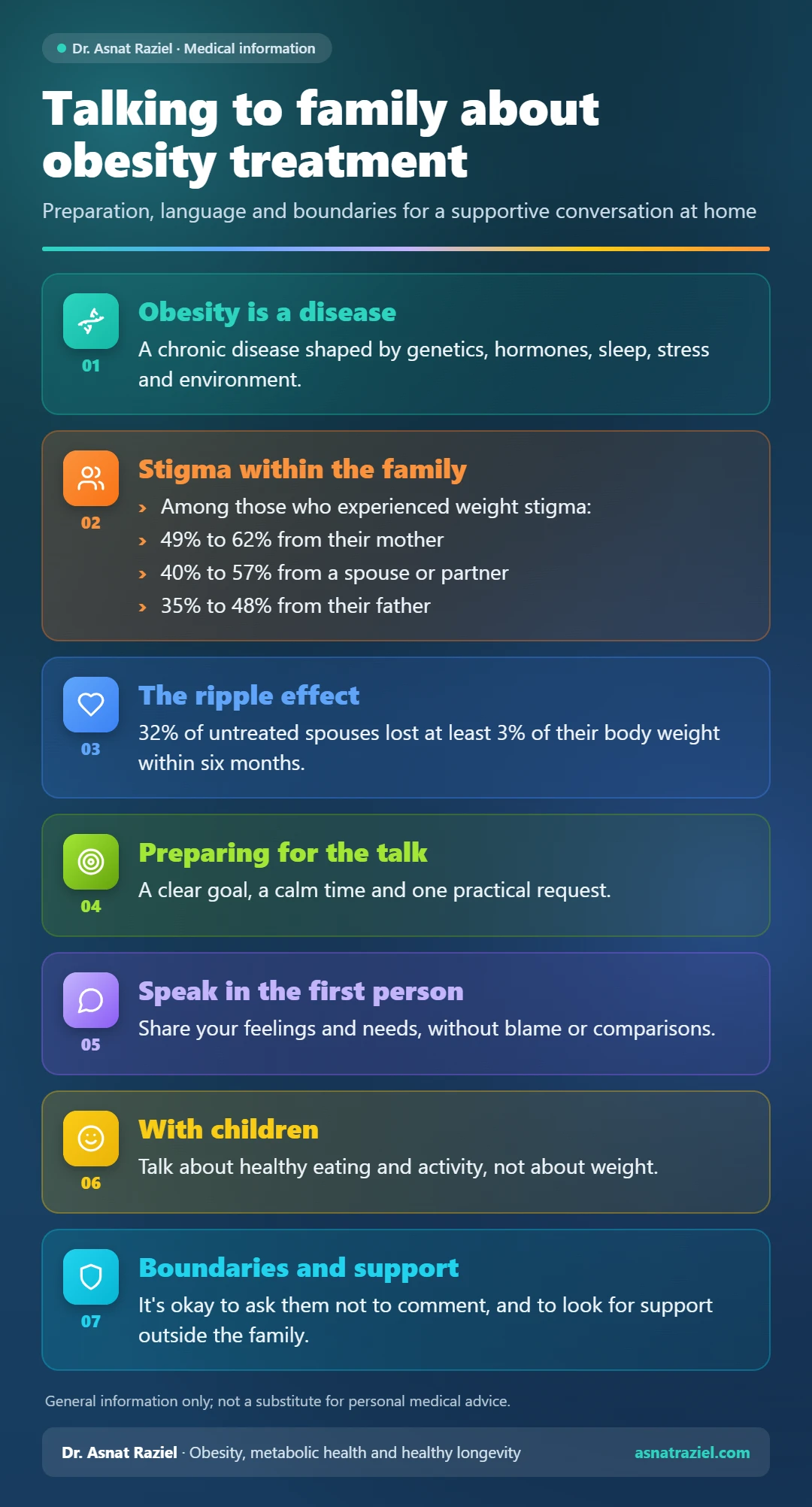
The first step is to be clear in your own mind about what you are discussing. Obesity is a chronic disease shaped by genetics, hormones, sleep, stress and environment. In other words, it is not the result of “a lack of willpower.” When you come to the conversation with this understanding, it is much easier to explain why you chose medical treatment.
Moreover, the social stigma of obesity carries a real health cost. I have written about this at length in my article on obesity stigma and respectful language. So keep in mind that this conversation is also a chance to correct misconceptions at home.
What research says about family and weight
Family is often both a source of support and a source of hurt. A multinational study of 8,100 adults in six countries examined experiences of weight stigma within the family. Among participants who reported weight stigma, 49% to 62% had experienced it from their mother. In addition, 40% to 57% had experienced it from a spouse or partner, and 35% to 48% from their father. The researchers found a link between these experiences and poorer mental health in all six countries.
On the other hand, family also has positive power. A randomized controlled trial in married couples found a “ripple effect.” When one spouse took part in a weight-loss program, the untreated spouse also lost weight. After six months, 32% of these spouses had lost at least 3% of their body weight. In other words, one person’s change affects the whole household.
Talking to family about obesity: preparing for the conversation
First, decide what your goal is. Do you only want to let them know? Are you asking for practical help? Or perhaps you mainly want them to stop commenting? A clear goal helps you phrase a clear request.
Second, choose a calm time and place. A holiday dinner or a moment of exhaustion is not the right setting for this kind of talk. Also, decide in advance how much detail to share. You don’t have to tell anyone about every test, medication or number on the scale. Your health belongs to you.
- Write down three main points you want to say.
- Think of one difficult question that may come up, and prepare a short answer.
- Define one practical request, such as a shared healthy dinner twice a week.
Phrases that help and phrases that hurt
Your language sets the tone for the whole conversation. Speak in the first person, about your own feelings and needs. For example: “It’s important to me that you know I’ve started treatment, and I need your support.” By contrast, a sentence like “You’re always commenting on me” invites defensiveness.
It also helps to explain to your family what doesn’t help. Comments about what’s on your plate, comparisons with others or “just eat less” all undermine motivation. Instead, ask for encouragement, a walking partner or simply a listening ear. If the topic is emotionally hard for you, you may find my guide to overcoming emotional eating useful.
When you choose medication or surgery
Many questions come up when treatment includes medication or surgery. Family members sometimes worry that it’s “the easy way out” or that it’s dangerous. This is where medical information helps. Explain that a doctor supervises the treatment and that it’s part of a plan that also includes nutrition and physical activity. You can point them to my overview of anti-obesity medications so they can read it for themselves.
In addition, treatment sometimes changes the dynamics of a relationship. Appetite changes, social habits change, and sometimes self-confidence changes too. I wrote about this in my article on weight loss drugs and relationships. That’s why it’s worth involving your partner early rather than waiting for the changes to appear.
Talking to family about obesity when there are children at home
With children and teens, extra care is needed. A study of about 2,800 adolescents found that when parents talked about weight and body size, teens were more likely to diet, use unhealthy weight-control methods and binge eat. However, conversations that focused on healthy eating rather than weight were linked with less dieting and fewer harmful methods among teens with excess weight.
So the rule is simple: talk about health, tasty and nourishing food and shared activities, not about numbers on the scale. You may also want to read the Academy of Nutrition and Dietetics’ tips on how to talk to kids about weight without creating hang-ups. If your child is dealing with excess weight, here is information on obesity treatment for children and teens.
What to do when the reaction is difficult
Not every conversation will end with a hug. Sometimes the response is criticism, dismissiveness or excessive worry. In that case, you can pause and say: “I can see this surprises you. Let’s come back to it in a few days.” One conversation doesn’t have to solve everything.
In addition, set clear boundaries. It’s okay to ask family members not to comment on your food or your body. Likewise, it’s okay to look for support outside the family: friends, a support group or a psychologist. A change like this also affects your self-esteem, so it’s important to have a stable support network.
Talking to family about obesity: patients ask, families ask
Sometimes family members want to come to a clinic appointment. That’s a good idea. At our clinic, we invite partners and parents to ask questions, so they hear the explanation from a professional source. If you’d like to know more about our approach, you can read about Dr. Asnat Raziel and the team.
The bottom line
Talking to family about obesity treatment is not only a matter of finding the right words. It also takes preparation, boundaries and patience. Studies show that family can hurt, but it can also support you and even change alongside you. Therefore, go into the conversation with a clear goal, speak in the first person and ask for practical help. Ultimately, the decision about treatment is yours.
This article provides general information and is not a substitute for personal medical advice.
Frequently asked questions
Do I have to tell my family that I’m getting treatment?
No. It’s a personal decision. Still, sharing it with at least one close person makes it much easier to stay on track.
How do I approach talking to family about obesity when my partner objects?
Invite your partner to an appointment with your doctor. A professional explanation of effectiveness, side effects and follow-up usually eases most concerns.
How do I talk to my children about my treatment?
Simply, and in a way that suits their age. Explain that you are taking care of your health, and avoid talking about weight, about being “fat” or about diets.
What if the comments in the family continue?
Repeat your request calmly and clearly. If that doesn’t help, it’s worth getting support from a mental health professional.
Sources
Family-based weight stigma and psychosocial health: A multinational comparison
Social stigma of obesity – Wikipedia
How to Talk to Kids about Weight – Academy of Nutrition and Dietetics (eatright.org)




