By Dr. Asnat Raziel, bariatric surgeon specializing in obesity treatment, metabolic health and healthy longevity; Director of the Multidisciplinary Center for Obesity Treatment, Assia Medical, Assuta Ramat HaChayal, Tel Aviv
Weight loss drugs and relationships: the change the scale doesn’t show
Weight loss drugs and relationships come up in my clinic almost every week. The GLP-1 family of medications, including Mounjaro, Wegovy, Ozempic and Rybelsus, has revolutionized obesity treatment. These drugs reduce hunger, lead to significant weight loss and improve metabolic health. However, alongside the physical effects, there is growing evidence that the change also seeps into relationships, self-image and intimacy.
When the body changes, identity changes too
Losing tens of kilograms is not just an outward change. For many people, it brings new confidence and a better self-image. People want to dress differently, go out, return to social activities and try things they used to avoid. I have also written about this process in my article on body image after weight loss.
This change is exciting and empowering. At the same time, it shifts the balance that existed in the relationship. The partner is happy about the success, yet sometimes also feels insecure, jealous or afraid of losing the closeness the couple had before.
The drug doesn’t create problems; it reveals them
Social media has even coined a nickname: “Ozempic divorce.” A Dazed magazine article from September 2026 described women who left relationships after starting treatment. They attributed this to new self-confidence and clearer boundaries. Still, psychologists and couples therapists stress that these drugs do not “break up marriages.” In many cases, they remove a layer that had hidden existing difficulties for years.
When a person lives with obesity, much of their emotional energy goes toward the body, eating and feelings of shame. After weight loss, there is room to re-examine the relationship, one’s needs and expectations. Sometimes it turns out the problems were there long before treatment. This shame is also linked to the stigma surrounding obesity, which harms both physical and mental health.
What we learned from bariatric surgery
This phenomenon is not new. Two large Swedish studies examined what happened to relationship status after bariatric surgery. In the SOS study, among people who were in a relationship, surgery was associated with a 28% higher risk of divorce or separation compared with a control group. Meanwhile, among single people, the likelihood of marrying or starting a new relationship was 2.03 times higher.
In addition, in the Swedish registry of gastric bypass operations, the risk of divorce rose by 41% and the likelihood of marrying rose by 35%. The researchers found that changes in relationship status were especially common among those who lost a lot of weight. In other words, major weight loss shakes up relationships in both directions.
Weight loss drugs and relationships: does sexual desire change?
The answer is not clear-cut. In some patients, desire increases, mainly thanks to better self-confidence, energy and body image.
On the other hand, others describe a certain drop in desire. One hypothesis is that these drugs affect the brain’s reward centers. The same mechanisms that reduce the drive to eat may also weaken other drives. However, according to the International Society for Sexual Medicine, the evidence is still mixed. Some of it is based on theoretical hypotheses and social media reports. Therefore, we cannot conclude that the drugs themselves cause a lasting change in desire. I covered this in more depth in my article on GLP-1 injections and libido.
New attention from the people around you
Many patients tell me that after losing a significant amount of weight, they receive compliments, looks and new social opportunities. Some see this as positive reinforcement. Others, by contrast, feel confused or embarrassed.
For some couples, the new attention strengthens the bond. For others, it stirs up tensions that weren’t there before. That’s why it’s worth talking openly about the change from the very start of treatment.
Careers are affected too
The impact of these drugs doesn’t end at home. A study by Professor Rebecca Diamond of Harvard University was published in June 2026 as a working paper of the US National Bureau of Economic Research. Diamond compared women who started GLP-1 treatment with women who wanted to start but had not yet done so.
After about a year and a half, single women’s likelihood of marrying or moving in with a partner rose by 29 percentage points. Additionally, among women who were not working, the likelihood of finding a job rose by 27 percentage points. In contrast, among women who were already in a relationship or employed, the researcher found no significant change. According to Harvard, the women did not report a notable change in depression, loneliness or life satisfaction. For this reason, the researcher believes that part of the change stems from how society responds to the outward change, and not only from the women’s own sense of capability.
Weight loss is only the beginning of the journey
As a physician who treats thousands of people with obesity, I see every day that the biggest change is not necessarily in weight. The biggest change is in identity. People start believing in themselves, return to sports, form new connections and sometimes change the course of their lives.
This is exactly why drug treatment for obesity is more than a prescription. It should include medical, nutritional, emotional and behavioral support. That way, patients can also cope with the psychological and social changes that come with weight loss. I have written about the value of such a team in my article on holistic obesity treatment, and about the emotional side in my article on GLP-1 drugs and mental health.
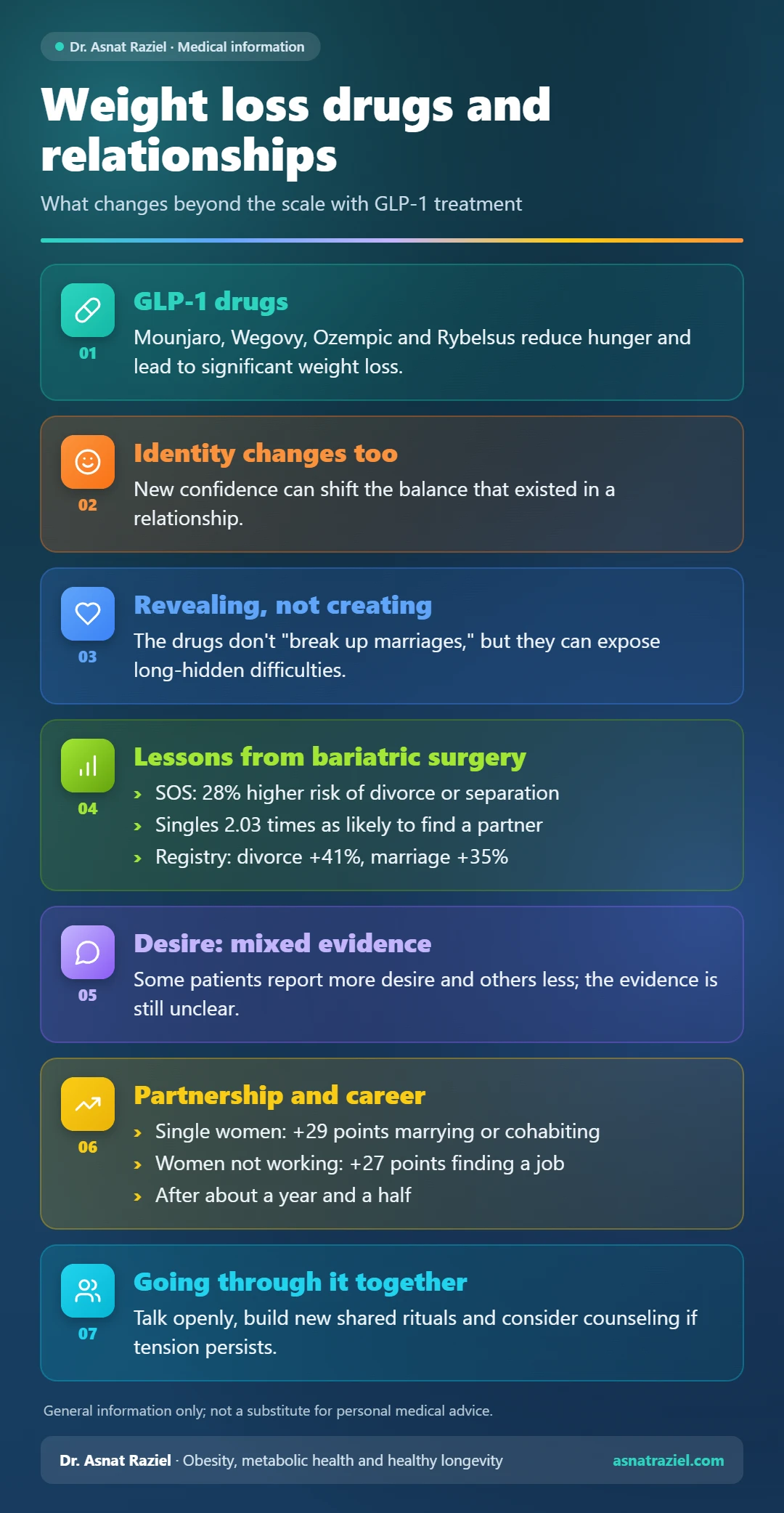
Weight loss drugs and relationships: getting through the change together
First, share the decision about treatment, and your expectations of it, with your partner. Second, remember that your shared eating habits will change too. A dinner out for two or an evening with wine looks different when your appetite is smaller. So you can build new rituals, such as walking together, working out as a couple or cooking together.
Also, pay attention to the feelings on both sides. Jealousy or worry is not a sign of failure. Rather, it is a natural reaction to a big change. When tension persists, couples counseling or psychological support can help. Finally, talk to your treating doctor about any change in mood or desire.
Looking ahead: weight loss drugs and relationships
GLP-1 drugs are not just weight loss medications. They change the way people feel, behave and experience themselves. For many, they open the door to a healthy, active and confident life. However, the deeper the change, the more important it is to prepare for its emotional and relationship consequences as well.
The bottom line
Ultimately, the link between weight loss drugs and relationships teaches us that weight loss doesn’t only change the body. It changes the way a person meets the world, and sometimes the way the world meets them. An open conversation with your partner, and sometimes emotional support, can help you get through the change together.
This article provides general information and is not a substitute for personal medical advice.
References
GLP-1–Induced Weight Loss and the Female Obesity Penalty
Women more likely to marry, land jobs after taking GLP-1s
How Might Weight Loss Medications (GLP-1 Agonists) Affect Sexuality?




