By Dr. Asnat Raziel, bariatric surgeon specializing in obesity treatment, metabolic health and healthy longevity; Director of the Multidisciplinary Center for Obesity Treatment, Assia Medical, Assuta Ramat HaChayal, Tel Aviv
GLP-1 and libido: a question patients rarely ask
GLP-1 and libido is a topic that almost never comes up in my clinic. Yet GLP-1 drugs have transformed obesity treatment. They lower weight, improve blood sugar control and reduce heart risk. Alongside these successes, however, a delicate question arises: does their effect on the brain also touch desire?
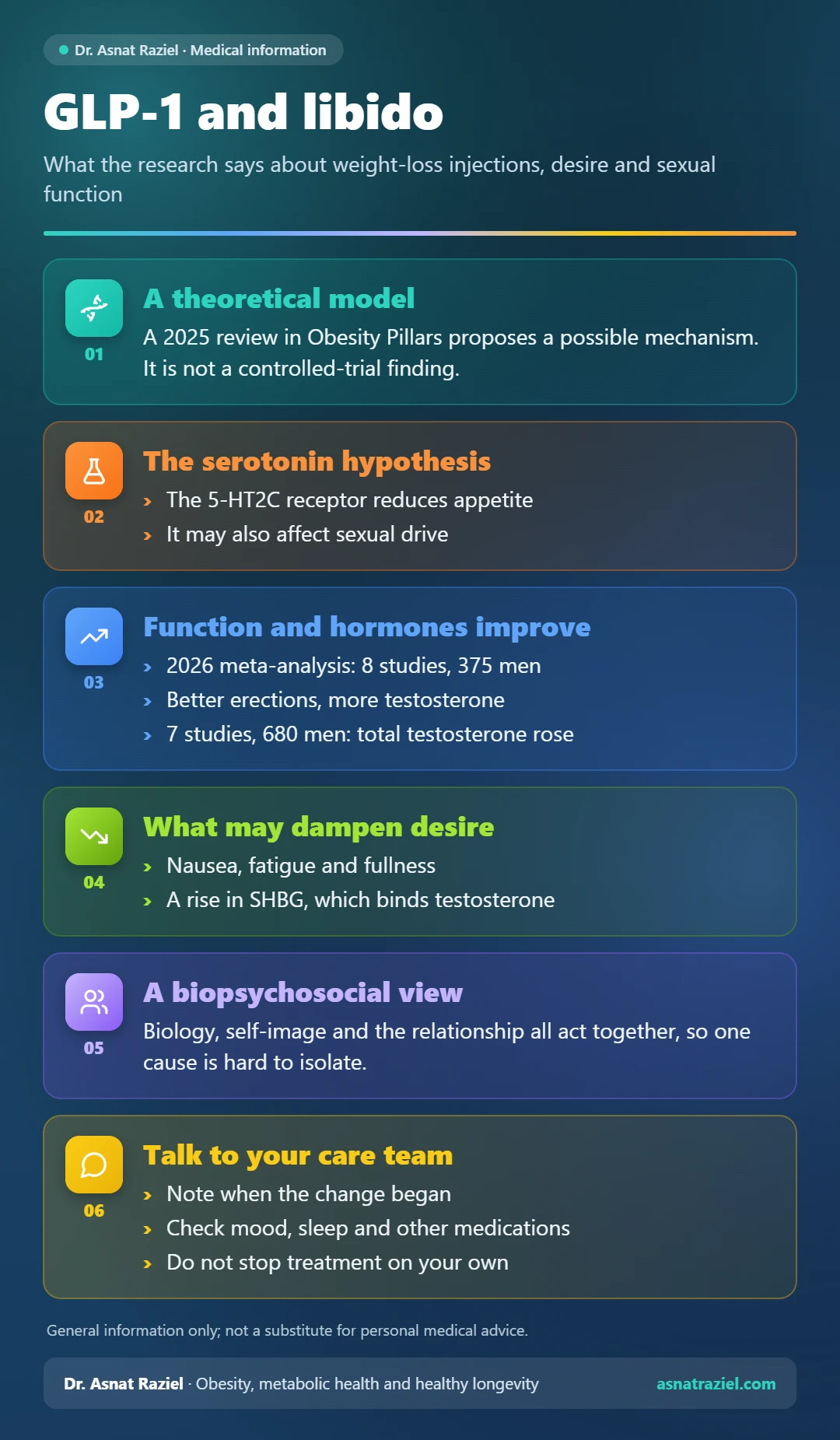
A clinical review in the journal Obesity Pillars offers a framework for understanding this possibility. The review was published in November 2025. In it, the authors propose a possible mechanism and explain why it is so hard to see in practice. It is important to stress one point: this is a theoretical model, not a finding from a controlled trial.
Not just the pancreas and the gut: the brain is involved too
GLP-1 acts not only in the body but also in the brain. GLP-1 receptors sit in brain areas that regulate appetite, impulse control and reward. Their effect on these areas explains the weaker drive to eat and the stronger sense of fullness. You can read more about this mechanism in my article on hunger, satiety and the brain.
The same areas are also linked to motivation and pleasure, including sexual desire. The central hypothesis of the review concerns serotonin, and in particular the 5-HT2C receptor. Activating this receptor reduces appetite. At the same time, it may also affect sexual drive. A similar parallel is familiar from psychiatric medications, where high serotonergic activity is sometimes linked to lower desire.
In other words, when a drug dampens one biological drive through central pathways, a natural question follows. Does it also affect other drives that run through the same neural systems?
Why there is almost no data
Most studies of GLP-1 drugs have focused on weight loss, blood sugar control and heart health. They also tracked digestive side effects. Sexual quality of life, by contrast, is not a routine part of the measurements. Without structured measurement, subtle changes in desire are hard to detect.
What’s more, many patients don’t bring it up on their own. The care team doesn’t always ask, either. As a result, the change, if it exists, stays under the radar.
GLP-1 and libido: the side that improves
Meanwhile, opposing forces are also at work. Weight loss improves blood vessel function, reduces inflammation and sometimes raises testosterone in men with obesity. A 2026 meta-analysis included eight studies and 375 men. In these studies, GLP-1 drugs improved erectile function and raised total and free testosterone levels.
Likewise, a meta-analysis of seven studies with 680 men showed a rise in total testosterone. In addition, a review of diabetes drugs found an advantage for GLP-1 drugs over metformin in improving erections, especially in patients with obesity. For more on the link between weight and hormones, see my article on hormones and weight.
It is important to distinguish between two concepts. Sexual function is the physical ability. Sexual desire is the wanting. So the drug may improve the first while slightly weakening the second.
The side that may weaken desire
The review also points to factors that dampen desire, for example nausea, fatigue and a feeling of fullness. In addition, weight loss sometimes raises SHBG, a protein that binds testosterone in the blood. An umbrella review of semaglutide even noted reports of erectile problems as a signal that needs further research. For women, the data are even scarcer.
A biopsychosocial model: the full picture
The review suggests looking at the issue through three dimensions:
- The biological dimension: effects on reward pathways, serotonin and dopamine.
- The psychological dimension: better self-image, less shame around weight and less depression.
- The social dimension: changes in couple dynamics and intimacy after weight loss.
When all three dimensions act together, it is hard to isolate a single factor. In some patients, desire is preserved or even improves. In others, a subtle decline appears and goes unreported. Moreover, body image during treatment plays an important role here.
GLP-1 and libido: opening the conversation
GLP-1 drugs are among the most effective and best-established treatments for obesity. These findings do not undermine their place. Still, quality of life also includes sexuality, desire and vitality.
An open conversation in the clinic about changes in desire is not a luxury. Rather, it is part of a holistic approach. Advanced metabolic medicine deals not only with weight or HbA1c, the three-month average of blood sugar, but also with overall well-being. That is why it is worth telling your care team about any change. Sometimes adjusting the dose or treating the side effects improves the situation. You can read more in my article on the side effects of weight-loss drugs.
What to do if you notice a change in GLP-1 and libido
First, notice when the change began. If it appeared while the dose was being increased, it may be related to nausea and fatigue. In that case, relief from the side effects sometimes brings desire back as well. Second, check other factors, such as mood, sleep, other medications and tension in the relationship.
In addition, men with obesity should have their testosterone levels checked. For women, it is worth paying attention to hormonal changes and menopause. Finally, do not stop treatment on your own. A conversation with your care team will help you find a solution that fits you, without giving up on your health.
Between controlling the drive to eat and human complexity
When we intervene in deep pathways of appetite and reward, we touch the core of human behavior. Satiety and desire are not completely separate. At times, they share a common neural infrastructure. In the future, studies that include sexual function questionnaires and hormone tests will clarify the picture.
The bottom line
The link between GLP-1 and libido has not yet been proven in a controlled trial. There is a possible mechanism for weaker desire, and there is also evidence of improved function and hormones. Ultimately, the future of obesity medicine lies in understanding the whole person: body, mind and relationships.
The information in this article is general and does not replace personal medical advice.
References
Effects of Anti-Diabetic Drugs on Erectile Dysfunction: A Systematic Review and Meta-Analysis




