By Dr. Asnat Raziel, bariatric surgeon specializing in obesity treatment, metabolic health and healthy longevity; Director of the Multidisciplinary Center for Obesity Treatment, Assia Medical, Assuta Ramat HaChayal, Tel Aviv
Hormones and weight loss: why it is not just willpower
The link between hormones and weight loss is far stronger than most people think. The body manages hunger, satiety and fat stores through a system of chemical messages between the gut, the pancreas, fat tissue and the brain. That is why many people feel they are “fighting their body” when they try to lose weight. That feeling is accurate, and it has a clear biological explanation.
In this article, I will explain which hormones affect weight, why the body resists weight loss and what you can do with this knowledge. I will also explain how the new medications use exactly the same mechanisms.
Hormones and weight loss: it starts in the brain
In the brain, in an area called the hypothalamus, there is a kind of “control center” for energy balance. It receives signals from the gut after every meal, as well as long-term signals from fat tissue. Based on these signals, it decides when we feel hungry, when we feel full and how much energy the body burns. I have written about these pathways in detail in my article on the physiology of satiety.
In other words, weight management is not just a matter of calories in and calories out. It also depends on how the brain interprets hormonal signals. When those signals go awry, keeping a stable weight becomes very difficult.
The key hormones and what they do
Leptin: the signal from fat stores
Leptin is a hormone secreted by fat tissue. The more fat the body has, the higher the leptin level. Normally, it tells the brain that energy stores are sufficient. In people with obesity, however, the brain responds to it less well. This is called leptin resistance, and it is one of the reasons obesity tends to feed itself.
Ghrelin: the hunger hormone
Ghrelin comes mainly from the stomach. Its level rises before a meal and falls afterward. It is one of the strongest signals that drive us to look for food. As we will see below, dieting raises ghrelin levels, so hunger grows precisely when you are trying to lose weight.
GLP-1, GIP and PYY: satiety hormones from the gut
After a meal, the gut releases several satiety hormones. GLP-1 slows stomach emptying, signals fullness to the brain and helps the pancreas release insulin. GIP acts mainly on the pancreas and fat tissue, while PYY adds a satiety signal of its own. I have also written about these hormones in an article on the satiety hormone revolution.
Insulin and cortisol
Insulin is the hormone that moves sugar into cells and promotes fat storage. When cells respond to it less well, a condition called insulin resistance, the pancreas releases large amounts of it. This makes weight loss harder and raises the risk of diabetes. Meanwhile, cortisol, the stress hormone, increases appetite and belly fat storage when it stays high over time.
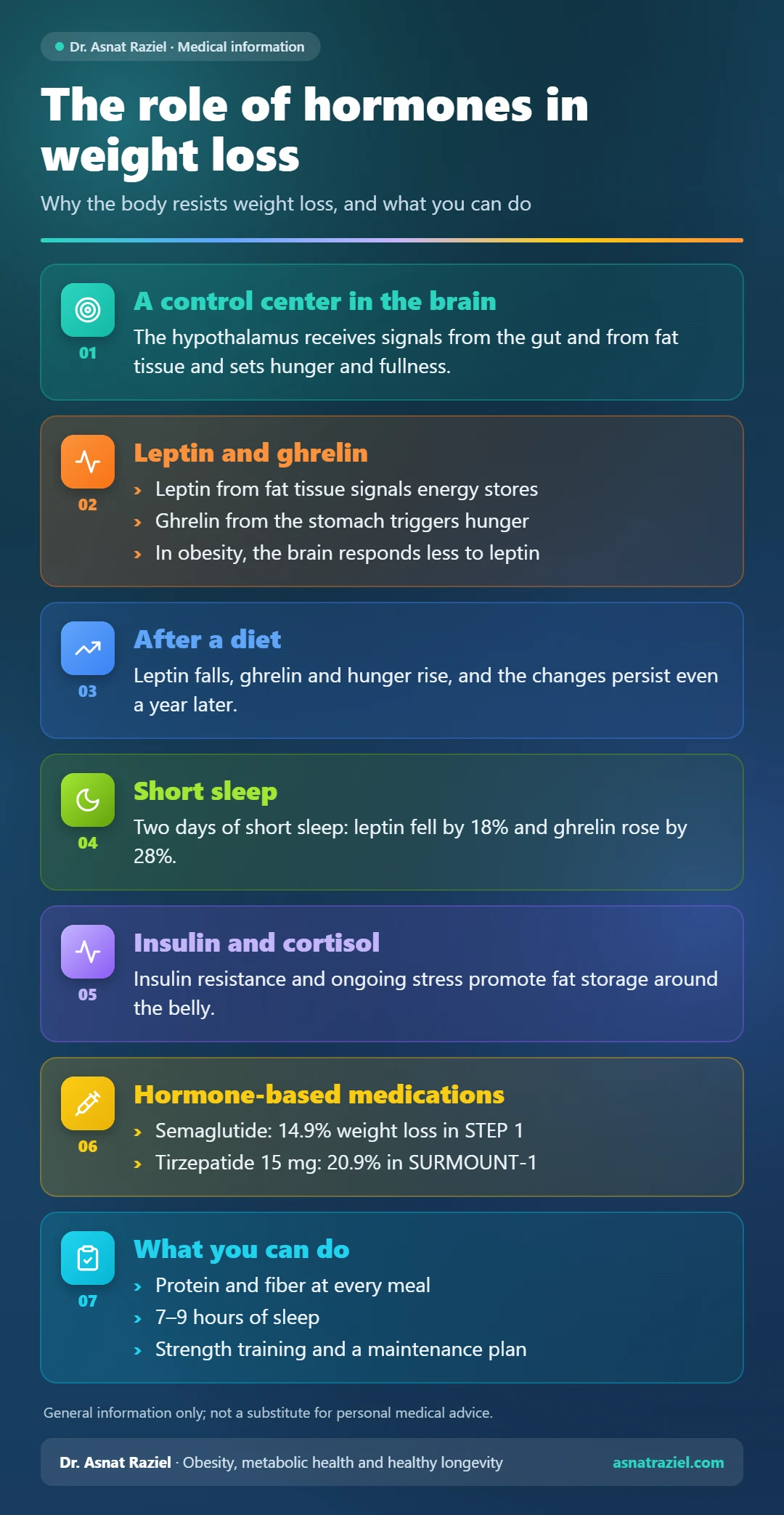
Hormones and weight loss after a diet
This brings us to one of the most important findings in the field. An Australian study published in NEJM included 50 people with overweight or obesity. They followed a very low-calorie diet program for 10 weeks and lost an average of 13.5 kg. The researchers measured appetite hormones before the diet, at its end and one year later.
The results showed that the body “fights” weight loss. Leptin levels dropped, and so did the levels of the satiety hormones PYY and cholecystokinin. Ghrelin, on the other hand, went up, and so did hunger. What’s more, one year after the diet, most of these changes were still present. In other words, the body keeps pushing you to eat long after the diet has ended.
This is the main reason so many people regain the weight they lost. It is not a personal failure, but a predictable biological response. So it pays to plan the weight maintenance phase in advance, not just the weight loss phase.
Sleep, stress and routine: a direct effect on hormones
Short sleep also disrupts the hunger system. In a small controlled study, researchers restricted the sleep of 12 healthy young men for two days. Leptin fell by 18%, ghrelin rose by 28% and hunger rose by 24%. In addition, the participants especially craved carbohydrate-rich foods. I have written more about this connection in an article on sleep deprivation and obesity.
Changes in routine matter too. For example, a trip abroad shifts your sleep and meal times. In situations like this, try to keep regular hours as much as possible. Ongoing stress, meanwhile, raises cortisol and increases the tendency toward emotional eating.
Sex hormones, the thyroid and hormonal disorders
In women, the drop in estrogen at menopause changes how fat is distributed and encourages it to build up around the belly. I wrote about this in my article on obesity at menopause. At a younger age, polycystic ovary syndrome (PCOS) is linked to insulin resistance and weight gain. You can read more in an article on obesity and hormonal disorders.
In men, obesity is linked to low testosterone levels, and the relationship works in both directions. I covered the research on this in an article on testosterone and diabetes prevention. An underactive thyroid, by contrast, slows metabolism, but it usually causes only moderate weight gain. So it is worth checking, but it should not be seen as the explanation for every weight gain.
Hormones and weight loss with medication
The new medications for obesity rely directly on our understanding of hormones. They mimic the gut’s satiety hormones and work throughout the week. You can read about them in plain language on the Cleveland Clinic page on GLP-1 drugs.
In the STEP 1 trial, semaglutide 2.4 mg a week led to an average weight loss of 14.9% after 68 weeks, compared with 2.4% in the placebo group. In the SURMOUNT-1 trial, tirzepatide, which mimics both GLP-1 and GIP, led to an average weight loss of 20.9% at the 15 mg dose after 72 weeks. You will find an overview of the available options on my page about medical treatment for obesity.
Still, these medications are not magic. They are prescribed according to medical criteria and require follow-up. In addition, when people stop them without a follow-up plan, the weight tends to come back.
Hormones and weight loss: what you can do
- Eat protein and fiber at every meal to strengthen satiety signals from the gut.
- Sleep 7 to 9 hours a night and keep regular hours.
- Include strength training, which preserves muscle mass and improves insulin sensitivity.
- Deal with stress in practical ways, such as movement, breathing exercises or talking with someone.
- Check with a doctor for conditions such as an underactive thyroid, PCOS or diabetes.
- Plan the weight maintenance phase in advance.
The bottom line
The role of hormones in weight loss explains why dieting alone is not enough for many people. The body responds to weight loss by increasing hunger and weakening satiety signals, and sometimes this response lasts more than a year. That is why the right treatment combines nutrition, sleep, physical activity and stress management, and sometimes medication as well. If you feel you are fighting your own body, it is worth seeking a thorough evaluation from a doctor who specializes in obesity. You can read about my approach to treatment on the About Dr. Asnat Raziel page.
The information in this article is general and does not replace personal medical advice.
Questions and answers
What role do hormones play in weight loss?
Hormones determine when we feel hungry and when we feel full, and how much fat the body stores. Leptin, ghrelin, GLP-1 and insulin are the main ones.
Why is it hard to keep the weight off after a diet?
After weight loss, ghrelin rises and leptin falls. In the study, these changes were still present one year after the diet, so hunger stayed high.
Can a blood test reveal a “hormonal problem” with weight?
Blood tests can detect conditions such as diabetes, an underactive thyroid or low testosterone levels. However, leptin and ghrelin are not usually measured in routine testing.
Does sleep really affect hunger?
Yes. In a controlled study, two days of short sleep lowered leptin by 18% and raised ghrelin by 28%.
Sources
Long-term persistence of hormonal adaptations to weight loss
Once-Weekly Semaglutide in Adults with Overweight or Obesity