By Dr. Asnat Raziel, bariatric surgeon specializing in obesity treatment, metabolic health and healthy longevity; Director of the Multidisciplinary Center for Obesity Treatment, Assia Medical, Assuta Ramat HaChayal, Tel Aviv
Ozempic face: what is it, really?
Ozempic face is a popular nickname for a face that looks hollow and older after rapid weight loss. The cheeks lose volume, the temples sink, and the skin along the jawline and neck becomes loose. It is not a medical diagnosis or an official side effect of the drug. Still, the change is real, and many of my patients ask me about it. In this article I explain what the research shows, who it affects, and what you can do before, during and after treatment.
Why the face loses volume with weight loss
The face has layers: bone, supporting ligaments, deep and superficial fat pads, muscle and skin. The fat pads give the face its full, youthful look. When you lose weight, your body draws on fat stores everywhere, including the face. In addition, skin makes less collagen and elastin as we age. As a result, it shrinks back slowly once the volume underneath disappears.
It is worth being precise here: the drug does not “target” facial fat. A systematic review of 14 studies looked at what happens to the face after major weight loss. In most of the studies, the weight loss came from bariatric surgery, and in some from medication. The researchers found that major weight loss goes hand in hand with accelerated facial aging. The most noticeable volume loss was in the mid-cheek, together with skin laxity in the central neck. Moreover, people who lost a lot of weight looked older than their age.
Ozempic face by the numbers: what researchers measured
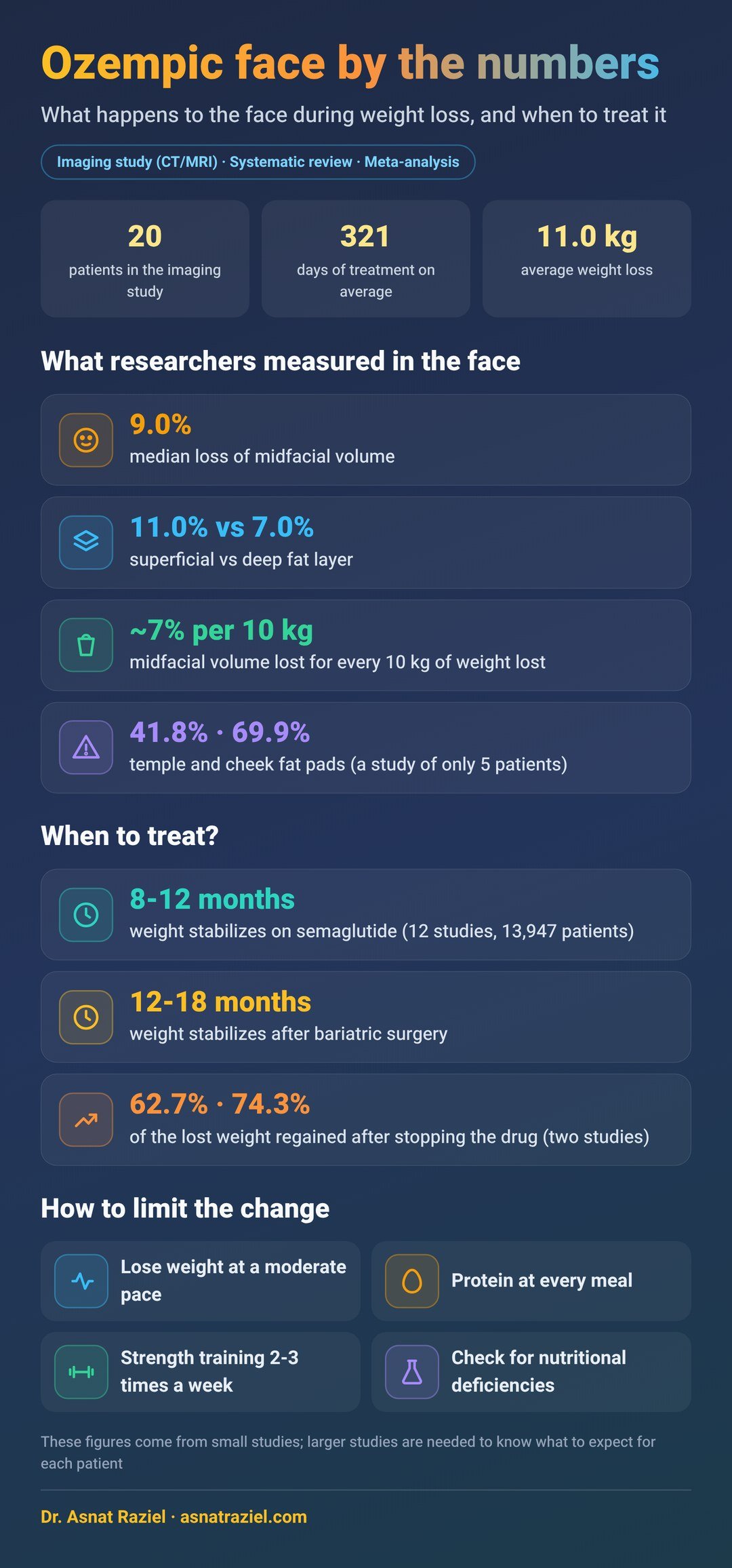
A study from Vanderbilt University is one of the first to measure the change on imaging. The researchers studied 20 patients who had CT or MRI scans of the head both before and after starting GLP-1 medications. Their median age was 54. Treatment lasted 321 days on average, and average weight loss was 11.0 kg.
Median midfacial volume fell by 9.0%. The superficial fat layer shrank by 11.0%, and the deep layer by 7.0%. Furthermore, the researchers found a clear link to the amount of weight lost: for every 10 kg lost, the midface lost about 7% of its volume, mainly in the superficial layer. In other words, the more weight you lose, the more volume the face loses.
However, this was a small retrospective study based on scans already in patients’ medical records. The systematic review also included an even smaller study of only five patients taking semaglutide. There, the temple fat pad shrank by 41.8% on average and the cheek fat pad by 69.9%. So the numbers are interesting, but we need larger studies to know what a typical patient can expect.
Who is at risk of Ozempic face?
Not everyone on weight-loss injections will see a marked change in their face. First, the amount of weight lost matters a great deal. Second, pace matters: rapid loss gives the skin no time to adapt. Third, age is important, because young skin is rich in collagen and far more elastic.
Another factor now getting attention is nutrition. A review of nutritional deficiencies during GLP-1 treatment notes that facial changes have several causes acting together. Among other things, low intake of protein, zinc, iron, vitamin C and vitamin D may affect skin quality. That said, the authors point out that no study has yet proven this link. Meanwhile, the low appetite during treatment makes it hard to eat enough, so the risk of deficiencies goes up.
How to limit the change during treatment
Lost volume is hard to restore without treatment, so it is better to act early. These are the steps I recommend in my clinic:
- A moderate pace: gradual dose increases and, at times, a target-based dose rather than the maximum dose.
- Protein at every meal.
- Strength training two to three times a week, to protect muscle on weight-loss medication.
- Blood tests for deficiencies, such as iron and vitamin D, with supplements as needed.
- Enough fluids, good sleep and sun protection, which slows collagen breakdown.
In addition, a new study found that structured support from a coach, dietitian and physical therapist improved body composition during treatment. However, that study has important limitations.
When is the right time to treat Ozempic face?
The short answer: once your weight has stabilized. A meta-analysis of 12 studies with 13,947 patients looked at when weight loss plateaus on semaglutide. The authors concluded that weight usually stabilizes after 8 to 12 months of treatment. By comparison, after bariatric surgery weight stabilizes after 12 to 18 months.
On the other hand, two studies looked at what happens after stopping the drug. By the end of follow-up, participants had regained 62.7% and 74.3% of the weight they had lost. Therefore, before any aesthetic treatment, decide with your doctor whether you will stay on the medication. Otherwise, weight regain may change the result.
The International Society of Aesthetic Plastic Surgery (ISAPS) has also addressed the issue. According to its guidance, elective surgery should be deferred until the dose-escalation phase is over. In addition, people with digestive symptoms such as constipation should wait until these resolve before surgery. So it is important to tell your surgeon and anesthesiologist about any weight-loss injections.
What treatments are available
The choice depends on what stands out more: volume loss or excess skin. A review of GLP-1 drugs in aesthetic medicine describes several options:
- Fillers, such as hyaluronic acid, to restore volume in the cheeks and temples.
- Biostimulatory agents that encourage collagen production, to improve skin quality.
- Energy-based devices, such as radiofrequency, to tighten mildly loose skin.
- Fat grafting, when a lot of volume is needed.
- A face and neck lift, when there is real excess skin.
In my experience as a bariatric surgeon, the same principle applies to the whole body: after major weight loss, surgeons treat excess skin on the abdomen, arms and thighs only once weight is stable. It is also important to remember the emotional side. Body image updates slowly, and the change in the face is often most upsetting in the first few months.
The bottom line on Ozempic face
Ozempic face is the result of large, rapid weight loss, not direct damage from the drug. How much weight you lose, how fast, your age and your nutrition all shape how much your face changes. Losing weight at a moderate pace, eating enough protein, strength training and checking for deficiencies all help limit the change. If you still want aesthetic treatment, wait until your weight is stable and decide in advance whether you will continue the medication. In the end, the health you gain from losing weight matters far more, and we can improve appearance.
This article is general information and does not replace personal medical advice.
References
Radiographic Midfacial Volume Changes in Patients on GLP-1 Agonists
The Rise of GLP-1 Receptor Agonist Drugs and Plastic Surgery