By Dr. Asnat Raziel, bariatric surgeon specializing in obesity treatment, metabolic health and healthy longevity; Director of the Multidisciplinary Center for Obesity Treatment, Assia Medical, Assuta Ramat HaChayal, Tel Aviv
Muscle mass on weight-loss medication: why it matters
Keeping muscle mass on weight-loss medication is one of the topics my patients ask about most. Injections such as Wegovy and Mounjaro lead to major weight loss. However, not every kilogram lost is fat. So it is important to know how much muscle you may lose, and what you can do to protect it.
The good news is that most of the weight lost is fat. In addition, we have two effective tools to protect muscle: protein and strength training. In this article I explain what the studies show and how to put it into practice in daily life.
What happens to the body during rapid weight loss
When the body gets less energy, it draws on its reserves. It mainly breaks down fat, but also some of the protein in muscle. Doctors call this process catabolysis, and it happens with any weight loss, not only with medication. In fact, both a low-calorie diet and bariatric surgery lead to a similar effect.
One term is worth understanding: lean mass. This is all the tissue that is not fat, meaning muscle, internal organs, bone and water. So a drop in lean mass is not the same as muscle loss. By most estimates, muscle makes up about half of lean mass.
Muscle mass on weight-loss medication: what the studies showed
Semaglutide in the STEP 1 trial
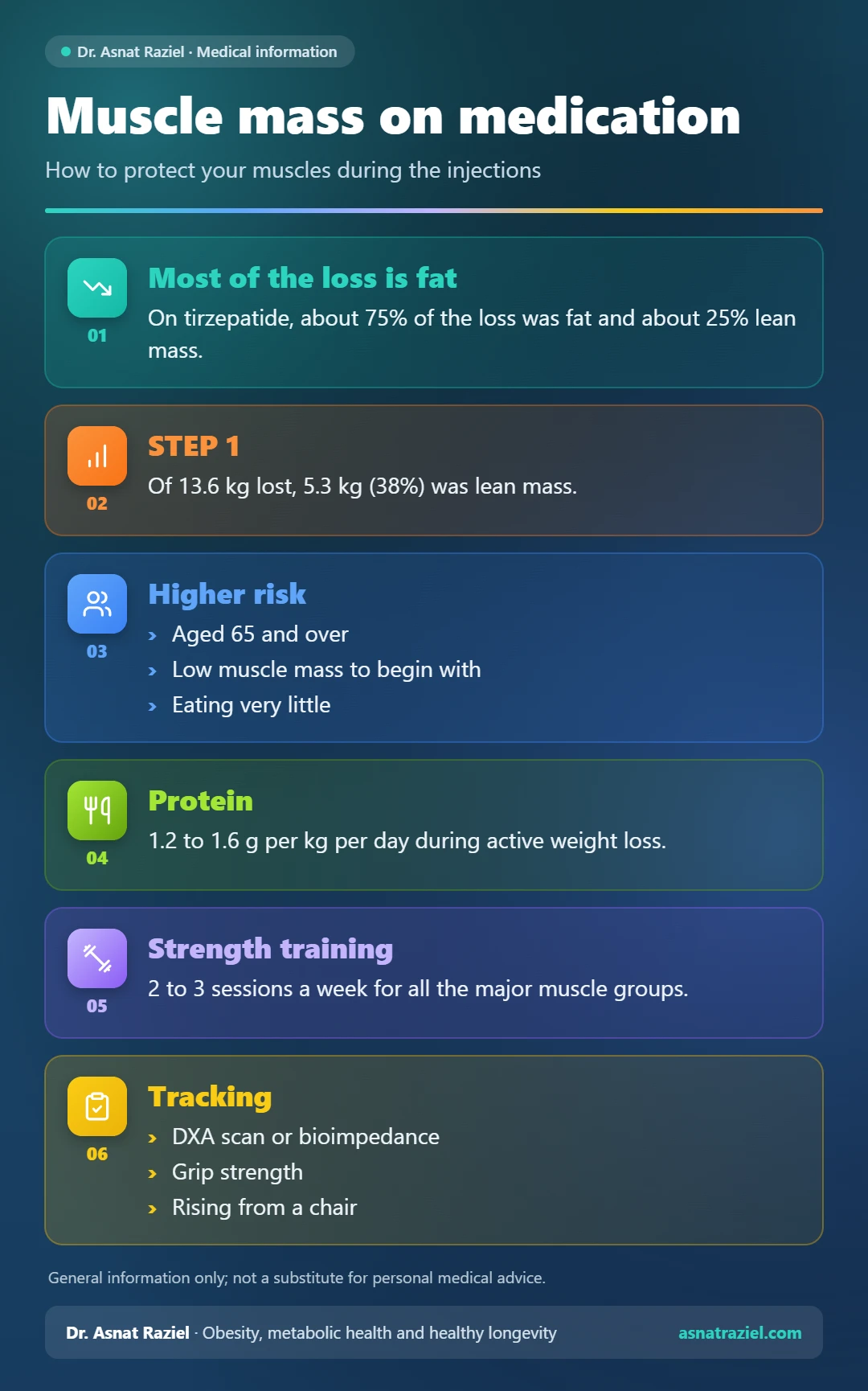
In the STEP 1 trial, researchers measured body composition with a DXA scan, a low-dose X-ray that measures fat, muscle and bone. Of an average loss of 13.6 kg, 8.3 kg (62%) was fat and 5.3 kg (38%) was lean mass. According to joint recommendations from American nutrition and obesity organizations, this corresponds to muscle loss of about 20% of the total weight lost.
Tirzepatide in the SURMOUNT-1 trial
Tirzepatide, the active ingredient in Mounjaro, was studied in a SURMOUNT-1 substudy of 160 participants. After 72 weeks, weight fell by 21.3%, fat mass by 33.9% and lean mass by 10.9%. In other words, about 75% of the loss was fat and about 25% was lean mass. The ratio was similar in the placebo group, which lost less weight.
What does this mean in practice? Overall, the fat-to-muscle ratio is similar to that of other weight-loss methods. Moreover, a recent review notes that tirzepatide even reduced the fat that infiltrates muscle. On the other hand, in older people or those with low muscle mass to begin with, even a small loss of muscle can affect strength and function.
Who is at risk of losing muscle mass on weight-loss medication
The risk differs from patient to patient. I pay special attention to a few groups:
- People aged 65 and over, whose muscle declines with age anyway.
- People with sarcopenic obesity, meaning low muscle mass alongside excess fat.
- Patients who eat very little because of nausea or a sharp drop in appetite.
- People who do not exercise at all, or who have been inactive for a long time.
For these patients, it is worth planning muscle protection even before the first injection. In such cases we also start the medication slowly and follow up closely.
Nutrition to protect muscle mass on weight-loss medication
These drugs reduce appetite, so it is very easy to eat too little protein. The basic recommendation for adults is 0.8 grams of protein per kg of body weight per day. However, during active weight loss, experts suggest a higher target of 1.2 to 1.6 grams per kg. For people with obesity, we sometimes use an adjusted body weight rather than actual weight, to avoid overshooting.
A few practical tips that work for my patients:
- Start every meal with the protein source: eggs, yogurt, cheese, chicken, fish, tofu or legumes.
- Spread protein across three to four meals a day.
- When appetite is especially low, a protein shake can help.
Also, there is no need to overdo it: experts do not recommend a long-term intake above 2 grams per kg per day.
Strength training: the best protection for muscle mass on weight-loss medication
According to nutrition and exercise strategies tested in studies, both aerobic exercise and strength training help preserve muscle during weight loss. But only strength training also improves muscle strength. That is why I usually recommend 2 to 3 strength sessions a week, working all the major muscle groups.
You do not need a gym. Resistance bands, light weights and bodyweight exercises are an excellent start. It is best to increase the load gradually, ideally with guidance from a trainer or physical therapist.
Tracking muscle mass on weight-loss medication
Weight alone does not tell the whole story. So it is worth measuring body composition at the start of treatment and during it. A DXA scan is the most accurate. Alternatively, a bioimpedance (BIA) scale gives a simple, accessible estimate.
Moreover, it is important to test function, not just structure. Grip strength, rising from a chair and walking speed show whether the muscle works well. If these measures decline, we adjust the plan: add protein, strengthen the training or slow the pace of weight loss.
Does structured support improve muscle mass on weight-loss medication?
In October, the journal Diabetes, Obesity and Metabolism published a study of structured support alongside weight-loss injections. The researchers followed 245 adults with obesity who had started a GLP-1 medication in the eight weeks before the study. Of these, 151 joined Omada’s support program and 94 received usual care. The program included a personal health coach, peer support groups, digital meal tracking and an exercise plan designed by a physical therapist.
After 12 weeks, program participants had lost 6% of their body weight, compared with 3.3% in usual care. In addition, body fat percentage fell by 3.3 percentage points, compared with 1.6. Muscle mass percentage rose by 0.6 points, compared with 0.2. Participants also reported a drop of about 30% in symptoms of depression and anxiety.
A higher muscle percentage is not new muscle
This point needs care. When fat goes down, the muscle percentage rises even if the body builds no new muscle at all. For example, a person weighing 100 kg with 30 kg of muscle is at 30% muscle. If they drop to 94 kg and lose 1 kg of muscle, their muscle percentage rises to 30.9%. So the figure shows that the weight lost was mostly fat, but it does not prove any muscle gain.
The study’s limitations
The study has several important limitations:
- The researchers did not randomize participants, so program members may have started out more motivated.
- The company that sells the program ran the study.
- About 26% of the usual-care group took part in another lifestyle program.
- Follow-up lasted only 12 weeks, while participants were still early in treatment.
- Participants measured body composition on home scales, not with a DXA scan.
Even so, the direction fits what we know from higher-quality studies: protein, strength training and professional support improve the quality of weight loss. In our clinic, the dietitian and body composition tracking are part of every medication-based treatment. Weight loss also affects appearance, which I cover in my article on facial changes after weight loss.
What’s on the horizon
Drug companies are now testing new medications designed to preserve muscle during weight loss. However, no regulator has approved any of them yet. So for now, the tools we have are protein, movement and tracking.
The bottom line
Keeping muscle mass on weight-loss medication is possible in most cases. Most of the weight lost on injections is fat, but a small part is muscle. Enough protein, regular strength training and body composition tracking reduce that loss. In my clinic, a dietitian and body composition tracking are part of every medication-based treatment.
This article is general information and does not replace personal medical advice.
Frequently asked questions
Do weight-loss injections “burn” muscle?
Not directly. Any weight loss includes a little muscle. With medication, as with diet or surgery, most of the loss is fat.
How much protein do I need to protect muscle on weight-loss medication?
During active weight loss, experts suggest 1.2 to 1.6 grams per kg per day. Your dietitian will adjust the target to your weight and health.
Can I build muscle during treatment?
Some patients can, especially those who start exercising for the first time. Even without building muscle, strength training improves strength and function.
How do I know if I have lost muscle?
A body composition test, such as DXA or bioimpedance, together with a grip strength test. It is worth doing them at the start of treatment and during it.
References
Once-Weekly Semaglutide in Adults with Overweight or Obesity
Beyond Weight Loss: Skeletal Muscle Health During Incretin-Based Therapy in Patients with Diabesity