By Dr. Asnat Raziel, bariatric surgeon specializing in obesity treatment, metabolic health and healthy longevity; Director of the Multidisciplinary Center for Obesity Treatment, Assia Medical, Assuta Ramat HaChayal, Tel Aviv
Longevity investment: big money comes to aging research
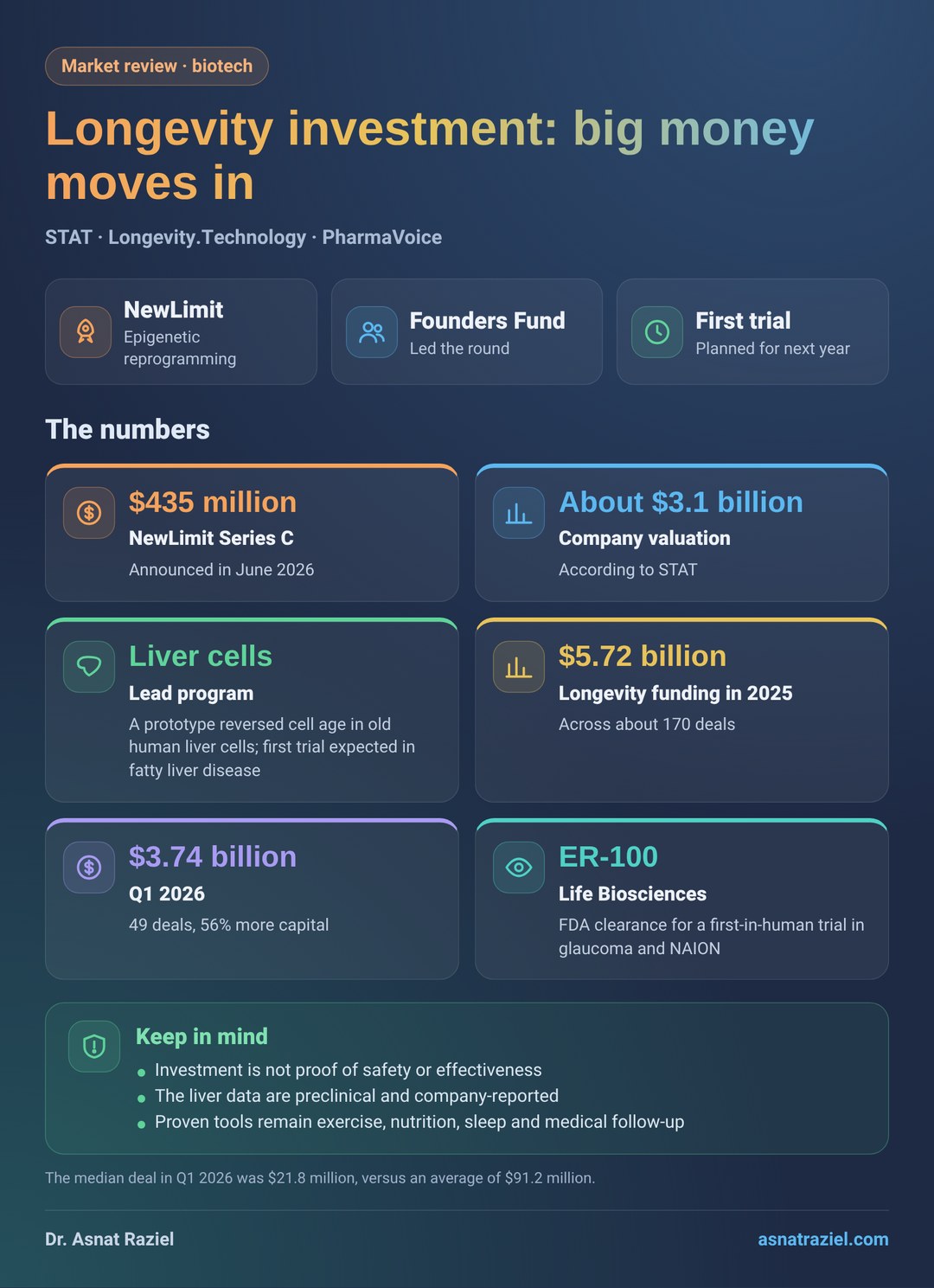
Longevity investment is no longer just for dreamers. In early June, the US company NewLimit announced a $435 million raise. This is a Series C round, a relatively late funding stage. The money is meant to bring the company’s first treatment into a human trial.
Who is NewLimit?
NewLimit was founded in 2021 in South San Francisco. Its founders include Brian Armstrong, CEO and co-founder of Coinbase, and Blake Byers, a bioengineer and former partner at GV. The third founder, Jacob Kimmel, is a biologist and serves as the company’s CEO.
The company develops epigenetic reprogramming treatments. In other words, it aims to change the “software” that controls which genes a cell switches on, without changing the DNA itself. The goal is to restore youthful function to older cells. According to the company, it uses artificial intelligence and genomic tools to find these treatments.
Who invested, and how much
Founders Fund led the round. New investors include Thrive Capital, Greenoaks and Quiet Capital. Existing investors also took part, among them Kleiner Perkins, Eli Lilly Ventures, the investment arm of drugmaker Lilly, and Human Capital. According to STAT, the company is valued at about $3.1 billion.
This raise follows a $130 million Series B in May 2025. In addition, in October 2025 the company raised another $45 million.
The first treatment targets the liver
NewLimit’s lead program is a reprogramming treatment for the liver. According to the company, a prototype of the drug reversed cell age in older human liver cells. In preclinical experiments, treated livers healed faster after injury. They also coped better with dietary stress and recovered faster from alcohol.
According to Longevity.Technology, the first clinical trial is expected to focus on people with fatty liver disease. The company plans to start it next year, far sooner than it once expected. It also has programs for blood vessel cells and immune cells. As someone who treats fatty liver disease every day, I am following this trial with great interest.
Longevity investment by the numbers
NewLimit is not alone. According to an analysis by Longevity.Technology, longevity companies raised about $5.72 billion across roughly 170 deals in 2025. In the first quarter of 2026, the total reached about $3.74 billion across 49 deals. That is 56% more capital than in the same quarter a year earlier. The site’s most realistic forecast for the full year is $8-9 billion.
That said, a few giant deals skew the picture. The median raise was only $21.8 million, compared with an average of $91.2 million.
Others in the race
Beyond NewLimit, several companies have already raised huge sums. For example, according to PharmaVoice, Altos Labs has $3 billion in funding, from backers including Jeff Bezos and Yuri Milner. In the same report, Retro Biosciences raised $180 million from Sam Altman.
Meanwhile, in January 2026 Life Biosciences received FDA clearance for a first-in-human trial of its treatment ER-100. The treatment is aimed at glaucoma and ischemic damage to the optic nerve (NAION), and it uses three of the four Yamanaka factors. I have written here about the first results in people.
What this means for us
Big capital moves research from the idea stage into real clinical trials. That matters, because only human trials will show whether these ideas work. However, investment is not proof. Even NewLimit’s CEO acknowledged that the field has suffered from “over-salesmanship” and a lack of rigorous science.
So it is worth reading every headline about “reversing aging” with caution. In the meantime, the proven tools are already in our hands: aerobic and strength training, good nutrition, sleep and medical follow-up. I have also written about what really slows aging.
The bottom line on longevity investment
Longevity investment is reaching new highs, and NewLimit is the standout example. For the first time, this money makes it possible to test cell reprogramming in people. But until the results arrive, our daily habits remain the best medicine we have.
This article provides general information and is not medical or investment advice.
References
Longevity startup NewLimit raises $435 million ahead of first clinical trial
No limits: NewLimit lands $435m ahead of human trials
NewLimit Raises $435 Million Series C To Bring Aging Reprogramming Medicine To Human Trials
Longevity biotech investment 2026: we’re set for a breakout year
FDA clears first human trial of epigenetic reprogramming therapy
Has the science of anti-aging caught up with the dream of a longer life?