By Dr. Asnat Raziel, bariatric surgeon specializing in obesity treatment, metabolic health and healthy longevity; Director of the Multidisciplinary Center for Obesity Treatment, Assia Medical, Assuta Ramat HaChayal, Tel Aviv
Weight bias in healthcare: my second report from ObesityWeek
Weight bias in healthcare harms patients before treatment even begins. That was the subject of the second talk in The Obesity Society workshop at ObesityWeek in Washington, DC. Dr. Thomas George, an obesity specialist who lives with obesity himself, presented the data. Above all, he shared what he went through as a patient.
I have written before about weight stigma and its effect on health. This time the focus is bias inside the clinic: among doctors, nurses and dietitians, and sometimes in me and in you.
“Maybe just chill out and enjoy life”
At about 150 kg, Dr. George was exceptionally strong. He said he bench-pressed about 222 kg and deadlifted about 320 kg. Still, his body was in danger. His liver enzymes were abnormal, and liver fibrosis was close. The kidneys were struggling too. Doctors recommended replacing a hip and both knees, and they found a dilated aortic root.
And what was he told? On one hand, “stop worrying about your weight and enjoy life.” On the other, some hinted that he was simply lazy. At work, he was passed over for a leadership role he was qualified for. He said he was told to his face that someone without willpower cannot lead. And at a party, a friend slapped his hand in front of everyone and asked: “Do you really need that cake?”
What the data show about weight bias in healthcare
First, the difference between two kinds of bias. Explicit bias is a negative opinion a person holds consciously. Implicit bias, by contrast, works below the surface. It can exist even in someone who sincerely believes the opposite.
Dr. George presented data from a study of more than 7 million tests on Project Implicit, a website that measures implicit bias. Implicit bias around sexual orientation, race and skin tone fell over the years. In contrast, implicit bias about body weight barely changed.
Professionals are not immune. In a test of about 100 nurse practitioners and physician associates, nearly 75% showed implicit bias against people with higher weight. Dr. George admitted with a smile that he got the same result, even though he lives with obesity.
How bias harms health
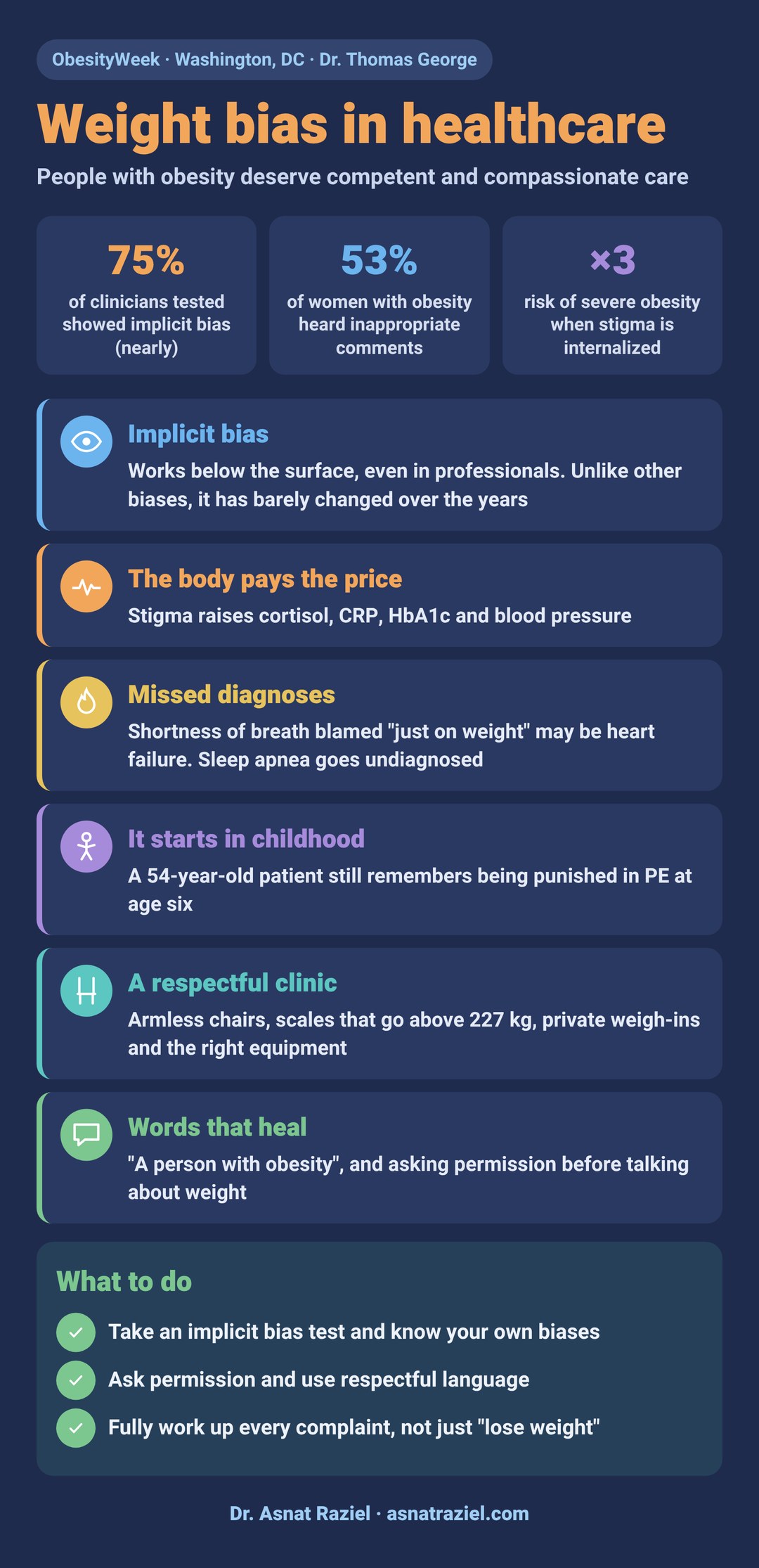
According to the slides, healthcare staff come second as a source of weight bias, right after family members. In addition, 53% of women with obesity reported inappropriate comments about their weight from healthcare staff. So many women put off checkups and prefer not to come at all.
Dr. George told of a patient who stopped coming for tests. The technician said the test “would be a lot easier if you lost weight.” The problem, he said, was not the patient but equipment that did not fit.
What’s more, doctors may blame shortness of breath “just on weight” when it is really heart failure. The same goes for sleep apnea that never gets diagnosed. According to a review on weight bias shown in the slides, stigma also raises cortisol, CRP (a blood marker of inflammation), HbA1c (average blood sugar over three months) and blood pressure.
In Dr. George’s words, people who face stigma in a healthcare setting have more than double the risk of severe obesity. Those who internalize it, meaning they come to believe it about themselves, have three times the risk.
Weight bias in healthcare starts young
One of the hardest moments in the talk was the story of a 54-year-old patient. When Dr. George raised physical activity with her, she burst into tears. At age six or seven, her PE teacher pulled her out of the game. All the other children played while she had to run laps and do jumping jacks. To this day, she will not walk down the sportswear aisle in a store.
I have also written about this in my article on teen obesity. Bias starts early and stays with us for decades.
When the fast-food bag tells a different story
Dr. George asked us to pause before we judge. A patient arrives with a fast-food bag. Maybe she is a single mother working three jobs, and this is what she can afford that day. He added that even a person’s ZIP code can predict how much weight they may gain.
He also described another barrier: a health system that required a year of lifestyle change before he could get medication. In his words, it is like telling someone with diabetes and an HbA1c of 12: “Go run first, and maybe then you’ll get insulin.”
A voice from the audience: hunger is biology
During questions, a dietitian named Summer shared that she lives with obesity and is now well managed on a GLP-1 medication. In her words, hunger almost always wins, sometimes in very quiet ways. A few extra bites at every meal can add up to about 500 calories a day. Once patients understand the biology, they engage with treatment much more easily.
How to reduce weight bias in healthcare
The first step, Dr. George said, is to look in the mirror. Take Harvard’s implicit association test and get to know your own biases. Then, when you meet bias, address it gently. He told of a respected colleague who claimed obesity is an addiction problem. Instead of getting angry, Dr. George sat down with him over the data, and the colleague changed his mind.
It also matters to ask permission: “Could we talk about your weight today?” It helps to ask which words the patient prefers, too. Accordingly, say “a person with obesity,” not “an obese person.” I wrote more about this in my article on respectful language in obesity.
A clinic that respects everyone
Finally, equipment sends a message too. Dr. George described a waiting-room chair with arms that got stuck on his hips. He also mentioned a scale that only went up to 136 kg, and a blood pressure cuff that was too small. That is why the slides recommend sturdy armless chairs and a scale that measures above 227 kg. Likewise, never weigh patients in the hallway, and never call out the number. Even a gynecological exam or an MRI can fail without the right equipment.
What you can do today
Remember: obesity is a disease, not a failure of willpower. Other people’s bias is not your fault.
Ask for: a blood pressure cuff that fits, a private weigh-in and a comfortable chair.
Question: if a symptom is blamed “just on weight,” ask for a full workup of the cause.
Choose: a care team that treats you with respect and builds a complete treatment plan with you.
Weight bias in healthcare on the board: the workshop illustration
Throughout the workshop, the Ink Factory team drew a live illustration that sums up the talks of Part I, including the talk on weight bias in healthcare. The lower corner carries the messages: reduce bias and stigma, look at implicit and explicit bias, and be the change agent. Compassion is key. The top corner calls for person-first, empathetic language to earn trust.
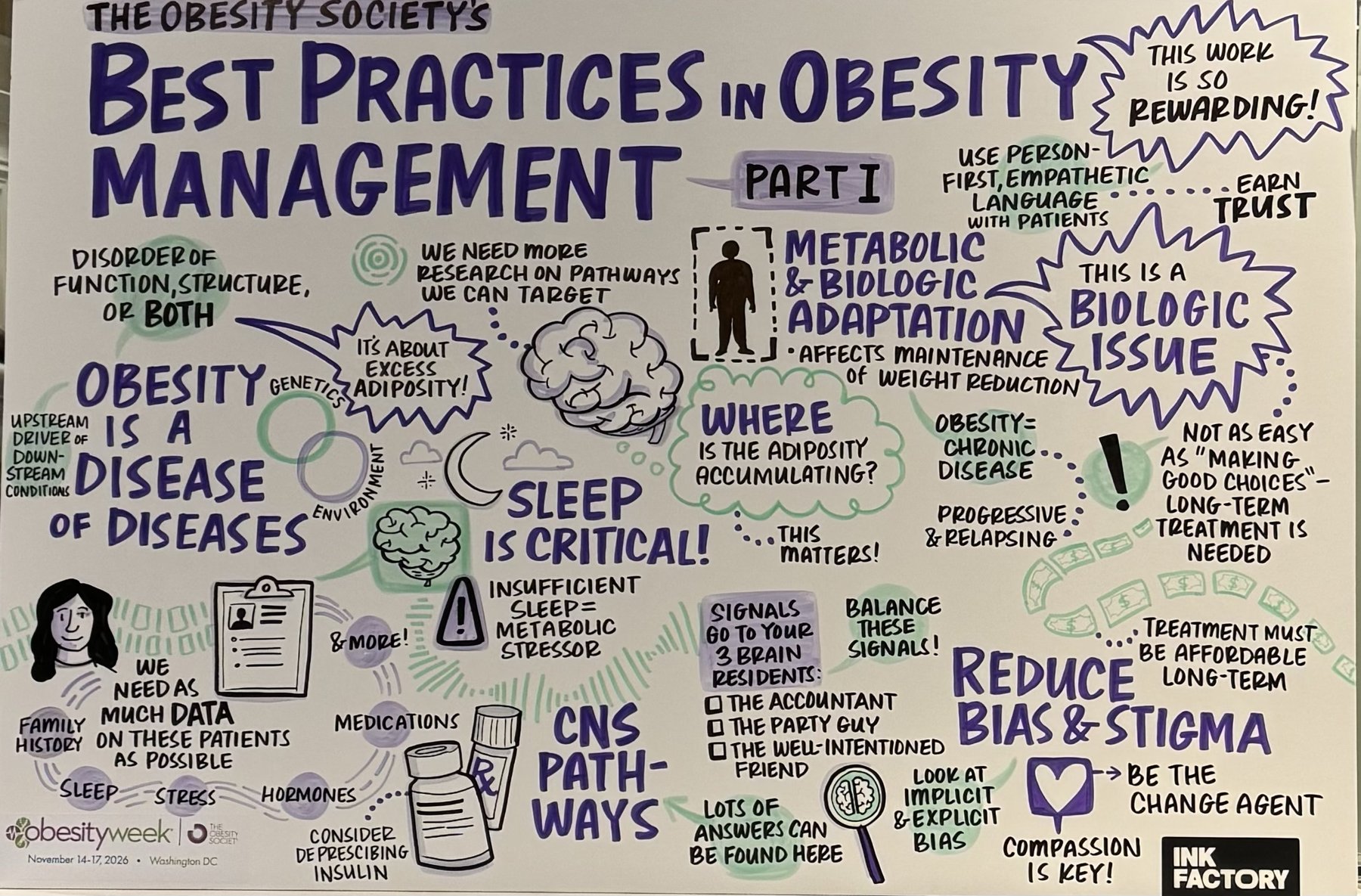
Illustration: Ink Factory for The Obesity Society, ObesityWeek, Washington DC. Photo: Dr. Asnat Raziel. Click the image to enlarge.
Bottom line: breaking weight bias in healthcare
At the end of the talk, Dr. George pointed to the Obesity Bill of Rights. Its message is simple: people with obesity deserve competent and compassionate care. Weight bias in healthcare is a real problem, but it can change. That change starts with each of us, in every conversation and in every clinic.
This article is general information and does not replace personal medical advice.
Sources
Patterns of Implicit and Explicit Attitudes: IV. Change and Stability From 2007 to 2020
Overcoming Weight Bias in the Management of Patients With Diabetes and Obesity
Confronting and coping with weight stigma: an investigation of overweight and obese adults
Best Practices in Obesity Management Series
The workshop was supported by educational grants from Amgen, Lilly, Novo Nordisk and Zealand. According to the organizers, the sponsors had no influence on the content.