By Dr. Asnat Raziel, bariatric surgeon specializing in obesity treatment, metabolic health and healthy longevity; Director of the Multidisciplinary Center for Obesity Treatment, Assia Medical, Assuta Ramat HaChayal, Tel Aviv
Stopping GLP-1: what happens when you stop?
Stopping GLP-1 treatment is a question on the mind of almost every patient who starts Wegovy or Mounjaro. These drugs, semaglutide and tirzepatide, have transformed obesity treatment. They reduce hunger, increase fullness and sometimes silence food noise: the recurring thoughts about food throughout the day. But what happens when you stop?
Controlled studies show that for many people, hunger comes back, and later some of the weight does too. The good news is that the response is not uniform, and some people keep a large part of the weight off. So if you might want to lower your dose or stop in the future, it’s worth preparing for it long before the last injection.
Why does the weight tend to come back?
Obesity is a chronic disease, and the body doesn’t easily “forget” its previous weight. After weight loss, biological mechanisms kick in that encourage regain. Appetite increases, fullness weakens and energy expenditure changes.
In the STEP 1 extension study, participants lost 17.3% of their body weight on semaglutide 2.4 mg. A year after stopping, they had regained 11.6 percentage points, or about two-thirds of the loss. In the STEP 4 trial, those switched to placebo gained 6.9% over the next 48 weeks. By contrast, those who continued treatment lost another 7.9%.
A similar picture emerged in the SURMOUNT-4 trial with tirzepatide. After a 20.9% loss in the first phase, those switched to placebo gained 14.0% over a year. On the other hand, those who continued treatment lost another 5.5%.
In January 2026, the BMJ published a meta-analysis of 37 studies with 9,341 participants. According to the analysis, after stopping obesity medications, weight returns at an average rate of 0.4 kg a month. According to the University of Oxford’s announcement, the rate is especially fast after semaglutide and tirzepatide, about 0.8 kg a month. However, these are averages, not every patient’s personal destiny. You’ll find more on what happens after stopping in my article on stopping GLP-1 drugs.
The drug as a “window of opportunity”
My conclusion is not that you should avoid these drugs. Nor is there any reason for every patient to aim to stop them. On the contrary: for many people, long-term treatment is the right part of managing a chronic disease.
But when a patient may want to stop in the future, the year of treatment must not be a year in which “the injection does the work.” I prefer to see this period as a window of opportunity. When hunger and food noise are low, it’s easier to build a new system of eating, movement, sleep and coping. The goal is not just to lose weight, but to finish the year with a new toolbox.
And what about people who ate junk food and lost weight anyway?
This is exactly where work is needed. On treatment, you can lose weight even with a less-than-ideal diet, simply because you eat less. But if you plan to stop, you can’t assume your portions will stay small once the drug’s effect is gone.
There’s no need to ban chocolate, pizza or dessert forever. Absolute bans can create a problematic relationship with food. Instead, your nutritional foundation should create natural fullness: vegetables, fruit, legumes, whole grains, quality protein, fish, eggs, nuts and olive oil. At the same time, it’s worth cutting back on ultra-processed food, which is easy to overeat. The principle: shift gradually from fullness that comes from the drug to fullness that also relies on how your meals are built.
Protein, fiber and food volume
As you get closer to reducing treatment, protein should be a central part of every meal, alongside vegetables and fiber-rich foods. I wrote about amounts and sources in my guide to protein intake during weight loss. In addition, foods with low energy density let you eat a large volume for fewer calories. This matters especially when appetite returns.
For many people, the answer is not stopping but a planned maintenance phase. I describe it in my article on continuing GLP-1 for weight maintenance.
Your daily routine matters too. Instead of reaching the evening very hungry and relying on willpower, it’s better to build an eating structure that prevents extreme hunger.
Stopping GLP-1 and the most powerful non-drug tool: exercise
One of the most interesting studies on this topic came from Denmark. In a study from Copenhagen, participants first lost weight on a low-calorie diet. They then received a year of supervised exercise, liraglutide, a combination of the two, or placebo. One year after treatment ended, those who received liraglutide alone had gained 6.0 kg more than those who exercised. In addition, those who received the combination often maintained a loss of at least 10%.
The principle is important: the drug stops working when you stop taking it, but the fitness you’ve built stays with you. That’s why I recommend combining aerobic activity with two to three strength-training sessions a week. It’s also worth increasing everyday movement: walking, stairs and activity that isn’t a formal “workout.” I wrote about the right combination in my article on aerobic versus strength training. The goal is not only burning calories, but preserving muscle mass, function and fitness.
When food noise returns after stopping GLP-1
First, the return of hunger is not a failure. It is an expected biological response to the fading drug effect. Second, it’s important to distinguish between physical hunger and eating out of habit, boredom or stress. I wrote about the mechanism in my article on food noise.
You can create a “quiet environment” in advance: don’t keep large amounts of foods that are hard to control at home, prepare filling options, and eat sitting down rather than in front of screens. And when food noise returns in full force, that’s the time to step up follow-up, not to wait for a big gain.
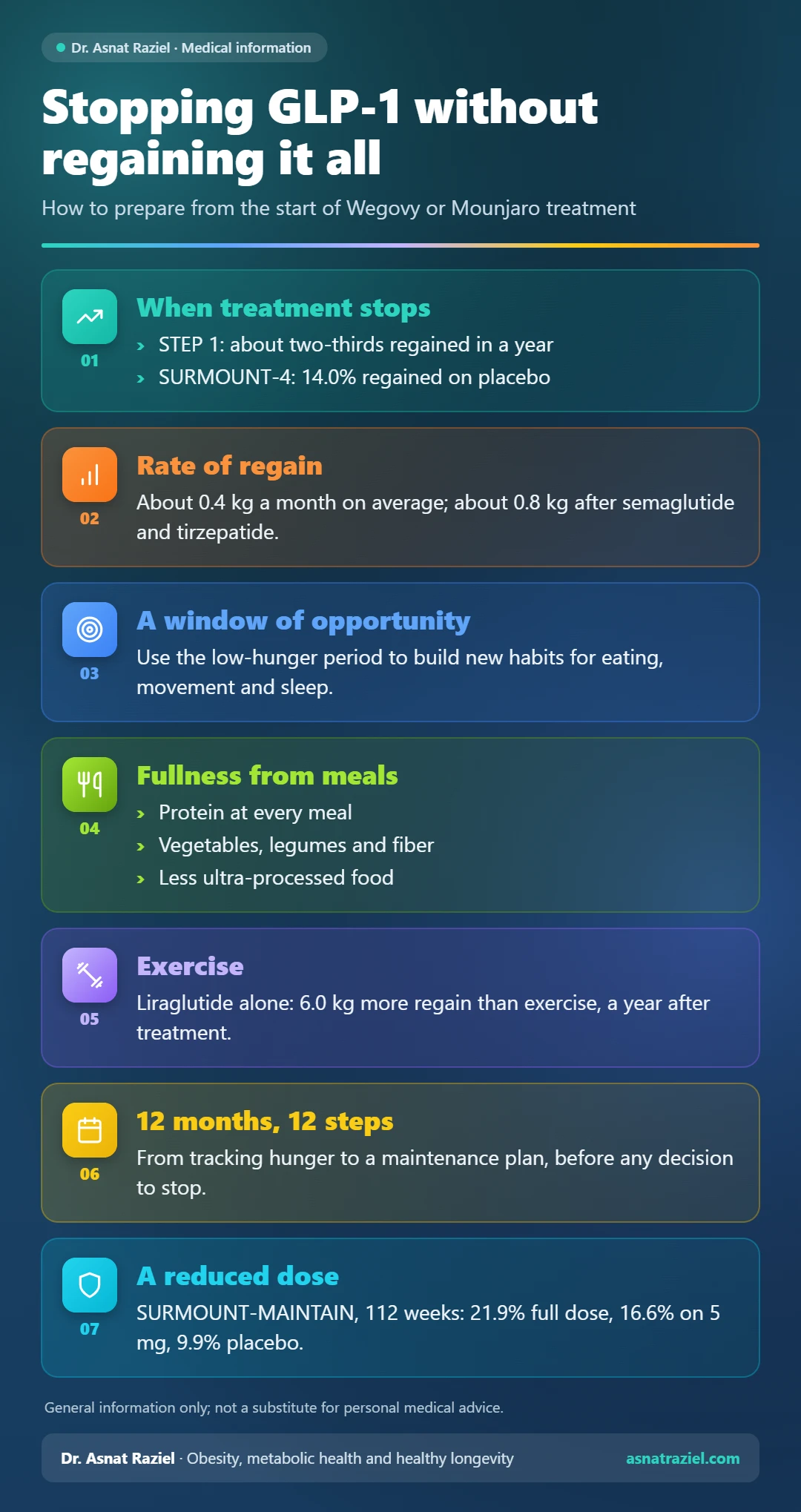
12 months, 12 steps toward stopping GLP-1
I suggest turning the year of treatment into a year of preparing for maintenance:
- Month 1: Learn your hunger and fullness patterns and start tracking.
- Month 2: Build meals around protein.
- Month 3: Add vegetables, legumes, fruit and fiber.
- Month 4: Cut back on ultra-processed food and sweetened drinks.
- Month 5: Set a personal step goal.
- Month 6: Start regular strength training.
- Month 7: Add structured aerobic activity.
- Month 8: Work on sleep, because fatigue and hunger are a problematic combination.
- Month 9: Identify emotional eating, stress and triggers.
- Month 10: Practice restaurants, vacations and events.
- Month 11: Build a maintenance plan: a weight range, how often to weigh yourself and how to respond to a gain.
- Month 12: If there is a medical decision to reduce or stop, you reach it when the whole system is already working.
Stopping GLP-1 gradually: is it better?
The idea of lowering the dose or spacing out injections is very appealing, and there are intriguing real-world data. However, there are still no large randomized trials proving that gradual tapering prevents regain better than stopping outright. The first randomized trial on this question, a study testing gradual tapering of semaglutide, will only report results in 2030.
In the meantime, there is an important finding on reduced doses. In the SURMOUNT-MAINTAIN trial, published in The Lancet in May 2026, participants first received tirzepatide at the maximum dose. After 112 weeks, weight loss stood at 21.9% on the maximum dose, 16.6% on 5 mg and 9.9% on placebo. In other words, a low maintenance dose preserved a large part of the result, but less than the full dose. That’s why any dose reduction should be individualized and medically supervised.
The goal is not “never gain a kilo”
Weight maintenance is not a straight line. Even people who do very well can gain two or three kilograms on vacation or during a stressful period. The difference lies in what happens next. That’s why I define a “maintenance range” in advance, rather than one magic number. When weight crosses the limit, we respond early: we check hunger, sleep, activity, eating and medical status, and decide whether to reinforce behavior, nutrition or medication.
Stopping GLP-1: can we predict who will regain weight?
Update, November 13, 2026: At ObesityWeek, researchers from Mayo Clinic and Phenomix Sciences presented real-world data on 45,017 adults who stopped treatment. Among them, 28,599 had taken semaglutide and 16,418 tirzepatide. In addition, follow-up lasted up to three years after stopping.
On average, people lost 11.3% of their weight on semaglutide and 11.0% on tirzepatide. However, after stopping, they regained on average 73.7% and 69.2% of the weight they had lost, respectively. As a result, half of the lost weight came back within about six months on semaglutide, and nearly five months on tirzepatide.
However, there is good news too. Those who lost 20% or more kept a net loss of 13% (semaglutide) and 16% (tirzepatide) two years after stopping. In addition, a prediction model separated patients well. In the highest-risk group, half the weight returned within 1.8 to 2.0 months. By contrast, in the lowest-risk group it took 19.0 to 19.2 months.
Even so, keep in mind that these are conference abstracts released by the company, not yet a full peer-reviewed publication. For now, the prediction tools are not currently available in Israel.
What you can do today
- Plan stopping GLP-1 in advance with your doctor, rather than stopping all at once.
- Add strength training and enough protein to protect muscle mass.
- Consider a lower maintenance dose or a switch to a pill, when appropriate.
- Weigh yourself once a week and set a threshold for restarting treatment in advance.
- Keep working with a dietitian and a psychologist after stopping.
The bottom line on stopping GLP-1
Stopping GLP-1 treatment is not a test of willpower. Some people will need long-term treatment, and some will be able to reduce or stop and keep their results. We still can’t predict who will belong to which group. But there’s one thing you can do today: don’t wait for the last injection to start preparing for life after it.
This article is not a recommendation to stop treatment. Obesity is a chronic disease, and for many people long-term treatment is justified. Lowering the dose, changing the interval, switching drugs or stopping should be done individually, in coordination with your doctor.
The information in this article is general and does not replace personal medical advice.