By Dr. Asnat Raziel, bariatric surgeon specializing in obesity treatment, metabolic health and healthy longevity; Director of the Multidisciplinary Center for Obesity Treatment, Assia Medical, Assuta Ramat HaChayal, Tel Aviv
Healthy fat tissue: the goal is not just less fat
Healthy fat tissue matters as much as the amount of fat in the body. That was one of the key messages of the presidential address of The Obesity Society, which opened ObesityWeek in Washington, DC. Prof. Jacqueline Stephens of Pennington Biomedical has studied fat cells for more than 35 years. In her view, metabolic disease is linked mainly to fat that does not work properly, not only to how much fat there is.
The talk also asked why people respond so differently to the same treatment, and why weight tends to return. The answers, it turns out, lie deep in biology.
Why people respond differently to the same treatment
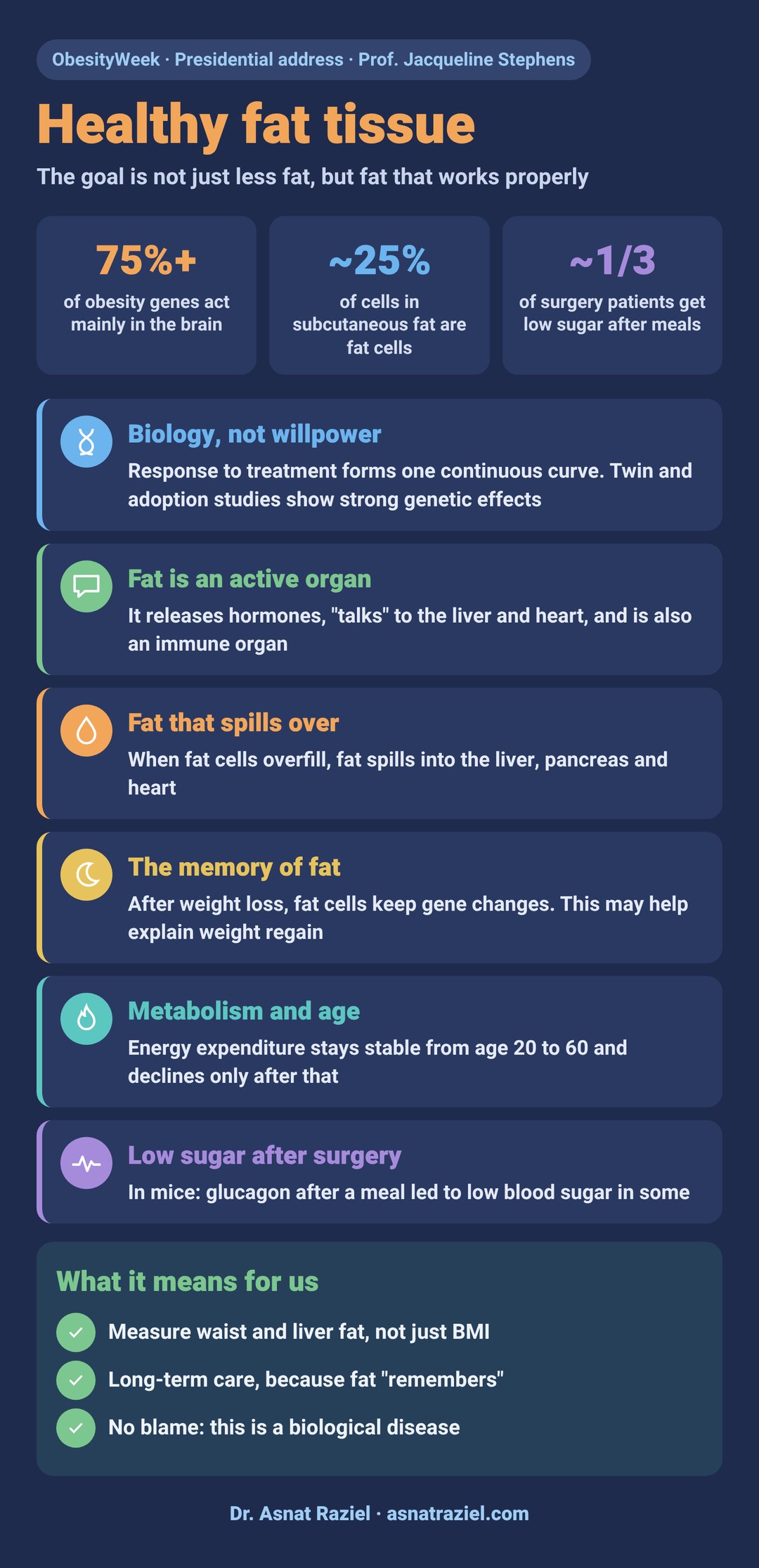
Response to obesity treatment varies widely between people. This is true for diet, medication, devices and surgery. Prof. Stephens showed that responses do not split into two groups of people who “stick with it” and people who do not. Instead, they form one continuous curve. In her view, therefore, the differences come largely from biology, not simply from effort.
Twin and adoption studies support this:
- Identical twins raised apart reach similar body weights.
- When identical twins are overfed, the response varies between pairs but is similar within each pair.
- Adopted children’s weights resemble those of their biological parents, not their adoptive parents.
Moreover, more than 75% of the genes linked to obesity act mainly in the central nervous system, especially in appetite pathways.
What about metabolism and age?
One surprising finding: a large study in Science found that energy expenditure, adjusted for lean mass, stays stable between ages 20 and 60. Only after 60 does it start to decline. In other words, “my metabolism slowed down at 40” is not the whole story.
Healthy fat tissue is an active organ
Our understanding of fat has changed a great deal. We once thought of it as simple energy storage. Today we know that fat cells are endocrine cells, which means they release hormones. In addition, adults have brown fat, which burns energy to make heat, and also “beige” fat with similar properties. Both are linked to good metabolic health.
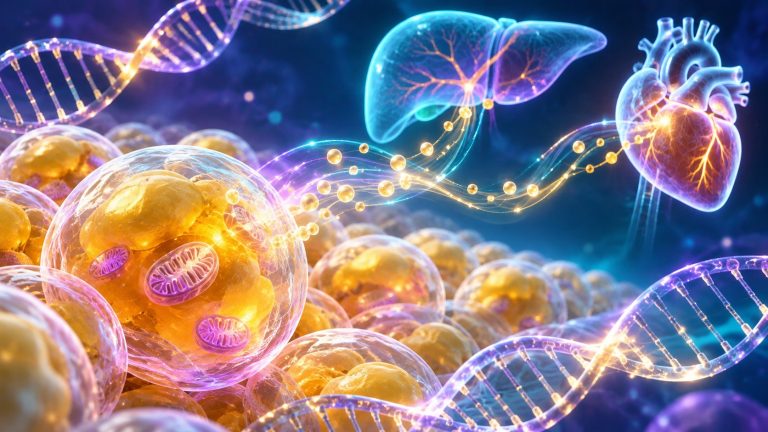
Fat tissue also “talks” to other organs. It releases tiny vesicles carrying molecules that regulate genes in the liver. According to animal studies, even fragments of mitochondria may travel from fat to the heart.
Fat is also an immune organ. In fact, in fat under the skin, only about a quarter of the cells are fat cells. The rest are other cells, such as immune cells.
When fat stops working, it spills over
This is the heart of the matter. When fat cells fill beyond their capacity, fat spills into the liver, pancreas and heart. There it contributes to insulin resistance, heart disease and kidney disease. That is why, according to Prof. Stephens, the goal should be healthier fat tissue, not only less fat. Healthy fat storage might even improve health before major weight loss.
This fits well with what we see in the clinic. Two people with the same BMI can be in completely different metabolic shape. So it is worth measuring waist circumference and checking fat in the liver and pancreas. Read more about pancreatic fat.
A new direction: drugs that target fat itself
Most of today’s obesity drugs act on the brain. Also, part of the weight lost comes from muscle. Therefore, Prof. Stephens suggested developing treatments that target fat tissue directly. One pathway under study involves a liver hormone called activin E, which acts on a receptor in fat cells and slows fat breakdown. However, this is still basic research, with open safety questions such as fat buildup in the liver.
The memory of fat: why weight comes back
One of the most fascinating topics was the “memory” of fat tissue. A study published in Nature examined fat tissue from people before bariatric surgery and after major weight loss. The researchers found that fat cells kept changes in gene activity even after the weight loss. In mice, this “memory” sped up weight regain.
According to Prof. Stephens, this memory may explain part of the weight regain after treatment stops. In a mouse experiment, temporarily boosting the GIP receptor in fat cells reduced fat mass and improved metabolic health, and the benefit lasted even after the boost ended. In other words, we may one day be able to “erase” the memory of fat.
After surgery: low blood sugar
In the same session, Prof. Darleen Sandoval of the University of Colorado, winner of the society’s Founders Award, presented research on post-bariatric hypoglycemia. She said low blood sugar after meals affects about one-third of surgery patients, sometimes months or years after the operation.
In mice after sleeve gastrectomy, her team found that glucagon, the hormone meant to raise blood sugar, behaves differently. A low dose of glucagon after a meal actually led to low blood sugar in some mice, along with insulin release. Blocking the GLP-1 receptor prevented part of this effect. For this reason, she suggested that glucagon may not be the ideal treatment in this setting. These are still mouse findings.
The bottom line: healthy fat tissue as a treatment goal
The message of the talk is clear: obesity is a biological disease, not a failure of willpower. Fat is an active organ, and the goal is healthy fat tissue that stores fat well and does not spill into other organs. In addition, fat “remembers,” so treatment needs to be long term. Prof. Stephens closed with a line that stayed with me: a cure sitting on a shelf is not a cure. Discoveries matter only when they reach people.
Read more about obesity as a disease of diseases and about combining medication and surgery.
This article is general information and does not replace personal medical advice.
References
Adipose tissue retains an epigenetic memory of obesity after weight loss