By Dr. Asnat Raziel, bariatric surgeon specializing in obesity treatment, metabolic health and healthy longevity; Director of the Multidisciplinary Center for Obesity Treatment, Assia Medical, Assuta Ramat HaChayal, Tel Aviv
Weight maintenance after GLP-1: why it is the key question
Weight maintenance after GLP-1 treatment is one of the biggest challenges in obesity care. Today, there is more than one way to approach it: continue the same dose, lower the dose, switch from an injection to a pill, or stop with a structured plan. In this article, I explain what happens in the body when you stop, and what new studies teach us about each option.
When you stop obesity medication, the weight tends to come back in most cases. This is not a malfunction or a personal failure, but an expected biological response. The new drugs have brought a revolution: significant weight loss, good metabolic control and heart protection. Still, one question comes up at almost every clinic visit: what will happen the day after?
This article focuses on the options for keeping your results and on the biology behind them. I have written separately about tapering obesity drugs gradually and about how fast the weight comes back after the injections. Here, we will try to understand why it happens and how to build a personal plan.
What happens to your weight when you stop: the latest studies
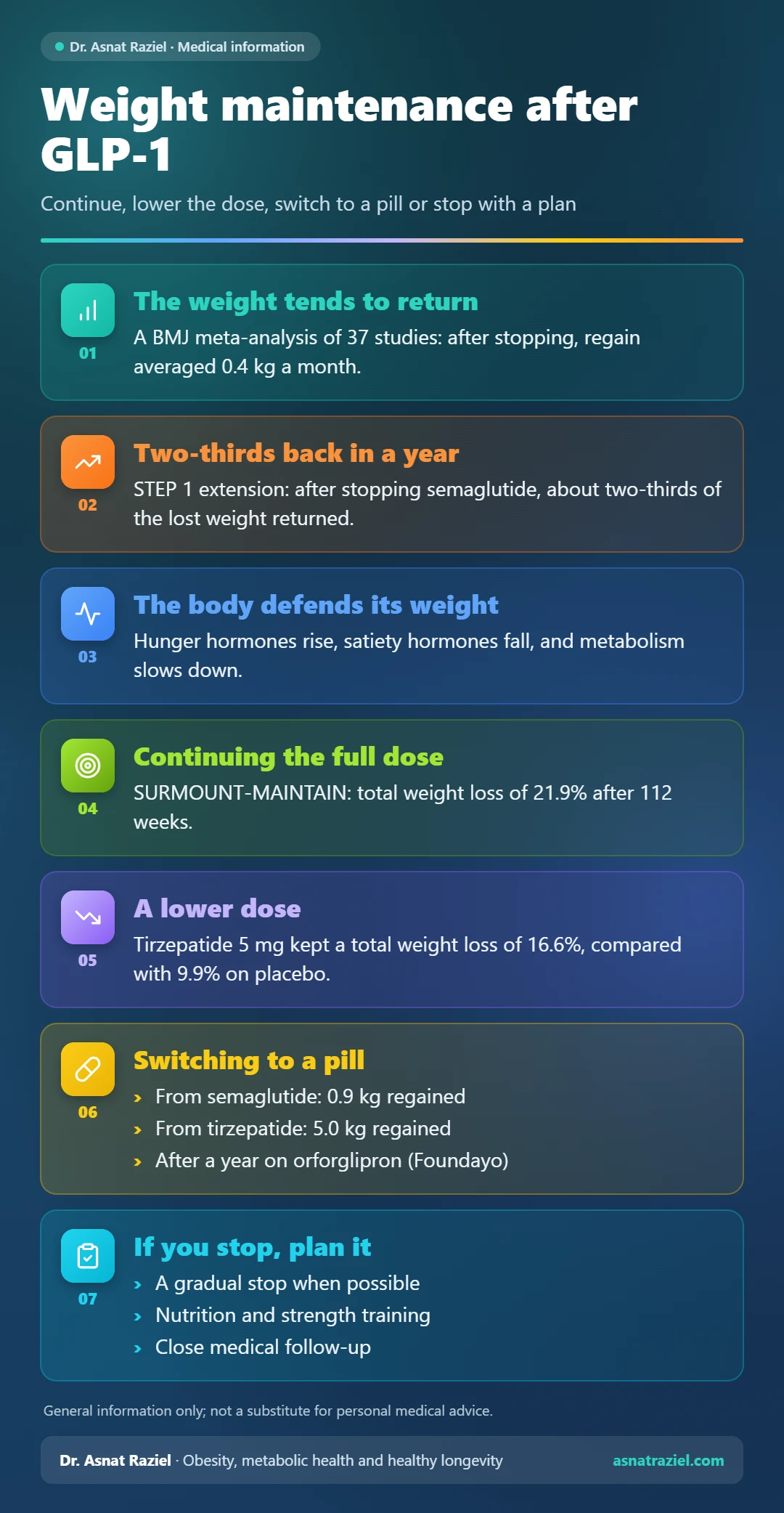
In January 2026, researchers from the University of Oxford published a large meta-analysis on this topic in the BMJ. It included 37 studies and 9,341 participants. After stopping the drugs, participants regained an average of 0.4 kg a month. According to the researchers’ estimate, all cardiometabolic measures return to the starting point within about 1.4 years. In addition, the weight came back faster than after stopping diet and behavior programs.
Clinical trials show a similar picture. In the STEP 1 extension, participants who stopped semaglutide regained about two-thirds of the weight they had lost within a year. In the SURMOUNT-4 trial with tirzepatide, those who switched to placebo gained 14.0% of their body weight within a year. By contrast, those who continued treatment lost another 5.5%.
Why the body brings the weight back
Weight loss triggers strong compensation mechanisms. Hunger hormones rise, satiety hormones fall, and metabolism slows down. The body “sees” the weight loss as a threat and tries to return to its previous set point. Evidence for this came from a study in the NEJM that followed people who lost weight on a diet. Even a year after the weight loss, ghrelin, the hunger hormone, remained high. At the same time, leptin and other satiety hormones stayed low, and the feeling of hunger persisted.
In other words, the body remembers its previous weight. This is true after a diet, and it is also true after drug treatment. This mechanism is not a character flaw. Rather, it is an ancient survival mechanism designed to protect us in times of food shortage.
When you stop the medication, the brain returns to its starting point
Obesity drugs act on the satiety and hunger centers in the brain and in the digestive system. As long as treatment is active, these signals are balanced. When you stop the medication, the system gradually returns to its baseline state, and sometimes even overreacts for a while. Appetite grows, satiety weakens, and the tendency toward emotional or impulsive eating returns.
Therefore, without a strong nutritional and behavioral foundation, the risk of rapid weight gain is high. Practical tools for this stage appear in my article on coping with hunger after stopping the injections.
Weight maintenance after GLP-1: does treatment have to be lifelong?
Not necessarily, but sometimes yes. Obesity is a chronic disease, like high blood pressure, diabetes or asthma. For some patients, long-term treatment is the way to keep their results. For others, it is possible to consider a lower dose, a gradual stop or a switch to another treatment. In any case, the decision is made together with the care team.
A new study supports this approach. In the SURMOUNT-MAINTAIN trial, published in the Lancet in May 2026, participants first lost weight on the maximum dose of tirzepatide. After that, they either continued the same dose, stepped down to 5 mg or switched to placebo. After 112 weeks, total weight loss was 21.9%, 16.6% and 9.9%, respectively. In other words, a low dose kept a large part of the result, far better than stopping completely.
Another option is switching from an injection to a pill. In the ATTAIN-MAINTAIN trial, participants switched from weekly injections to the daily pill orforglipron, marketed as Foundayo. After a year, those who switched from semaglutide kept almost all of their weight loss, except for 0.9 kg on average. Those who switched from tirzepatide kept most of their weight loss, with an average difference of 5.0 kg. The full results were published in Nature Medicine in May 2026.
The modern approach is not “all or nothing,” but personal tailoring. Who needs ongoing treatment? Who can stop? And who needs a combination of additional tools?
Weight maintenance after GLP-1: the options at a glance
- Continuing the full dose: in SURMOUNT-MAINTAIN, total weight loss was 21.9% after 112 weeks. In SURMOUNT-4, those who continued lost another 5.5%.
- A lower dose: tirzepatide 5 mg kept a total weight loss of 16.6%, compared with 9.9% on placebo.
- Switching to a pill: those who switched from semaglutide to orforglipron regained 0.9 kg on average over a year, and those who switched from tirzepatide regained 5.0 kg.
- Stopping completely: on average, the weight comes back at about 0.4 kg a month, so stopping requires a plan and close follow-up.
No single option fits everyone. The choice depends on your medical situation and personal preference, and you make it together with your care team.
A plan for weight maintenance after GLP-1
Stopping treatment is not an end point, but another stage in the process. To reduce the risk of regaining weight, I recommend a few principles:
- First, a gradual stop rather than a sudden one, when possible.
- Second, a clear, personally tailored nutrition foundation, as I described in my article on nutrition for keeping the weight off after treatment.
- In addition, regular physical activity, with an emphasis on strength training to preserve muscle mass.
- Finally, ongoing medical follow-up that spots an upward trend in time and allows early action.
Sometimes, restarting treatment at a low dose or switching to another drug is part of good management. This is not a failure, but an adjustment of treatment to a chronic disease.
The emotional side of stopping medication
Regaining weight sometimes brings frustration, guilt and a sense of losing control. That is why it is important to change the conversation: the weight gain is not the patient’s fault, but an expression of biology. Emotional support, a stronger sense of self-efficacy and realistic expectations are part of the treatment. If you are worried about this moment, you will find tools in my article on the fear of regaining weight.
When patients understand how the disease works, it is easier for them to cope with ups and downs along the way. It also makes it easier to stay committed to the process.
The bottom line
Drug treatment for obesity is not magic, but a powerful medical tool within a long process. When you stop the medication, the body follows its own biology, and this is expected. Ultimately, the goal is not “to stop at any cost.” The goal is to protect your health, your results and your quality of life over time.
The information in this article is general information and does not replace personal medical advice.
References
Long-term persistence of hormonal adaptations to weight loss
The STEP 1, SURMOUNT-4, SURMOUNT-MAINTAIN and ATTAIN-MAINTAIN trials were funded by the drug manufacturers, Novo Nordisk and Eli Lilly.