By Dr. Asnat Raziel, bariatric surgeon specializing in obesity treatment, metabolic health and healthy longevity; Director of the Multidisciplinary Center for Obesity Treatment, Assia Medical, Assuta Ramat HaChayal, Tel Aviv
Fear of weight regain: why it is so common
Fear of weight regain is one of the things I hear most often in my clinic, and often from people who have succeeded in losing weight. They worked hard and saw results, and now every meal feels like a test. Every kilogram on the scale sets off alarm bells. However, this fear has a clear biological and psychological explanation, and there are proven ways to deal with it.
In this article, I will explain where the fear comes from and what research says about keeping weight off. I will also show how to turn anxiety into a calm plan of action.
Where the fear comes from: the body “defends” its previous weight
This fear does not come out of nowhere. Many people have already gone through several rounds of losing and regaining, known as yo-yo dieting or weight cycling. Each round leaves behind a memory of disappointment. So even when the current weight loss is going well, the mind is already waiting for the next “fall.”
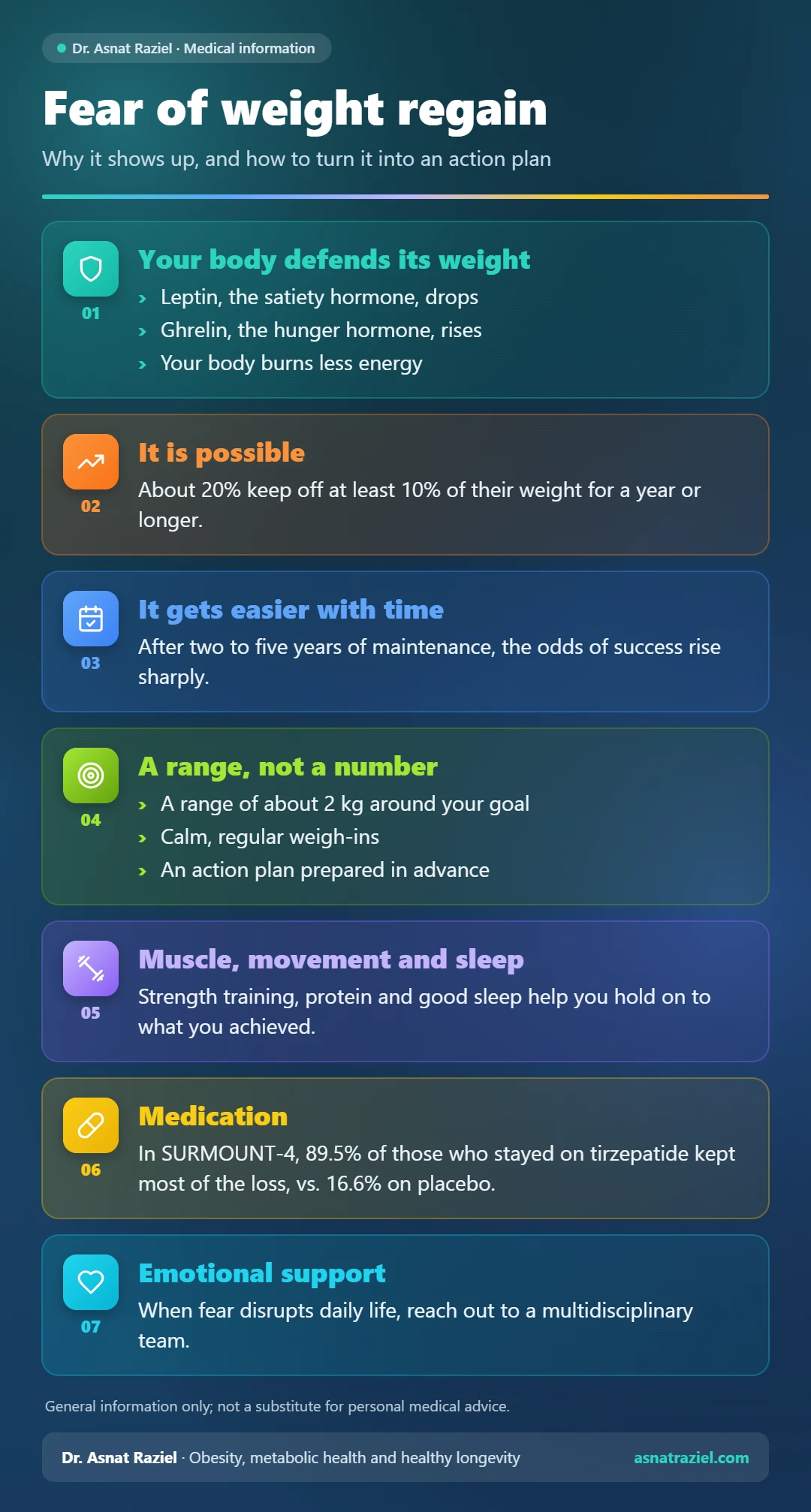
In addition, the body really does react to weight loss. According to a review from the US National Library of Medicine on the metabolic consequences of weight loss, levels of leptin, the satiety hormone, drop after weight loss. At the same time, levels of ghrelin, the hunger hormone, rise. The body’s energy use also falls by more than we would expect from the weight loss alone.
A well-known follow-up study looked at contestants from the TV show The Biggest Loser. Researchers found that even six years after the competition, their resting metabolic rate was about 704 calories a day below their starting point. In other words, the feeling that “my body is fighting me” is not imaginary. Instead, it reflects a real mechanism.
What research says about keeping weight off long term
There is good news, too. A comprehensive review of long-term weight loss maintenance showed that about 20% of people with excess weight manage to lose at least 10% of their body weight and keep it off for at least a year. Members of the US registry that tracks successful weight maintainers lost an average of 33 kg and kept it off for more than five years.
What’s more, the same review found that maintaining weight gets easier over time. After two to five years of maintenance, the chances of long-term success rise sharply. So what sets successful people apart? Regular physical activity, eating breakfast, a consistent eating pattern even on weekends and regular weight tracking. The researchers also found a link between low levels of depression and of uncontrolled eating and success.
The conclusion matters: keeping weight off is not a matter of luck. Rather, it is a skill you can learn, and it helps to treat the fear as a signal to build that skill.
When fear of weight regain becomes paralyzing
A small dose of fear can help. It keeps you alert and keeps good habits in place. But when it takes over, it actually works against the goal. Here are signs to watch for:
- Weighing yourself several times a day, with your mood depending on the number.
- Avoiding family events, restaurants and holiday meals.
- Extreme food restriction, followed by bouts of binge eating.
- Thoughts about food that never let up throughout the day.
- A feeling that every small slip is “the end of the road.”
The restriction-and-binge pattern deserves special attention. Strict restriction often leads to overeating and rapid weight gain. Those nonstop food thoughts are also known as food noise, and I wrote about them at length in my article on food noise and how to treat it. When these patterns appear, the anxiety is no longer serving you. Instead, it is running your life.
How to cope with fear of weight regain
The way out begins with a change of perspective. Instead of trying to “never gain a single gram,” you build a system that knows how to respond in time. Here are the tools I recommend in my clinic.
A weight range instead of a single number
Your weight changes from day to day because of fluids, salt, your menstrual cycle and constipation. That is why it is worth setting a range of about two kilograms around your goal. Fluctuation within that range is simply life. Only moving outside it calls for a response.
An action plan prepared in advance
Write down in advance what you will do if your weight moves out of range. For example, go back to a food diary for two weeks, add a daily walk and book a session with your dietitian. With a plan in place, the number on the scale turns from a source of panic into useful information.
Regular weighing, without the drama
Regular weight tracking is one of the standout habits of successful maintainers. Still, if weighing makes you anxious, once a week is enough, at the same time and under the same conditions.
Muscle, movement and sleep
Part of the weight lost on any diet is lean body mass, mainly muscle. Strength training alongside aerobic activity and a protein-rich diet helps preserve it. In addition, enough sleep and stress management reduce the urge to eat emotionally.
Address the emotional side
If your previous attempts ended in disappointment, it is worth understanding why. My article on weight loss failure explains why this happens even to very hardworking people. Moreover, the tools in my guide on how to overcome emotional eating help you spot the moments when food serves as comfort.
Medication and fear of weight regain
In recent years, many people have lost weight with medications such as Wegovy (semaglutide) or Mounjaro (tirzepatide). For them, the fear centers on the moment they stop, and there is a basis for it. In the STEP 1 trial extension, a year after stopping semaglutide and the lifestyle program, participants regained about two-thirds of the weight they had lost.
On the other hand, the SURMOUNT-4 trial showed the other side. Among those who continued on tirzepatide, 89.5% kept off at least 80% of the weight they had lost. By contrast, only 16.6% of those switched to placebo managed to do so. In other words, medication works as long as you keep using it.
According to the US National Institute of Diabetes and Digestive and Kidney Diseases (NIDDK), you can continue the medication as long as it helps and there are no serious side effects. For this reason, the decision to continue, lower the dose or stop should be planned together with your doctor. I have written more about this in my articles on obesity medication and on weight gain after stopping weight loss injections. It is also worth reading about maintenance treatment for obesity.
It is also important to remember the emotional side of treatment. In my article on GLP-1 and mental health, I reviewed what we know today about the link between these drugs and mood.
Fear of weight regain: when to seek help
It is worth getting help when the fear disrupts your routine, your relationships or your sleep. Repeated binge eating or extreme restriction is also a good reason to reach out. A dietitian works in our clinic. In addition, when needed, I refer patients to a multidisciplinary mind-body team. That team includes dietitians, psychologists, holistic coaches, naturopaths and complementary medicine practitioners, as well as Pilates and yoga instructors and stress-reduction experts. This fear calls for care of both body and mind. Anyone who knows the yo-yo dieting cycle up close knows that support makes all the difference.
The bottom line
Fear of weight regain is a natural response to a body that really is trying to return to its previous weight. Yet research shows that keeping weight off is possible and gets easier over time. So instead of fearing every kilogram, build a weight range, an action plan and habits around movement and sleep. When needed, add long-term medication and emotional support.
The information in this article is general and does not replace personal medical advice.
Questions and answers
Is fear of weight regain normal?
Yes. Many people feel it after significant weight loss, especially after previous attempts that did not last. It becomes a problem when it disrupts daily life or leads to extreme restriction.
How often should I weigh myself?
Regular tracking helps you maintain your weight. However, if weighing stresses you out, a fixed weekly weigh-in is enough. Focus on the range rather than a single number.
Will I regain weight if I stop weight loss injections?
In studies, many people regained a large share of their weight after stopping. That is why it is best to plan the decision with your doctor, together with a nutrition, exercise and follow-up plan.
When does keeping weight off get easier?
According to the review by Wing and Phelan, after two to five years of maintenance, the chances of long-term success rise sharply.
Sources
Long-term weight loss maintenance
Persistent metabolic adaptation 6 years after “The Biggest Loser” competition
Metabolic Consequences of Weight Reduction