By Dr. Asnat Raziel, bariatric surgeon specializing in obesity treatment, metabolic health and healthy longevity; Director of the Multidisciplinary Center for Obesity Treatment, Assia Medical, Assuta Ramat HaChayal, Tel Aviv
Obesity: a lifelong disease or a problem you can solve?
Is obesity a lifelong disease? This is one of the questions my patients ask me most often. Many hope it is a condition they can fix once and for all. However, the question is not only philosophical or emotional. In fact, it goes to the heart of how modern medicine understands obesity. It also shapes the treatment itself, how long follow-up lasts and what we can expect from the process.
Obesity is not a one-time event
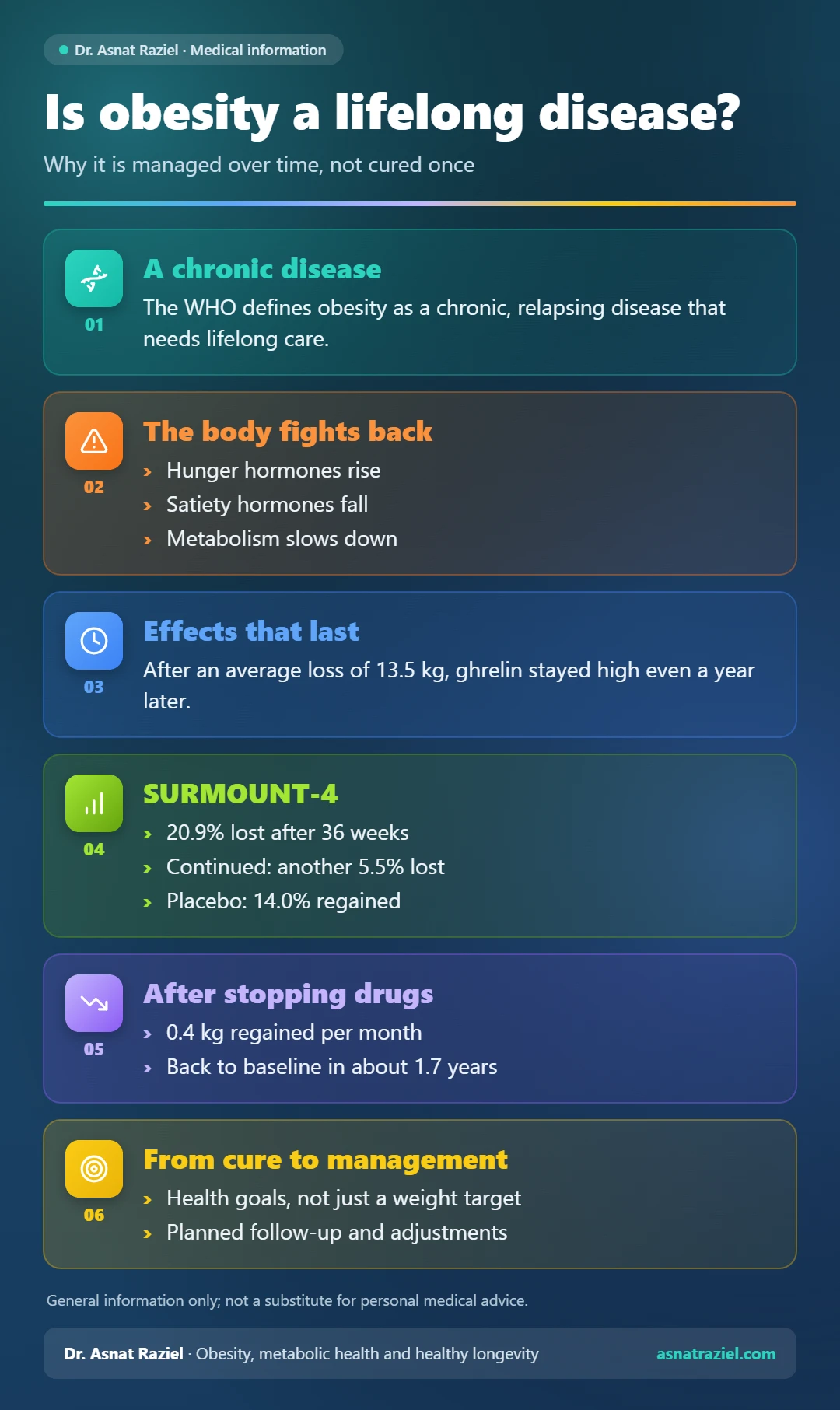
Today, medicine sees obesity as a chronic disease, much like diabetes, high blood pressure or asthma. In December 2025, the World Health Organization published its first guideline on the use of GLP-1 medicines. In it, the WHO defined obesity as a chronic, relapsing disease that needs comprehensive, lifelong care. I wrote about the guideline itself in my article on the WHO guideline.
In other words, the problem does not disappear after one “successful” treatment. Instead, it is an ongoing biological state, driven by deep mechanisms in the brain, the hormonal system and fat tissue. Losing weight, even a lot of weight, does not “cure” obesity. It improves health and reduces complications, and sometimes it even leads to a long remission. Still, the underlying mechanisms tend to stay active.
Why does the body fight weight loss?
The human body is programmed to conserve energy. So after weight loss, it switches on powerful compensation mechanisms. Hunger hormones rise, satiety hormones fall and metabolism slows down. These processes are not the patient’s failure. Rather, they are an expected physiological response.
A study published in the NEJM showed this clearly. The researchers followed 50 participants who lost an average of 13.5 kg on a low-calorie diet. Even a year later, the hunger hormone ghrelin stayed high. At the same time, leptin and satiety hormones such as PYY stayed low, and hunger remained strong. That is why many people regain weight after a diet, even when they did everything “right.” Biology does not change overnight, so it has to be managed. I explain the hunger and fullness system in my article on the physiology of satiety.
What happens when you stop medication?
Data from the new medications reinforce this picture. In the SURMOUNT-4 trial, participants lost 20.9% of their body weight after 36 weeks of tirzepatide. Then some of them stayed on the drug, while others switched to a placebo. Those who continued lost another 5.5%. By contrast, those who switched to placebo regained 14.0%.
In January 2026, the BMJ published a meta-analysis of 37 studies with 9,341 participants. After stopping weight loss medication, participants regained an average of 0.4 kg a month. According to the estimate, weight returns to its starting point within about 1.7 years. Likewise, heart and blood sugar markers return to their pre-treatment values within about 1.4 years. You can read more in my article on weight regain after stopping GLP-1 drugs.
Does obesity as a lifelong disease require constant treatment?
Not necessarily in the same way, but sometimes it does. As with other chronic diseases, obesity has periods of stability, worsening and improvement. Some patients will need long-term medication. Others, after a period of intensive treatment, will do well with follow-up, nutrition and exercise.
Dr. Idit Dotan, who heads the obesity treatment center at Beilinson Hospital in Israel, described it similarly in an interview with Ynetnews. In her words, obesity care is a lifelong process, “a marathon,” with good periods, hard periods and plateaus.
The key point is that obesity treatment is not a “short project.” Rather, it is an ongoing process that can be adjusted over the years. Stopping treatment is not a failure, as long as it is planned and supervised. I explain how to do it properly in my guide to stopping weight loss medication.
A new conversation: from cure to management
A common mistake is to look for a “complete cure.” Today, the conversation is replacing the idea of cure with the idea of management. Managing obesity well means protecting health, function and quality of life. This holds true even when the number on the scale is not “ideal” according to the charts.
In 2025, a Lancet commission proposed a new distinction. Clinical obesity is a chronic, systemic disease in which excess fat already harms how organs work. In contrast, preclinical obesity is excess fat with normal organ function but a higher risk. Therefore, the goal of treatment is to improve or put into remission the clinical signs of disease, not to reach a number on the scale.
This approach reduces guilt and frustration. In addition, it lets us see the journey as continuous and flexible, rather than a battle of success versus failure.
The role of medication and surgery
Medications and bariatric surgery are not shortcuts. They are medical tools that help rebalance biology. They open a “window of opportunity” to build habits, improve metabolic markers and lower the risk of disease.
For some patients, these tools will be needed for the long term. For others, they will serve as a temporary stage. The decision is personal. It depends on risk factors, on the response to treatment and on the patient’s preferences.
Expectations matter when you manage a lifelong disease
Unrealistic expectations are one of the main sources of frustration in obesity treatment. Once you understand that the goal is to manage the disease well, rather than “beat” it, it becomes easier to stick with it. It also becomes easier to adjust treatment and to cope with natural ups and downs in weight. I wrote about the power of persistence in my article on sticking with treatment.
Success is not measured only by the number on the scale. It is also measured by better medical markers, fewer other medications, daily function and quality of life. For practical tips on this stage, see my article on maintaining your weight after major weight loss.
What does this look like in my clinic?
In my clinic, I build a long-term plan with each patient from the very first visit. First, we set health goals together, not just a weight target. For example, better blood sugar control, lower blood pressure, an improvement in fatty liver or better sleep. Second, we decide in advance how often we will meet. Follow-up is frequent at the start of treatment and becomes less frequent later.
In addition, we plan ahead for what happens if the weight starts to come back. A small gain is no reason to despair. Instead, it is a signal to adjust the treatment. Finally, nutrition, exercise and emotional support remain a permanent part of the plan, even when the medication changes or stops.
The bottom line: a lifelong disease that can be managed well
Obesity is a chronic disease, and in that sense it is a lifelong disease. Even so, it can be managed effectively. This understanding is not pessimistic; quite the opposite. It allows personalized, guilt-free treatment that respects human biology and sets achievable goals. Ultimately, long-term treatment with professional support makes it possible to live a healthy life, even with a chronic disease.
The information in this article is general and does not replace personal medical advice.
References
WHO issues global guideline on the use of GLP-1 medicines in treating obesity
Long-term persistence of hormonal adaptations to weight loss