By Dr. Asnat Raziel, bariatric surgeon specializing in obesity treatment, metabolic health and healthy longevity; Director of the Multidisciplinary Center for Obesity Treatment, Assia Medical, Assuta Ramat HaChayal, Tel Aviv
The WHO GLP-1 guideline: why medication alone is not enough
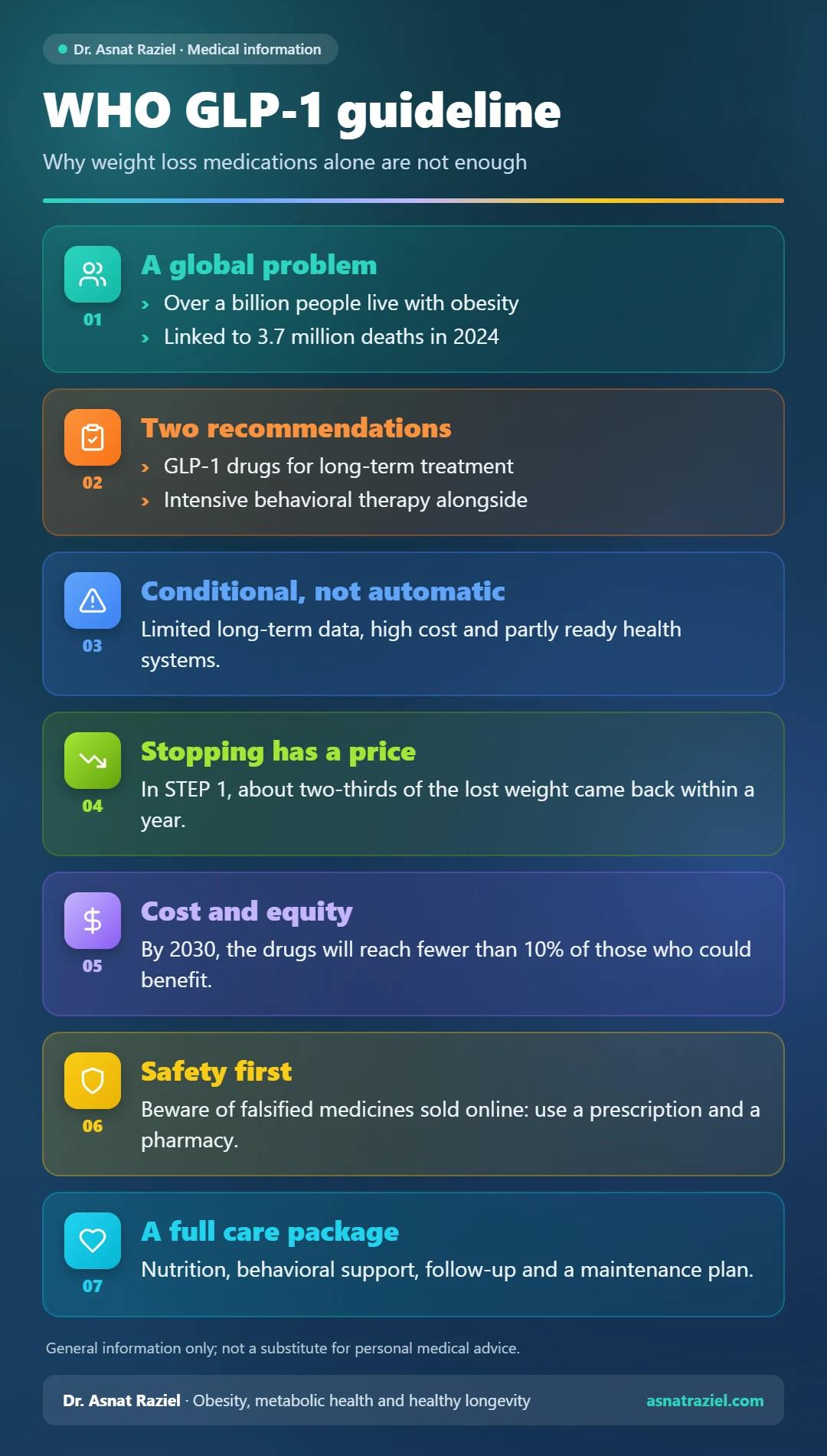
The WHO GLP-1 guideline is a milestone in obesity treatment. Over the past decade, obesity has become one of the most common and complex chronic diseases in the world. According to the World Health Organization, it affects more than a billion people. In 2024, the WHO linked it to 3.7 million deaths worldwide. At the same time, GLP-1 medications have redrawn the map of treatment options. They have sparked a wave of hope and public interest, and also controversy. Amid this debate, the WHO published a clear but cautious position: the medications are an important tool, but they are not the only answer.
What the WHO GLP-1 guideline says
On December 1, 2025, the WHO published the first global guideline on using GLP-1 medications for obesity. It covers three drugs: liraglutide, semaglutide and tirzepatide. It applies to adults with a BMI (body mass index) of 30 or higher, and it excludes pregnant women. The journal JAMA also published the guideline.
The guideline makes two main recommendations. First, doctors may use GLP-1 medications for the long-term treatment of obesity. Second, they may also offer these patients intensive behavioral therapy, including a healthy diet and structured physical activity. In other words, combining medication with ongoing support is at the heart of the guideline.
Conditional, not automatic, recommendations
The WHO defines obesity as a chronic, relapsing disease that requires lifelong care. Accordingly, both recommendations received a “conditional” rating. The reasons are clear: limited long-term data, open questions about the maintenance phase and stopping treatment, high cost and health systems that are only partly ready. It is important to understand that a conditional recommendation is not a negative one. It means the medications work, but the decision should fit the patient, their preferences and the available resources.
So the medications are not meant to work on their own. They should be part of a planned process: nutritional and behavioral counseling, emotional support, regular medical monitoring and a maintenance plan.
The data confirm the concern. In the STEP 1 extension study, patients stopped semaglutide after 68 weeks. Within a year, they had regained about two-thirds of the weight they had lost. I wrote about this in detail in my article on stopping GLP-1 drugs and weight regain.
Cost versus benefit, and the question of equity
One of the central issues in the guideline is cost. The newer weight loss medications are expensive, and researchers are still collecting long-term data. For this reason, the WHO warns against sweeping, rapid adoption without careful economic and health review. The WHO also expects the global economic cost of obesity to reach 3 trillion US dollars a year by 2030.
Beyond that, there is real concern about gaps in access. The WHO estimates that even with a rapid increase in production, by 2030 the medications will reach fewer than 10% of the people who could benefit from them. When only part of the population can afford ongoing treatment, health inequality follows. That is why the WHO proposes tools such as pooled procurement, tiered pricing and voluntary licensing. In Israel, too, the question of funding keeps coming up.
The WHO GLP-1 guideline and the path to safety
Huge demand has also created a new danger. The WHO has warned about falsified medicines for diabetes and weight loss sold online. In the new guideline, it repeats that warning. In addition, in September 2025, the organization added GLP-1 medications to its list of essential medicines, for treating type 2 diabetes in high-risk groups. The message is twofold: the medications matter, but only under medical supervision.
The care package that decides success
Alongside its caution, the WHO GLP-1 guideline offers a practical road map. It emphasizes early diagnosis and an integrated approach tailored to each person. This approach includes behavioral, drug and surgical treatment, along with treatment of related conditions. Examples include structured nutritional counseling, behavioral and psychosocial support, regular medical follow-up and measures of success that go beyond the number on the scale.
Special emphasis goes to the maintenance phase. This is the stage at which many people struggle to hold on to their gains. Investing in this phase is the key to preventing weight regain. You can read more in my article on maintaining weight after weight loss. Nutritional support during medication treatment is also an important part of the package.
What comes next after the WHO GLP-1 guideline
The guideline is not a final document. The WHO intends to update it regularly. In 2026, it is working on a transparent and fair framework for setting priorities. The goal is for treatment to reach the people with the greatest need first. Later, as access grows, eligibility can gradually be widened.
What this means for you as a patient
The WHO wrote the guideline for health systems, but its messages are relevant to every patient. Before you start a medication, it is worth asking a few simple questions:
- Have I had a full medical assessment, including tests and related conditions?
- Who will support me with nutrition, physical activity and the emotional side?
- How will we measure success, beyond the number on the scale?
- What is the plan for the maintenance phase, and what will happen if I stop the medication?
- Does the medication come from a regulated source, with a prescription and a pharmacy?
If the answers are clear, the chances of long-term success are much higher. On the other hand, medication without support is usually only a temporary fix.
Not an injection revolution, but a change in mindset
The WHO’s deeper message is not about technology but about how we think. Obesity is not a problem of personal discipline, and the medications are not a shortcut. It is a complex disease that requires multidisciplinary care that is continuous and respectful. As the WHO Director-General, Dr. Tedros Adhanom Ghebreyesus, put it, medication alone will not solve the global crisis.
The bottom line
The WHO GLP-1 guideline confirms what we see in the clinic every day. GLP-1 medications are a major breakthrough. However, only when they are rooted in a complete system of care can they fulfill their potential and change lives. In the end, the medication is part of the story, not the whole story.
The information in this article is general and does not replace personal medical advice.
References
WHO issues global guideline on the use of GLP-1 medicines in treating obesity
WHO issues warning on falsified medicines used for diabetes treatment and weight loss
WHO updates list of essential medicines to include key cancer, diabetes treatments




