By Dr. Asnat Raziel, bariatric surgeon specializing in obesity treatment, metabolic health and healthy longevity; Director of the Multidisciplinary Center for Obesity Treatment, Assia Medical, Assuta Ramat HaChayal, Tel Aviv
Attitudes toward weight-loss injections: what do health professionals think?
Attitudes toward weight-loss injections affect not only patients but also the people who prescribe and recommend them. Mounjaro (tirzepatide) and Ozempic (semaglutide) have become a global phenomenon. They are changing obesity medicine and the way the public sees it. But what do doctors, pharmacists and students actually think about them?
A study published in May 2025 explored this question in four Arab countries. The researchers looked at beliefs, concerns and bias toward obesity. The picture that emerged is complex. On the one hand, awareness was high. On the other hand, attitudes were cautious and even slightly negative.
Who took part in the study?
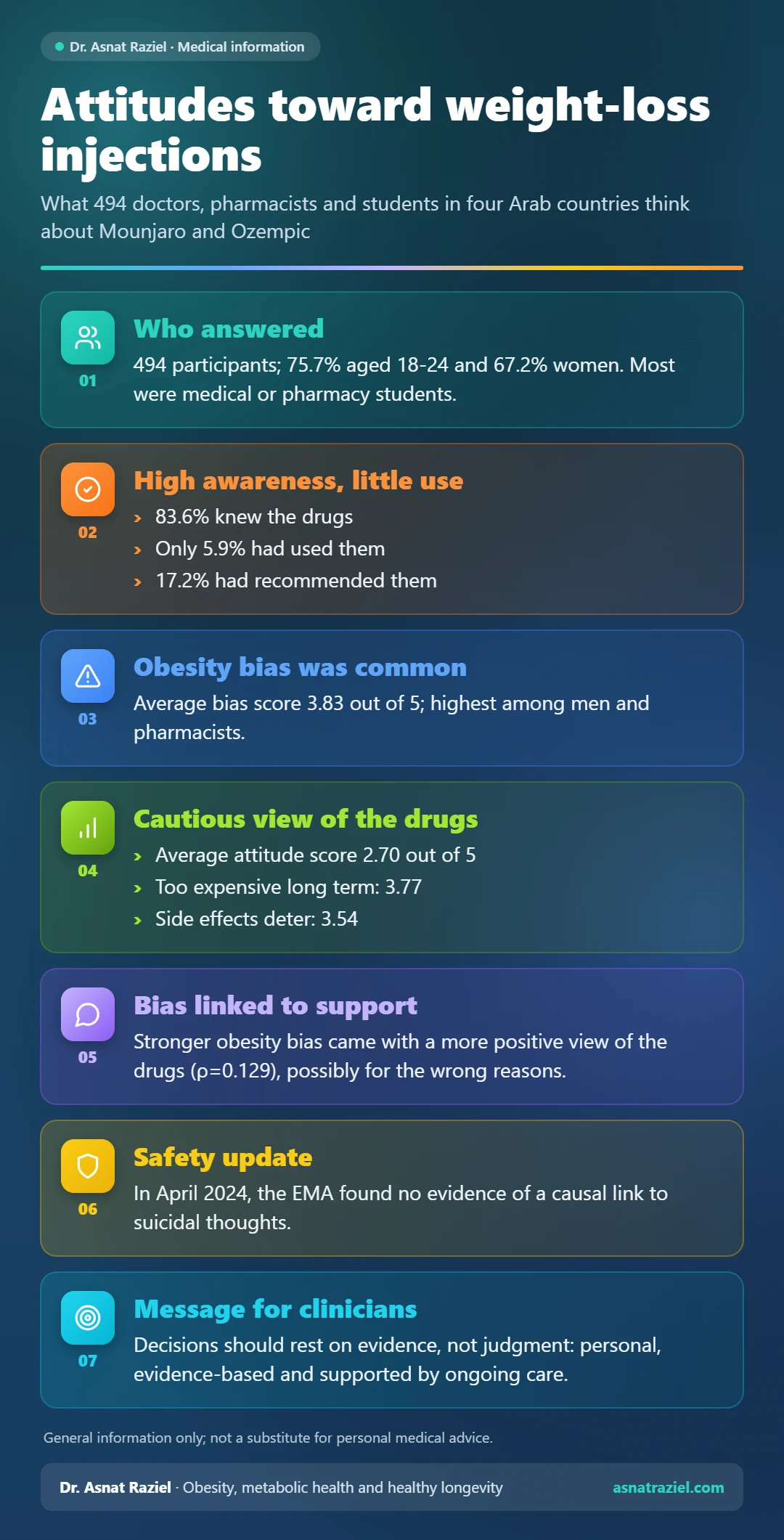
The researchers ran an online survey in November and December 2024. After careful screening for rushed or contradictory answers, 494 participants remained. Most were young: 75.7% were 18 to 24 years old. In addition, 67.2% were women, and most were medical or pharmacy students. Physicians made up 11.1% of the sample, and pharmacists 15.4%.
Participants came from four main countries:
- Kuwait – 32.8%
- Egypt – 20.9%
- Saudi Arabia – 18.8%
- Jordan – 15.4%
About 83.6% were at least somewhat familiar with Mounjaro and Ozempic. However, only 5.9% had used them themselves, and 17.2% had recommended them for weight loss.
How obesity stigma shapes attitudes toward weight-loss injections
One of the study’s key contributions is two new scales. The first measures bias toward obesity and overweight, called OOB for short. It included statements such as “being overweight is a sign of a lack of self-control” and “people with obesity are less productive.” At the same time, it also included statements about genuine health risks.
The average score on this scale was 3.83 out of 5. In other words, participants tended to agree with the statements. Men scored higher than women. Among the professional roles, pharmacists scored highest. Across countries, participants from Egypt scored highest and those from Saudi Arabia lowest. That kind of bias causes real harm, and words matter too, which is why I have written about respectful language around obesity.
The second scale: attitudes toward the drugs
The second scale, Mini-HBAGS, measured perceptions of effectiveness, risks, cost, social norms and willingness to recommend the drugs. The average score was 2.70 out of 5, which reflects a slightly negative attitude. The statements with the strongest agreement were that the drugs are too expensive for long-term use (3.77) and that side effects make them less attractive (3.54).
And here comes the interesting finding. The stronger the bias toward obesity, the more positive the attitude toward the drugs. The correlation was weak (ρ=0.129), but statistically significant. In other words, people who see obesity as a personal failure or a danger tend to support drug treatment. Still, the researchers warn that this may be support for the wrong reasons.
Attitudes toward weight-loss injections by role and experience
Physicians and pharmacists had the most positive attitude, with a score of 2.98. The researchers attribute this to broader clinical exposure. Medical students, by contrast, were the most cautious, with a score of 2.56. In addition, people who had previously used any weight-loss medication had a positive attitude.
The surprising finding concerns people who had already used Mounjaro or Ozempic, or had recommended them. In the simple analysis, they were the most positive group. However, the multivariable analysis took all the factors into account together, and there the picture flipped. Their link to a positive attitude turned negative. The researchers suggest several reasons: side effects, disappointment with results, and exposure to patients’ struggles with cost and availability.
The concerns: safety, mental health, cost and counterfeits
In their discussion, the researchers reviewed concerns raised in the literature. First, there were reports of psychiatric side effects such as anxiety, depression and suicidal thoughts. That said, an update is important here. In April 2024, the safety committee of the European Medicines Agency concluded that the evidence does not support a causal link between these drugs and suicidal thoughts. I have covered the US side of this story in my article on the FDA and the GLP-1 suicide warning.
Second, the researchers note a rise in unsupervised use of these drugs in the Gulf states. Third, the World Health Organization warned in June 2024 about falsified semaglutide. Finally, there is the ongoing concern about long-term cost.
What has changed since the study?
In December 2025, the WHO published its first global guideline on the use of GLP-1 medicines for obesity. The guideline defines obesity as a chronic, relapsing disease. It makes a conditional recommendation for long-term treatment in adults, alongside nutrition and physical activity programs. In addition, the WHO estimates that by 2030 these drugs will reach fewer than 10% of the people who could benefit from them. So the concerns about access and cost raised in the study are still very much valid. I discuss what the guideline means in practice in my article on the WHO GLP-1 guideline.
What can we learn from this?
The study raises broad questions about how stigma, culture, fear, cost and misinformation influence medical decisions. According to the researchers, it makes four notable contributions:
- A new tool for measuring attitudes toward GLP-1 drugs.
- Data on gaps in knowledge and attitudes between different health professionals.
- Insight into the role of social norms and the media in shaping medical attitudes.
- Evidence of the link between stigma and unbalanced treatment decisions.
There are also important limitations. This is a cross-sectional survey, so it cannot show cause and effect. The researchers recruited the sample through social media, and most participants were young students. In addition, the study did not include dietitians, who play a central role in obesity care.
Attitudes toward weight-loss injections: the message for clinicians
These drugs are a revolution, but they are not a magic bullet. High cost, limited availability and side effects need to be weighed alongside their impressive effectiveness. That is why the researchers call for investment in up-to-date medical education about benefits and risks. They also call for reducing obesity stigma, for example by using respectful language. Likewise, the joint international consensus statement for ending the stigma of obesity stresses that bias harms the quality of care.
Ultimately, attitudes toward weight-loss injections should rest on evidence, not on judgment. Obesity is a chronic disease that calls for modern treatment. A decision about drug treatment is right when it is personal, evidence-based and supported by ongoing care. It is not right when it comes from shame or social pressure.
The information in this article is general and does not replace personal medical advice.
References
Meeting highlights from the Pharmacovigilance Risk Assessment Committee (PRAC) 8-11 April 2024
WHO issues warning on falsified medicines used for diabetes treatment and weight loss
WHO issues global guideline on the use of GLP-1 medicines in treating obesity
Joint international consensus statement for ending stigma of obesity




