By Dr. Asnat Raziel, bariatric surgeon specializing in obesity treatment, metabolic health and healthy longevity; Director of the Multidisciplinary Center for Obesity Treatment, Assia Medical, Assuta Ramat HaChayal, Tel Aviv
GLP-1 suicide warning removed: what did the FDA decide?
Removing the GLP-1 suicide warning from obesity medications is one of the most important regulatory decisions of 2026. On January 13, 2026, the FDA, the U.S. Food and Drug Administration, asked for the warning about suicidal thoughts and behavior to be removed. The request applied to three drugs: Saxenda, Wegovy and Zepbound, the U.S. brand name of Mounjaro for obesity. The decision rests on a broad body of data that consistently points to no increased risk.
In this article, I will explain where the concern came from, what the FDA examined and what it means for patients.
Appetite-hormone drugs in brief
In recent years, drugs in the GLP-1 family have become a cornerstone of treatment for type 2 diabetes and obesity. They mimic natural satiety hormones that the gut releases after a meal. In addition, they slow stomach emptying, reduce appetite and improve metabolic balance. Besides Saxenda and Wegovy, the family also includes Ozempic and Mounjaro.
Alongside their impressive benefits, safety concerns also came up. One of them was a possible effect on mood, up to and including suicidal thoughts. You can read about the broader question in my article on whether Ozempic and Wegovy harm mental health.
Where did the concern come from?
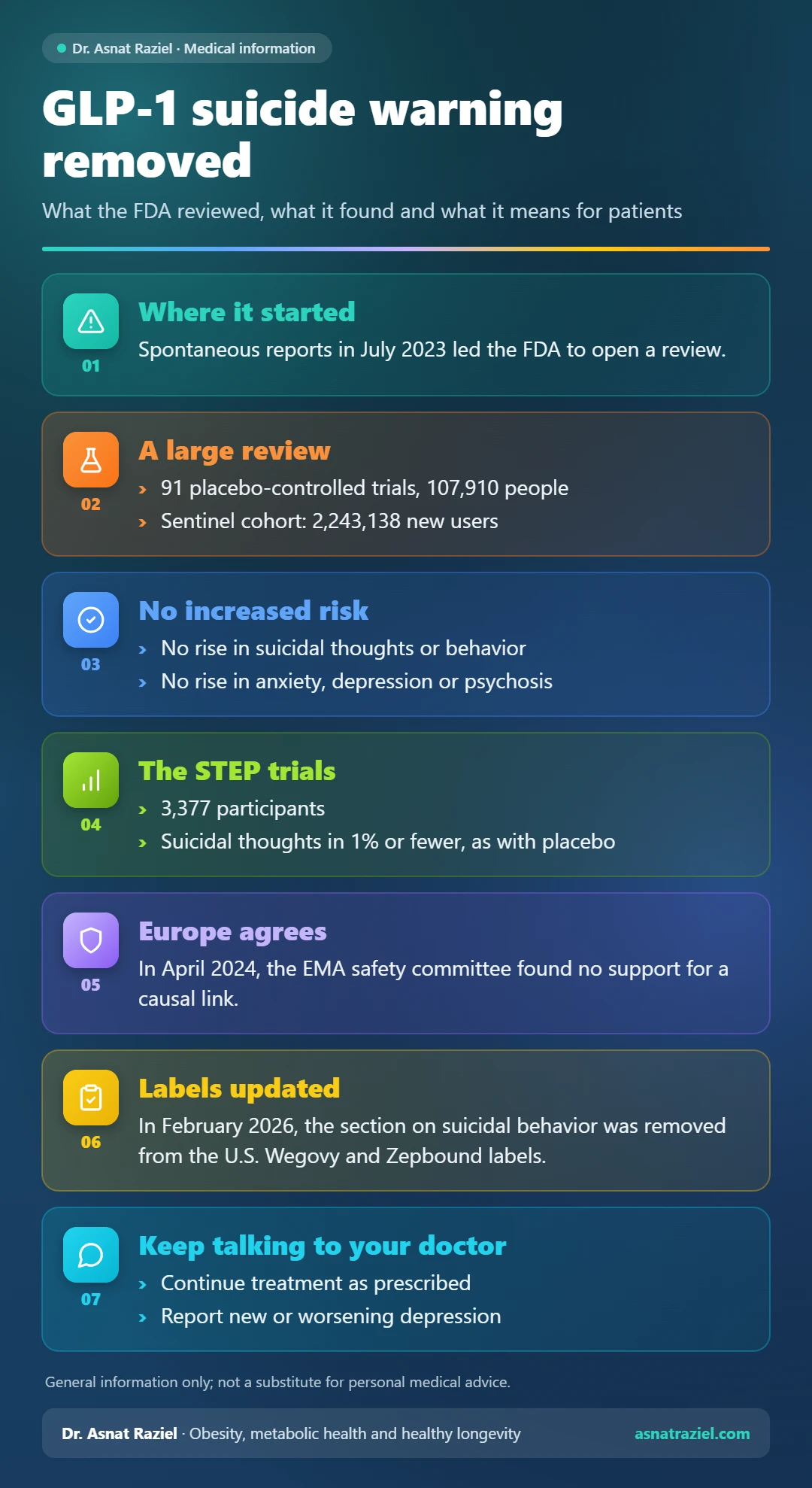
The discussion began in July 2023, after spontaneous reports from patients and doctors. As a result, the FDA opened a review. In an update from January 2024, it reported that it had found no evidence of a link. However, the number of events was small, so some uncertainty remained. The warning, which appeared on the labels of the weight loss drugs, stayed in place.
At the same time, Europe also looked into the issue. In April 2024, the safety committee of the European Medicines Agency concluded that the evidence does not support a causal link. In other words, the two major regulators reached the same conclusion independently.
Why spontaneous reports are not enough
A spontaneous report is a notice from a patient or doctor about an event that happened during treatment. Such reports are very important for detecting problems early. Even so, they do not prove that the drug caused the event. They have no comparison group, and they are influenced by media headlines. Moreover, people with obesity have a high rate of depression to begin with. For this reason, only controlled trials and large studies with a comparison group can answer the question.
What the review behind removing the GLP-1 suicide warning included
The FDA carried out a multistage analysis, one of the largest ever done in this field. According to the official safety communication, the review had three parts:
- A meta-analysis of 91 placebo-controlled trials with 107,910 participants.
- A cohort study in Sentinel, the FDA’s monitoring system, with 2,243,138 new users.
- A review of observational and pooled studies published in the literature.
The cohort study compared GLP-1 users with users of SGLT2 inhibitors, a different family of diabetes drugs. The comparison looked at intentional self-harm.
The bottom line: no increased risk
The results were consistent and clear. The meta-analysis showed no increase in suicidal thoughts or behavior. It also showed no increase in anxiety, depression, irritability or psychosis. Furthermore, the Sentinel study found no increase in self-harm, even among patients with both diabetes and obesity. Therefore, the FDA concluded that the overall evidence does not support a causal link.
Other studies support this conclusion. A pooled analysis of the STEP trials included 3,377 participants. Researchers recorded suicidal thoughts in 1% or fewer of them, with no difference between Wegovy and placebo. What’s more, researchers measured a small decrease in depressive symptoms in the Wegovy group. Likewise, a large cohort study found a lower risk of suicidal thoughts with semaglutide compared with other weight loss drugs.
What we still don’t know
The evidence also has limits. The STEP trials, for example, did not include people with known serious mental illness. As a result, there is less information about patients with severe depression, bipolar disorder or a past suicide attempt. For them, follow-up should be especially close, in coordination with their mental health provider.
GLP-1 suicide warning on the labels: what has already changed
The decision has already been put into practice. In February 2026, the U.S. labels for Wegovy and Zepbound were updated, and the section on suicidal behavior was removed. This brought them in line with the GLP-1 drugs for diabetes, which never carried such a warning.
To be precise, this is a decision by the U.S. regulator. Labels in other countries, including Israel, are updated through a separate process. Nevertheless, the scientific conclusion is the same in the United States and in Europe.
What it means for doctors and patients
First, the decision reduces unnecessary fear. In the past, that fear deterred patients from effective treatment. Second, it strengthens the safety profile of these drugs. However, it does not release us from follow-up. Obesity itself is linked to depression and anxiety, so monitoring mood remains part of any chronic treatment.
The FDA recommends that patients continue treatment as prescribed. At the same time, it is important to tell your doctor about new or worsening depression, suicidal thoughts or any unusual change in behavior. A doctor who identifies this kind of distress should refer the patient to a mental health professional. You will find more on the emotional aspects in my article on the injection, the pill and the mind.
This also has practical significance. In my clinic, I have met patients who stopped successful treatment just because of a frightening headline. Stopping like this usually leads to the return of appetite and weight. You can read about this in my article on weight regain after stopping the drug. Therefore, any decision to stop treatment should be made only after talking with your treating doctor.
Summary: what removing the GLP-1 suicide warning teaches us
The accumulated data are clear: appetite-hormone drugs do not raise the risk of suicide. Removing the GLP-1 suicide warning reflects up-to-date, responsible science. It also strengthens the place of these drugs as an effective and safe treatment for obesity and diabetes. Still, good medicine stays attentive. It keeps monitoring, asking questions and tailoring treatment to each patient. A broader review of the safety of obesity treatment and of GLP-1 drugs and mental health will help complete the picture.
The information in this article is general and does not replace personal medical advice. If you are in distress in Israel, you can call ERAN, the national emotional first aid hotline, at 1201, at any hour.
References
Meeting highlights from the Pharmacovigilance Risk Assessment Committee (PRAC) 8-11 April 2024
Association of semaglutide with risk of suicidal ideation in a real-world cohort




