By Dr. Asnat Raziel, bariatric surgeon specializing in obesity treatment, metabolic health and healthy longevity; Director of the Multidisciplinary Center for Obesity Treatment, Assia Medical, Assuta Ramat HaChayal, Tel Aviv
Ozempic and depression risk: where did the worry come from?
Does Ozempic raise the risk of depression? It is a question many of my patients type into a search bar. The semaglutide-based drugs, Ozempic and Wegovy, are at the center of a revolution in obesity treatment. Alongside their success in weight loss, an important question has come up: do they harm mental health? A large analysis of the STEP trials gives a clear and reassuring answer.
The worry began with real-world reports that surfaced after the drugs reached the market. As a result, drug regulators in the United States and Europe kept a close eye on their psychiatric safety. Now, after several years of follow-up, the picture is much clearer. This article focuses on the controlled trials themselves: what they measured, what they found and who the findings apply to.
Why the controlled trial data matter most
Most of the early concern came from scattered reports, not from careful comparisons. A randomized, placebo-controlled trial works differently. Participants are assigned to the drug or to a placebo by chance, and both groups are assessed with the same tools at the same time points. Therefore, any difference in mood between the groups can be traced to the drug itself, not to weight loss, dieting or chance. In the STEP trials, depression was not just recorded when someone happened to report it. Instead, it was measured on purpose with validated questionnaires, for 68 to 104 weeks. That is why I consider this analysis the most solid answer we have to the question.
What the STEP analysis of semaglutide and mental health examined
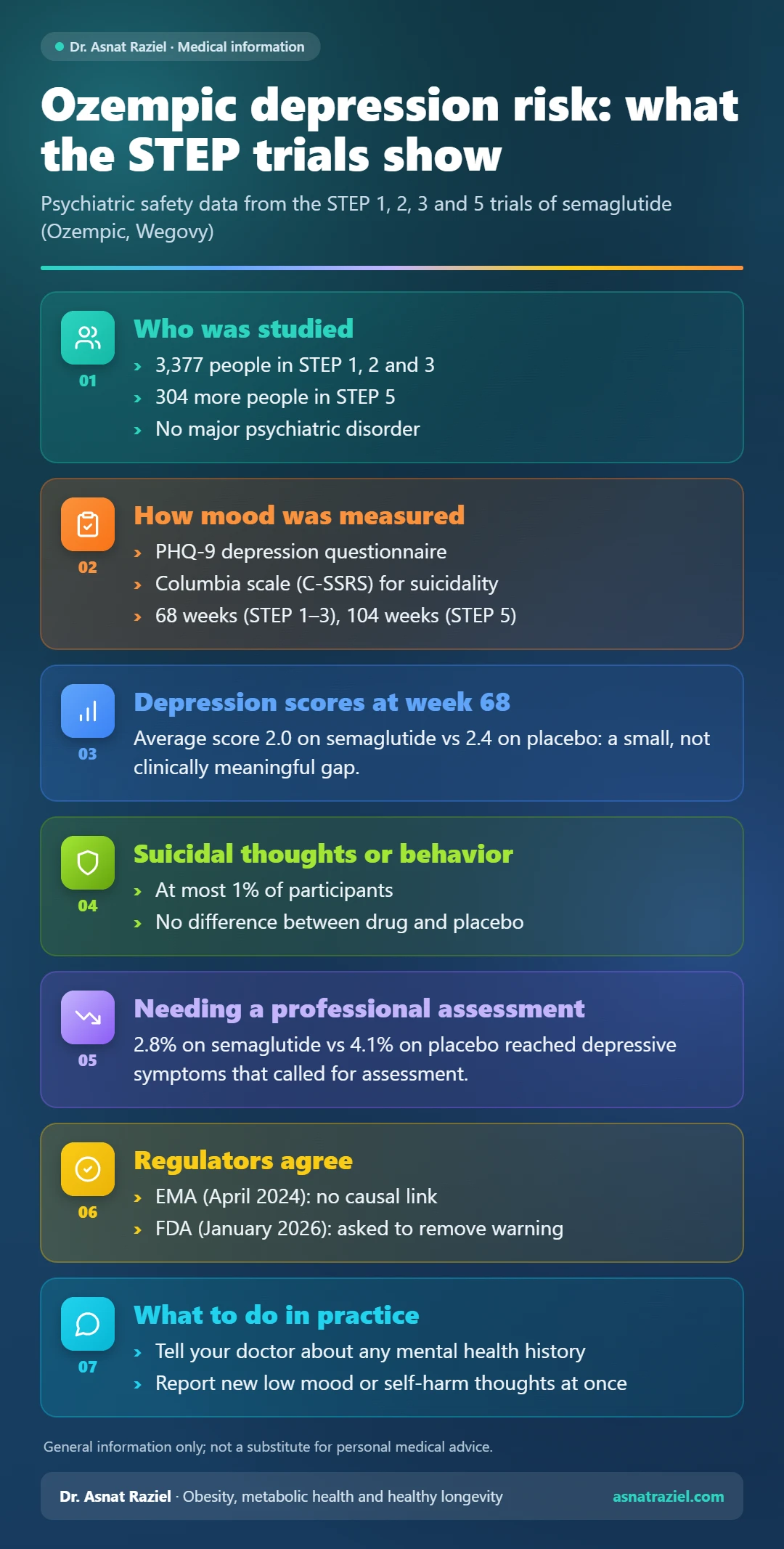
The study was published in JAMA Internal Medicine. The researchers pooled data from 3,377 participants in the STEP 1, 2 and 3 trials, plus 304 participants from STEP 5. These are the trials that led to the approval of Wegovy at a dose of 2.4 mg for treating obesity.
The goal was to see whether semaglutide raises the risk of depression, suicidal thoughts or suicidal behavior. The researchers measured depressive symptoms with the PHQ-9, a widely used depression questionnaire. In addition, they used the Columbia scale (C-SSRS), a structured tool for assessing suicidal thoughts and behavior. STEP 1–3 lasted 68 weeks, and STEP 5 lasted 104 weeks.
The results: Ozempic did not raise the risk of depression
The findings are unambiguous. In participants without a significant mental health disorder, semaglutide did not raise the risk of depression or suicidal thoughts compared with placebo. What’s more, at week 68 the average depression score was 2.0 in the drug group, compared with 2.4 in the placebo group.
The chance of moving up to a more severe category on the questionnaire was also 37% lower with semaglutide. However, the researchers stress that the difference is small and not clinically meaningful. In other words, the drug does not harm mood, but it is not a treatment for depression either.
Ozempic and depression risk by the numbers
When you look at the data more closely, the picture becomes sharper:
- At most 1% of participants reported suicidal thoughts or behavior during treatment, with no difference between the drug and placebo.
- According to a report on the study, 2.8% of patients on semaglutide reached depressive symptoms that called for a professional assessment, compared with 4.1% on placebo.
- Psychiatric side effects occurred at similar rates in both groups.
In other words, not only was there no increase in risk. On some measures, there was even a slight trend in the opposite direction.
How regulators read the same evidence
These data also match the conclusions of the regulators. In April 2024, the safety committee of the European Medicines Agency (EMA) concluded that the evidence does not support a causal link between GLP-1 drugs and suicidal thoughts. Consequently, it did not change the drugs’ package leaflets.
In January 2026, the US Food and Drug Administration (FDA) went a step further. It asked to remove the suicidality warning from the labels of Wegovy, Saxenda and Zepbound. The decision was based on an analysis of 91 trials with 107,910 participants. It also relied on insurance data covering 2,243,138 new users of GLP-1 drugs and of other types of diabetes drugs. The analysis found no increase in the risk of suicidal thoughts, nor of anxiety, depression, irritability or psychosis. Furthermore, GLP-1 users did not harm themselves at a higher rate than users of the other diabetes drugs. I explain that decision in detail in my article on the FDA’s removal of the suicidality warning.
Obesity, depression and the reverse link
It is important to understand that obesity itself is linked to higher rates of depression, anxiety and poor self-image. For this reason, effective weight-loss treatment may actually improve mental well-being in some patients. A large Swedish study from 2026 even found an association between semaglutide and less worsening of depression and anxiety. I cover that study, which looks at possible mental health benefits rather than safety, in my separate article on whether GLP-1 drugs can also help mental health.
Who these trial results apply to, and who they don’t
Here is a key point: the trial included people without a significant psychiatric disorder. People with major depression, schizophrenia or a history of suicide attempts did not take part.
So patients with a complex mental health history need a personalized approach and close follow-up. Sometimes it is wise to involve a mental health professional as well. The researchers themselves recommend monitoring the mental health of every patient with obesity.
Semaglutide: far more than weight loss
Beyond its safety, semaglutide is highly effective for weight loss. In the STEP 1 trial, participants lost an average of 14.9% of their body weight within 68 weeks, compared with 2.4% on placebo. In addition, many of their metabolic markers improved.
It is no surprise, then, that about 5 million Americans received a prescription for semaglutide in 2023. Almost four in ten of them took it for weight management. At the same time, the drug does have side effects, mainly in the digestive system. You will find a full review in my article on Wegovy side effects.
What this means for you in practice
The data are reassuring, but they do not remove the need to pay attention. So before starting semaglutide, tell your doctor about any mental health history, even if it is old. It is also important to mention any psychiatric medications you take (my article on psychiatric medications and weight gain explains why they matter in obesity care). That way, your doctor can build a monitoring plan that fits you.
During treatment, watch for a few signs:
- Persistent sadness or loss of interest in things you used to enjoy.
- New sleep problems or extreme fatigue.
- Irritability, anxiety or a sense of emptiness that is new to you.
- Thoughts of self-harm.
Keep in mind that rapid weight loss, changes in eating habits and digestive side effects can also affect your mood. On the other hand, many people find that treatment actually improves how they feel overall and boosts their self-confidence. The key is not to cope alone: an open conversation with your care team is part of the treatment itself.
The bottom line on Ozempic and depression risk
Whether Ozempic raises the risk of depression is a question that weighs on many patients. The trial data give an evidence-based answer: in people without a significant mental health disorder, semaglutide does not raise the risk of depression or suicidal thoughts. The FDA and the EMA reached a similar conclusion.
Still, as with any treatment, it is important to tailor it to the individual and to keep an eye on mood. If new depression, suicidal thoughts or a sharp change in mood appears, contact your doctor right away. In Israel, ERAN, the national emotional first-aid hotline, is available 24 hours a day at 1201; elsewhere, call your local crisis line or emergency number. Ultimately, this is a meaningful, effective and safe treatment tool when it is used correctly and under medical supervision.
The information in this article is general and does not replace personal medical advice.
References
Semaglutide does not increase risk of depression or suicidal thoughts
Meeting highlights from the Pharmacovigilance Risk Assessment Committee (PRAC) 8-11 April 2024
Once-Weekly Semaglutide in Adults with Overweight or Obesity
The STEP trials were funded by Novo Nordisk, the manufacturer of the drug.




