By Dr. Asnat Raziel, bariatric surgeon specializing in obesity treatment, metabolic health and healthy longevity; Director of the Multidisciplinary Center for Obesity Treatment, Assia Medical, Assuta Ramat HaChayal, Tel Aviv
Tapering weight loss drugs: why the weight comes back
Tapering weight loss drugs is a question that comes up at almost every clinic visit. Most patients want to know what will happen the day after. The honest answer is that for many people, the weight comes back. This is not a malfunction or a weakness. Rather, it is an expected biological response.
The body “remembers” the higher weight it used to carry. When you stop a drug that regulates hunger and fullness, it switches its survival mechanisms back on. Hunger grows stronger, metabolism slows down and the drive to eat intensifies. This response is especially pronounced when stopping is abrupt.
What is actually happening? After weight loss, levels of leptin, a hormone that tells the brain how much fat is stored, go down. At the same time, ghrelin, the hunger hormone, goes up. The drugs dampen these signals as long as you take them. Once the drugs are gone, the signals return at full strength. So the patient has not “failed.” Instead, they are meeting their own biology again.
What the large 2026 review found
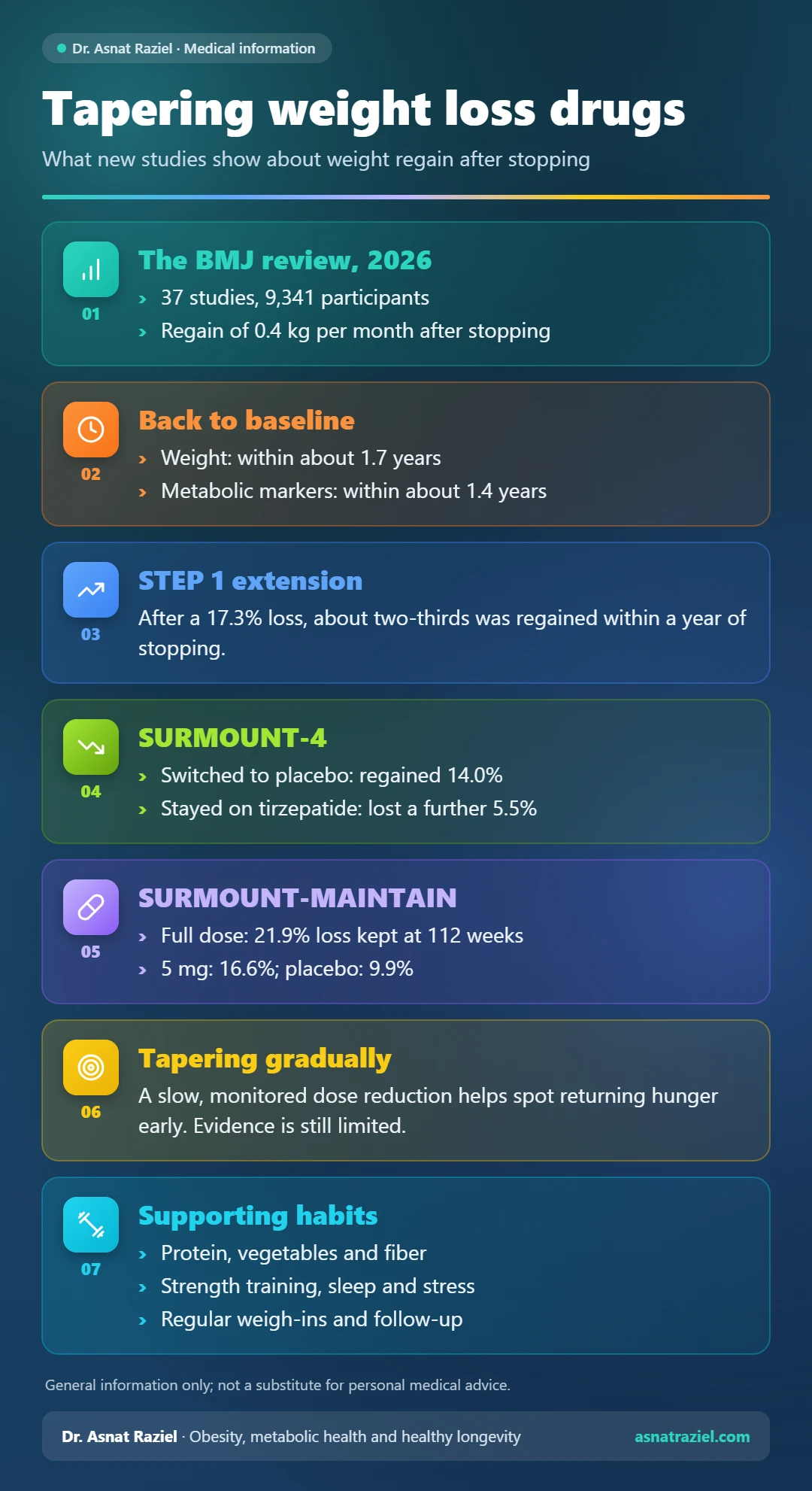
In January 2026, researchers from the University of Oxford published a systematic review and meta-analysis in The BMJ. The review included 37 studies and 9,341 participants. Drug treatment lasted 39 weeks on average. After stopping, participants regained an average of 0.4 kg per month.
According to the researchers’ model, weight is expected to return to its starting point within about 1.7 years. The metabolic markers that had improved, such as blood sugar, blood pressure and blood lipids, are also expected to return to baseline within about 1.4 years. Moreover, after drugs, regain was 0.3 kg per month faster than after diet and exercise programs. This difference did not depend on the size of the initial weight loss. According to a BMJ Group press release, that is almost four times as fast.
This finding is not surprising, but it forces us to say out loud what we already knew quietly. Obesity is a chronic disease. When you stop treating a chronic disease, the symptoms come back. That is true for high blood pressure, for diabetes and for obesity as well.
What happened in trials where the drug was stopped
The review’s findings match earlier studies. In the STEP 1 trial extension, participants stopped semaglutide after 68 weeks. By then, they had lost an average of 17.3% of their body weight. One year after stopping, they had regained about two-thirds of the weight they lost.
A similar picture emerged with tirzepatide, the active ingredient in Mounjaro. In the SURMOUNT-4 trial, participants lost 20.9% in the first 36 weeks. After that, those switched to placebo regained 14.0% over 52 weeks. By contrast, those who stayed on the drug lost a further 5.5%.
Oprah Winfrey has talked about it too
Oprah Winfrey shared publicly that she stopped the medication in early 2024. She said she kept eating well and exercising, yet still gained weight. Today she describes the treatment as something she will need for life. Her story has contributed to an honest, clear-eyed public conversation. It also highlights an important medical truth: obesity is not a matter of willpower.
Tapering weight loss drugs or a maintenance dose?
We should not see drug treatment as a “passing phase” or a short project. It is part of a long-term medical process. That said, not every patient needs to stay on the full dose forever. This is where the question of a lower maintenance dose comes in.
The SURMOUNT-MAINTAIN trial, published in The Lancet in May 2026, enrolled 441 adults. All of them first received tirzepatide at the maximum dose for 60 weeks. The researchers then divided them into three groups for another 52 weeks: continuing the full dose, stepping down to 5 mg, or switching to placebo.
At 112 weeks, the group that stayed on the full dose had kept off 21.9% of their starting weight. In the 5 mg group, the loss stood at 16.6%, and in the placebo group at only 9.9%. In other words, a lower dose did not preserve everything, but it protected much of the gain. The researchers note that the response varies from person to person. The trial was funded by Lilly, the drug’s manufacturer.
What we know about tapering weight loss drugs
When a patient decides to stop, my recommendation at the clinic is to do it gradually. This means a slow, monitored reduction in dose, while paying attention to hunger and fullness signals. That way, you can spot returning hunger early and respond in time.
To be honest, the evidence on tapering weight loss drugs is still limited. At the 2024 European Congress on Obesity, researchers presented data from Denmark on patients who gradually reduced their semaglutide dose. Some reported a stable weight six months after stopping. However, only a small number of them had follow-up data, and there was no control group. So these data are encouraging, not proof. A randomized trial is now testing this question directly, as I describe in my article on the REST trial of tapering semaglutide.
How to plan the day after
There is no one-size-fits-all decision, and it must be tailored to each person. Some will need continuous treatment at the full dose. Others will be able to move to a lower dose. And some will taper gradually until they stop, while strengthening a supportive lifestyle.
- Precise nutrition: enough protein, vegetables and fiber. I have a detailed guide to nutrition after stopping GLP-1 drugs.
- Physical activity: especially strength training, to preserve muscle mass.
- Managing hunger: recognizing returning hunger early, with practical tools for coping with appetite after stopping GLP-1.
- Sleep and stress management: two factors that directly affect appetite.
- Regular follow-up: weigh-ins and health markers, so you can resume treatment early if needed.
What this means at the first clinic visit
At the clinic, this means changing the conversation right from the start. I do not promise a temporary fix. Instead, I plan a path together with the patient. When patients understand from the outset that the goal is managing a disease, it builds a foundation of trust and cooperation. In addition, there is less disappointment if treatment needs to continue later on. You can find more about the practical steps in my guide to what happens when you stop weight loss medication.
The bottom line on tapering weight loss drugs
The new findings do not weaken the case for these drugs. On the contrary, they strengthen it. They remind us that the real power lies in the combination: medication, lifestyle, professional support and a deep understanding of body and mind. Tapering weight loss drugs, a maintenance dose or continuing full treatment are three legitimate paths. You and your doctor make the choice together. This is what modern obesity medicine looks like: not magic, but a process.
This article is general information and is not a substitute for personal medical advice.
References
Stopping weight loss drugs linked to weight regain and reversal of heart health markers
The STEP 1 and SURMOUNT trials were funded by the drug manufacturers (Novo Nordisk and Lilly).