By Dr. Asnat Raziel, bariatric surgeon specializing in obesity treatment, metabolic health and healthy longevity; Director of the Multidisciplinary Center for Obesity Treatment, Assia Medical, Assuta Ramat HaChayal, Tel Aviv
Body composition on weight loss drugs: what actually goes down
Body composition on weight loss drugs is one of the questions I hear most in my clinic. “I’m losing weight, but am I losing muscle?” The short answer: most of the weight lost is fat. However, part of it also comes from fat-free mass. It is important to understand what that means, and what it does not mean.
Two terms worth knowing
- FM (fat mass): all the fat in the body.
- FFM (fat-free mass): everything that is not fat. That means muscle, but also water, bone and internal organs.
A DXA scan usually measures both, separating fat, lean tissue and bone.
Body composition on weight loss drugs: the numbers
Here is the share of each component out of the total weight lost, according to DXA studies:
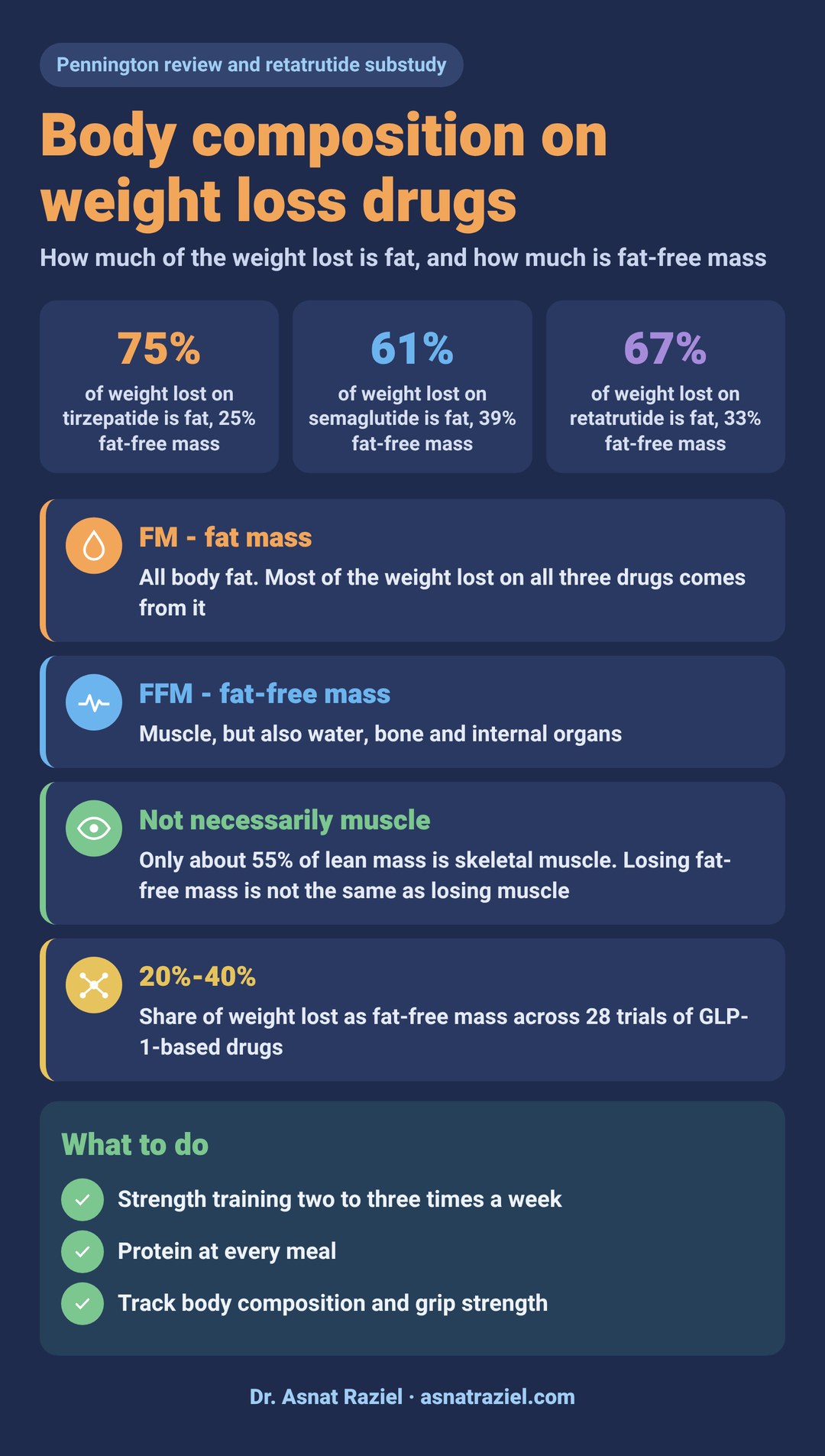
- Tirzepatide (Mounjaro): about 75% of the weight lost is fat mass, and about 25% fat-free mass.
- Semaglutide (Wegovy): about 61% of the weight lost is fat mass, and about 39% fat-free mass.
- Retatrutide, an investigational drug: about 67% of the weight lost is fat mass, and about 33% fat-free mass.
The tirzepatide and semaglutide data were compiled in a review by researchers at Pennington Biomedical, led by Dr. Robert Dubin and published in Diabetes, Obesity and Metabolism. The researchers examined 28 clinical trials. With GLP-1-based drugs, the share of weight lost as fat-free mass ranged from 20% to 40%. The retatrutide data come from a substudy of a phase 2 trial in people with type 2 diabetes. According to the researchers, the ratio of lean mass to weight lost was similar to other obesity treatments.
The key message: most of the loss is fat
With all three drugs, most of the weight lost comes from fat. That is the good news. On the other hand, part of the loss is fat-free mass, so it should not be ignored.
For comparison, the review notes that with diets, usually less than 25% of the weight lost is fat-free mass. With larger weight loss, such as after bariatric surgery, this share grows too. In other words, the more weight you lose, the more lean tissue the body also loses.
Fat-free mass is not only muscle
This is the most important point, and it is often missed. Losing fat-free mass does not necessarily mean losing muscle. According to the review, only about 55% of lean mass is skeletal muscle. The rest is water, organs and other tissue.
For example, when weight goes down, the liver also shrinks and fluid volume changes. In Israel’s POWER trial, which I took part in, we saw a 21% drop in liver volume after bariatric surgery. That counts as fat-free mass, but it is not muscle.
So a DXA scan is only an indirect measure. The researchers themselves note that it does not measure skeletal muscle directly, and that MRI and functional testing are needed to see the full picture.
Body composition on weight loss drugs: what to do
The goal is to lose fat and keep muscle. A few simple steps help:
- Strength training: at least two to three times a week. It is the most important tool for keeping muscle.
- Protein at every meal: when appetite drops, it is easy to eat too little protein. Start each meal with a protein source.
- Daily movement: walking and aerobic activity support the heart, bones and metabolism.
- Track body composition: not just weight. Periodic testing helps spot muscle loss early.
- Functional measures: grip strength and rising from a chair tell us a lot about muscle, even without a device.
Read more about the microbiome after bariatric surgery and about GLP-1 nutritional deficiencies.
The bottom line
When you look at body composition on weight loss drugs of the GLP-1 type, they mainly remove fat, which is what we want. Still, a quarter to a third of the loss is fat-free mass, and only part of it is muscle. So drug treatment should go hand in hand with strength training, protein and monitoring. That is how you keep a healthy body composition, not just a lower number on the scale.
This article is general information and does not replace personal medical advice.
References
Glucagon-like peptide-1 receptor agonist-based agents and weight loss composition: Filling the gaps