By Dr. Asnat Raziel, bariatric surgeon specializing in obesity treatment, metabolic health and healthy longevity; Director of the Multidisciplinary Center for Obesity Treatment, Assia Medical, Assuta Ramat HaChayal, Tel Aviv
Menopause and metabolism: what the new studies show
Menopause and metabolism is a topic almost every woman over 45 thinks about. Many women feel that their body has “switched off” and that the scale keeps creeping up for no reason. However, a new study presented at ObesityWeek paints a different picture. Metabolic rate stays almost the same as before. What changes is what happens to extra calories.
A session on women’s health, hormones and response to weight-loss treatments featured four studies. They covered women after menopause, men with obesity, a new investigational drug, and the link between obesity and breast cancer. The common thread is clear: hormones shape how our body responds to obesity and to its treatment.
The study: are postmenopausal women “thrifty” with energy?
Dr. Edward Melanson of the University of Colorado asked a simple question. After menopause, does the body burn less energy, especially during fasting and overeating? To find out, he compared 4 premenopausal women (average age 33) with 4 postmenopausal women (average age 58).
Each participant spent three separate 24-hour stays in a sealed room that measures energy expenditure and the type of fuel the body burns. On the first stay, she ate exactly what she needed. On the second, she fasted for a full day. Finally, on the third, she ate twice her needs on a low-protein diet.
The background is interesting. His team previously showed that brown fat activity in the cold is lower in postmenopausal women. So the researchers expected the response to fasting and overeating to be weaker too.
Menopause and metabolism: metabolic rate holds steady
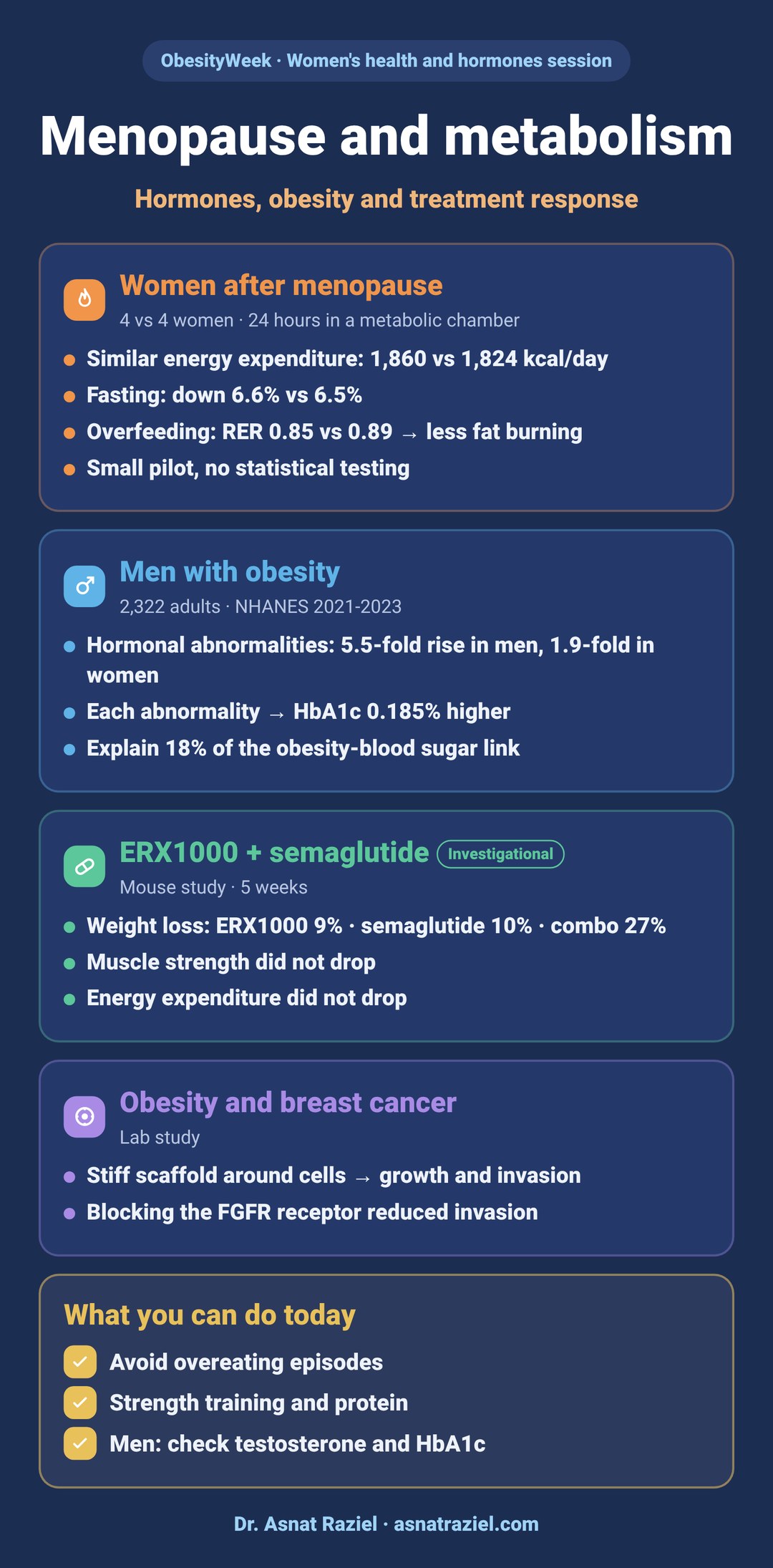
The result was surprising. On balanced eating, both groups burned similar amounts: 1,860 calories a day before menopause and 1,824 after. During fasting, energy expenditure fell by 6.6% and 6.5% respectively. In other words, the response was almost identical.
The body also responded similarly to overeating. Energy expenditure rose by 2.8% before menopause and by 5.3% after. So women after menopause are not especially “thrifty.” Their body still knows how to slow down when fasting and speed up a little when there is a surplus.
Menopause and metabolism: what happens to extra calories
Still, the researchers found one important difference. They also measured the respiratory exchange ratio (RER), which shows whether the body is mainly burning fat or mainly burning carbohydrates. A low value points to fat burning, and a high value points to carbohydrate burning.
During fasting, both groups switched to burning fat, with values of 0.77 and 0.76. During overeating, however, the value rose to 0.85 before menopause and to 0.89 after. The possible meaning: after menopause the body burns less fat during a calorie surplus, so it may store that fat more easily. This fits with the rise in visceral fat, the fat around the abdominal organs, that many women notice at this age.
Keep in mind that this is a very small pilot study, with only 8 participants and no statistical testing. The researchers themselves stress that the differences between women were large and that bigger studies are needed. I have also written about obesity in women across the lifespan and about CagriSema after menopause.
Men with obesity: a 5.5-fold rise in hormonal disruption
The second study, presented by Dr. Susan Palvai, moved from women to men. The researchers analyzed data on 2,322 adults from the U.S. national health survey (NHANES) for 2021-2023. They built a new score that counts how many hormonal abnormalities each person has, from zero to three.
For men, the score included low testosterone, low SHBG (the protein that carries sex hormones in the blood) and low DHEAS. For women, it included low AMH (a marker of ovarian reserve), low SHBG and high androstenedione.
The main finding: the score rose step by step with the degree of obesity, from 0.26 at normal weight to 0.81 in severe obesity. In men the rise was 5.5-fold (from 0.20 to 1.12). In women, by contrast, it was only 1.9-fold (from 0.31 to 0.60).
The link to blood sugar
Moreover, each additional hormonal abnormality was linked to an HbA1c (average blood sugar over the past three months) that was 0.185% higher. The link also appeared in people without diabetes. Hormonal abnormalities explained 18% of the link between obesity and high blood sugar. In addition, adding the score to BMI improved the ability to identify who is at risk of diabetes.
The message for men is clear: low testosterone in obesity is not just about libido or fertility. It is a marker of metabolic risk. This is an observational study, so it shows a link, not cause and effect. Even so, it supports checking metabolic and hormonal markers in every patient with obesity.
A new drug that restores leptin sensitivity
Dr. Louis Aronne of Weill Cornell presented a mouse study on ERX1000. This is an investigational pill designed to restore sensitivity to leptin. Leptin is the satiety hormone released by fat tissue. In obesity, the body stops responding to it, a state called leptin resistance.
In the study, 42 mice with obesity received ERX1000, semaglutide, the combination or a placebo for five weeks. ERX1000 alone reduced body weight by 9%, similar to semaglutide (10%). The combination, however, reduced it by 27%. This result suggests synergy between the two mechanisms.
The key finding: muscle strength did not drop despite the large weight loss. In addition, energy expenditure did not drop. Weight loss usually comes with a slowdown in resting metabolism, and the drug may help prevent it. Liver fat, cholesterol and insulin resistance also improved.
Of course, these are mouse results, and they do not always carry over to people. Still, a phase 2 trial in people with obesity is already recruiting. This is a promising direction for future drug combinations, alongside drugs like semaglutide that are available today.
Obesity and breast cancer: the role of the “scaffold” around cells
The fourth study, by Malika Sekhri of the University of Oklahoma, was a lab study. The researchers looked at the “scaffold” around the cells in breast tissue, the extracellular matrix. In tissue affected by obesity, this scaffold is rich in structural proteins and stiff, like fibrotic tissue.
In this environment, breast cancer cells grew fast and looked invasive. The researchers identified the protein FGF1 as a driver that changes the scaffold. When they blocked its receptor, invasion decreased. The findings may help explain why, in women with obesity, an early tumor more often progresses to an invasive one. This adds to evidence that obesity is linked to more than 230 medical conditions, and that treating it, for example with bariatric surgery, lowers obesity-related cancer.
Menopause and metabolism: what you can do today
The research on menopause and metabolism, hormones and drugs is still early. Even so, it carries practical messages of progress and hope:
- For women after menopause: your metabolism is not “broken.” So focus on avoiding overeating episodes, such as holiday meals and buffets, because that is when the body tends to store fat.
- Strength training and protein: keeping muscle mass helps keep energy expenditure up.
- For men with obesity: it is worth checking testosterone, SHBG and HbA1c. Weight loss usually improves both hormones and blood sugar.
- Follow-up and screening: keeping a healthy weight and keeping up with breast cancer screening are part of obesity care.
- Medication: drugs like semaglutide and tirzepatide are already available. In the future, new combinations may better protect muscle and metabolism.
The bottom line
The link between menopause and metabolism is subtle and surprising. The body does not slow down, but it handles a surplus differently. In men too, hormones play a central role in obesity and blood sugar. Finally, future drugs aim not only at weight loss but also at protecting muscle and metabolism. The right treatment takes into account hormones, sex and stage of life.
This article is general information and is not personal medical advice. Please talk to your doctor before making any change to your treatment.
References
Are Postmenopausal Women ‘Thrifty’? Metabolic Responses to Fasting and Overfeeding
A 5.5-Fold Rise in Reproductive Hormonal Disruption Links Male Obesity to Glycemic Dysregulation
Leptin Sensitizer ERX1000 Enhances the Metabolic Benefits of Semaglutide in Diet-Induced Obese Mice
Exploring the Role of Obesity-Associated Extracellular Matrix in Local Breast Cancer Progression
Brown adipose tissue metabolism in women is dependent on ovarian status
The first four studies were presented as abstracts in the session Women’s Health, Hormones, and Pharmacologic Response to Weight-Loss Interventions at ObesityWeek and have not yet been published as full papers.